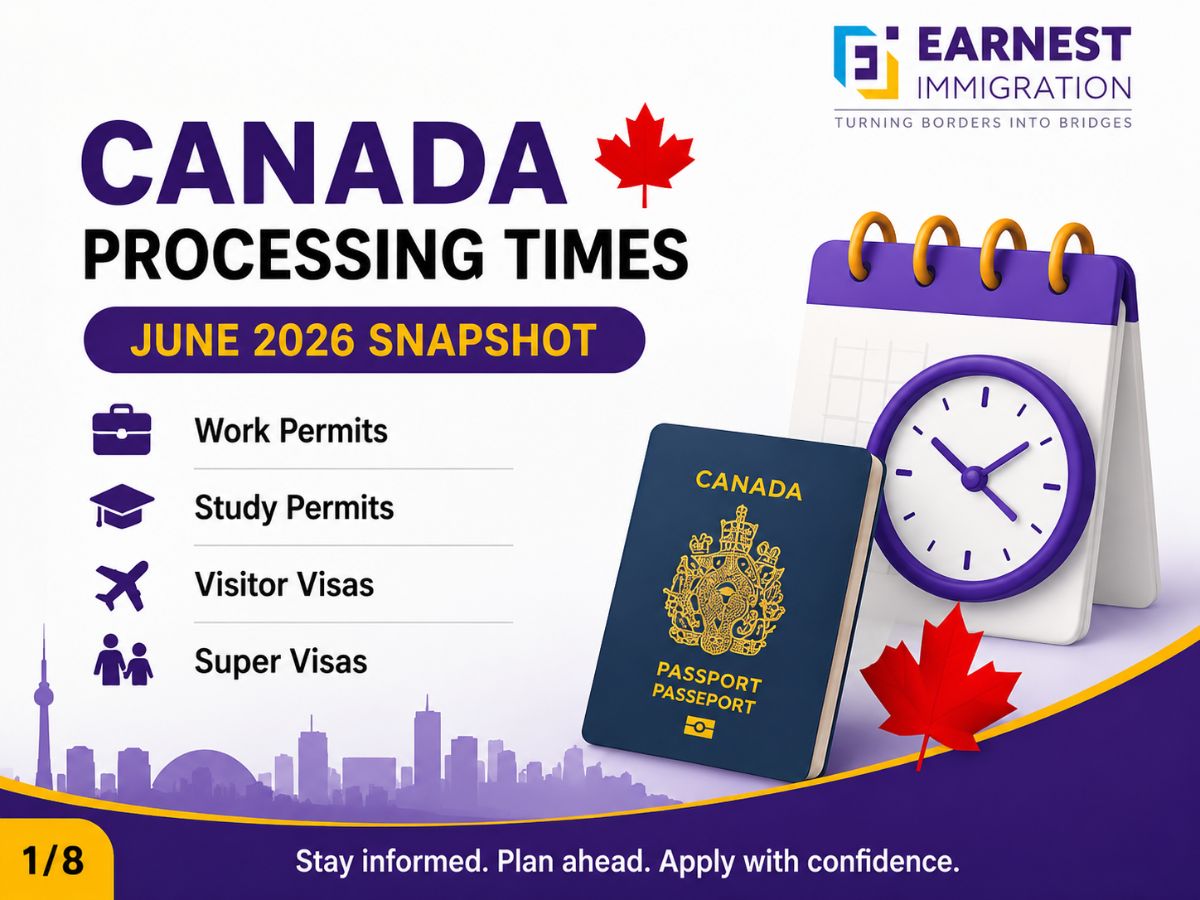
Immigration, Refugees and Citizenship Canada (IRCC) has updated its processing times across several temporary residence and permanent residence applications. Below is a June 2026 snapshot for the most-checked application types — plus, more importantly, how to read IRCC’s numbers correctly so you plan around the right figure.
Read this first: IRCC processing times are rolling estimates that change frequently and vary by country of residence, application type, and individual circumstances. Always confirm your specific time on the official IRCC Processing Times Tool before relying on any figure.
Table of Contents
ToggleJune 2026 Processing Time Snapshot
Figures below were posted as of June 2026 and are illustrative. Confirm current times on the IRCC Processing Times Tool — they update continuously.
| Application type | Posted time (June 2026 — verify live) |
| Electronic Travel Authorization (eTA) | ~5 minutes (most cases) |
| Seasonal Agricultural Worker Program (SAWP) | ~10 days |
| Work Permit (from the USA) | ~4 weeks |
| Work Permit (inside / outside Canada) | Varies — check the tool by country |
| Study Permit (inside / outside Canada) | Varies by country — check the tool |
| Visitor Visa (TRV) | Varies by country — check the tool |
| Super Visa | Varies by country — check the tool |
| Visitor Record Extension (inside Canada) | ~301 days |
| International Experience Canada (IEC) | Varies by season/country — check the tool |
| Permanent Resident (PR) Card | Varies — check the tool |
Note the spread: an eTA can clear in minutes while an inside-Canada visitor record extension can run roughly 301 days. That gap is exactly why you should plan around your specific line, not a headline average.
How to Read IRCC Processing Times Correctly
IRCC publishes two different numbers that applicants frequently confuse. Knowing which one you are looking at changes how you plan:
| Number | What it means |
| Service standard | IRCC’s target/benchmark for a category (e.g., a stated goal for a program). It is a commitment, not a live status. |
| Estimated processing time | What is actually happening now, based on recently finalized applications. This is the number to plan around. |
IRCC also calculates times in two ways:
- Backward-looking (historical): based on how long it took to finalize 80% of that application type recently. Some are shown by country of application.
- Forward-looking (estimated): based on the current inventory of that application type and expected processing capacity.
Your clock starts the day IRCC receives your complete application (including all fees and, where required, biometrics) and ends when a decision is made. An incomplete application can be delayed or returned — which resets your timing.
Why Your Time May Differ
- Country of residence / visa office workload
- Application type and whether dependants are included
- Overall application volume and IRCC capacity
- Complexity: background, security, medical, or admissibility reviews
- Completeness: missing documents trigger requests and delays
How to Use These Times When You Apply
- Screenshot the posted time on your submission day — canada.ca does not archive prior values.
- Treat the estimate as a planning tool, not a deadline; add a buffer.
- File renewals and extensions as early as allowed to avoid status gaps.
- Keep documents current during processing so a re-request does not stall your file.
- If you have crossed the posted estimate by a meaningful margin, you can follow up with IRCC through the appropriate channel.
If your work permit is approaching expiry while a PR or extension is in process, filing on time is what preserves maintained status — timing matters more than the headline number. Our work permit and LMIA team can help you file before your status lapses.
Plan by Application Type
Because times vary so widely, the smartest move is to prepare a complete, accurate application for your specific stream. Start here:
- Work Permits & LMIA — open and employer-specific permits, LMIA, and extensions.
- Study Permits & Student Counselling — study permits, PGWP, and study-to-PR planning.
- PR Card Renewal (2026 guide) — timing, residency obligation, and travel considerations.
- Visitor and Super Visas, citizenship, and more — see our full immigration services.
How Earnest Immigration Can Help
Earnest Immigration and Citizenship Services is a CICC-regulated, RCIC-licensed consultancy with offices in Windsor, Ontario and Regina, Saskatchewan, and 130+ five-star ratings. Processing times reward complete, accurate applications — incomplete files are where the worst delays happen.
Our team prepares compliant applications, files on time to protect your status, and monitors your file through to decision. Not sure which stream or timeline applies to you? Find a licensed RCIC consultant near you, or for complex cases see our immigration legal services in Windsor.
Frequently Asked Questions
How accurate are IRCC processing times?
They are rolling estimates, not guarantees. They reflect recently finalized applications or current inventory and can change week to week. Your specific file may finish faster or slower depending on country, complexity, and completeness.
What is the difference between a service standard and an estimated processing time?
A service standard is IRCC’s target benchmark for a category. The estimated processing time is what is actually happening now based on recent finalizations. Plan around the estimated time, not the service standard.
When does my processing time start?
The day IRCC receives your complete application, including all fees and, where required, biometrics. It ends when a decision is made. Incomplete applications can be delayed or returned.
Why is the inside-Canada visitor record extension so long?
As posted in June 2026, it was around 301 days. Inventory volume and the way IRCC calculates that line drive the figure. Confirm the current number on the IRCC Processing Times Tool, and file early to avoid status gaps.
My application has passed the posted time — what can I do?
First confirm you are past the estimate by a meaningful margin. You can then follow up with IRCC through the appropriate channel. Calling does not speed up processing, and you should not withdraw and reapply unless an officer advises it, as you lose your queue position.
Disclaimer: Processing times are published by IRCC and are subject to change without notice. The figures here are a June 2026 snapshot for general information only and do not constitute immigration or legal advice. Always confirm your current time on the official IRCC Processing Times Tool, and consult a CICC-regulated, RCIC-licensed immigration consultant or a licensed immigration lawyer for advice on your specific situation.
Source: IRCC Processing Times Tool and “Check current processing times” guidance (canada.ca). Re-verify all figures on the live tool before relying on them.