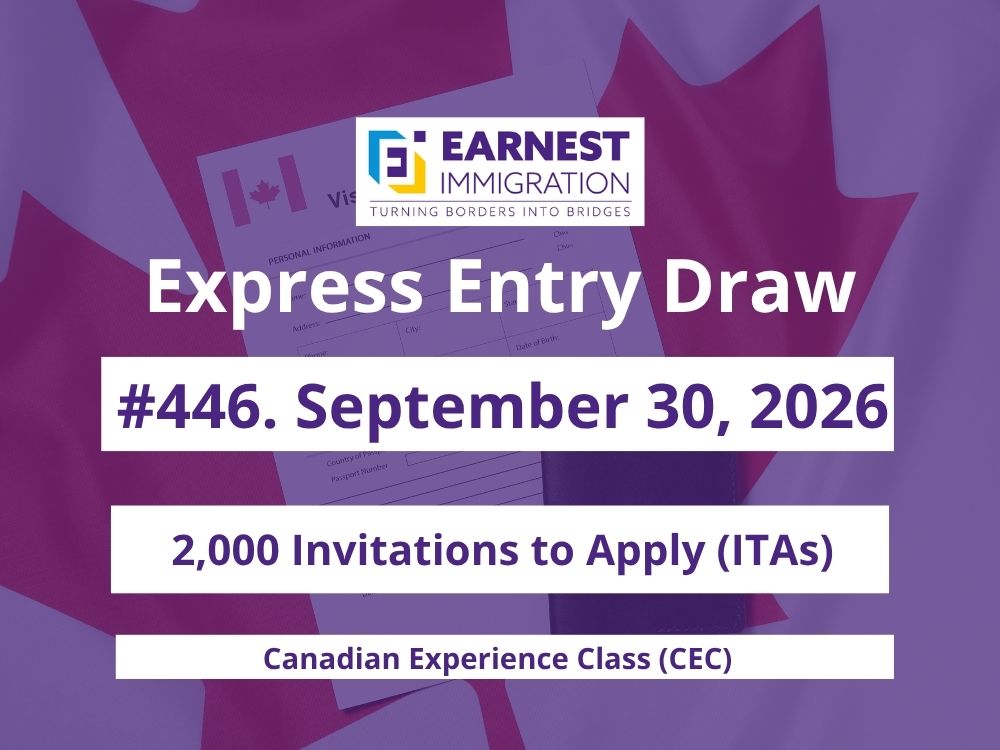
On September 29, 2026, Immigration, Refugees and Citizenship Canada (IRCC) held Express Entry Draw #446, issuing 2,000 Invitations to Apply (ITAs) to candidates in the Canadian Experience Class (CEC). The minimum Comprehensive Ranking System (CRS) score was 518.
On its face, this looks like the story many have been waiting for. 518 is the fourth small decline in a row – 523, then 521, 519, and now 518 – and it sits exactly at the ceiling of the 507–518 band that governed CEC all through the first half of the year. The obvious read is that the cut-off is finally drifting back to its old range. That read is wrong, and the proof is hidden in two numbers most coverage will skip: the size of the pool, and a tie-break date that reaches back to February. Below, the Earnest Immigration team shows why 518 is the plateau holding, not breaking.
Table of Contents
ToggleExpress Entry Draw #446 at a Glance
| Detail | Information |
| Draw number | #446 |
| Date | September 29, 2026 |
| Program | Canadian Experience Class (CEC) |
| Invitations issued | 2,000 |
| CRS cut-off score | 518 |
| Tie-breaking rule | February 13, 2026 at 20:48:08 UTC |
| Draw position in 2026 | 58th Express Entry round; 17th CEC round |
| Previous CEC draw | Draw #443 – September 15, 2026 – 2,000 ITAs at CRS 519 |
| Application deadline | 60 days from the date of the invitation |
The Surface Reading, and Why It Fails
Two weeks ago, after Draw #443, we argued that the CEC cut-off had settled onto a higher plateau – somewhere around 517 to 521 – and predicted it would not fall back into the 507–518 band that held earlier in the year. At 518, this draw appears to contradict that call. 518 is, after all, the top of the old band. Has the plateau broken?
No – and the reason is that a cut-off number on its own tells you almost nothing without the two variables behind it: how big the draw was, and how deep the pool was. This draw was 2,000 invitations, the same size as the last two CEC rounds. So the only thing that could have moved the cut-off meaningfully is the pool. If the pool had thinned, a 2,000-ITA draw would have reached lower, and we would see 514 or 512. If the pool had deepened, the cut-off should have held or risen. It held, almost exactly – a one-point easing from 519 to 518. That is not a cut-off falling back. That is a cut-off standing still.
Evidence One: the Pool Hit a New High
The competitive 501–600 CRS band – the tier CEC draws invite from – has deepened at every single pool update this year, and it set a new high right before this draw:
| Pool snapshot | Candidates at CRS 501–600 |
| July 19, 2026 | 18,133 |
| August 30, 2026 | 19,542 |
| September 13, 2026 | 20,784 |
| September 27, 2026 | 21,070 |
There are now about 2,900 more competitive candidates in the pool than in mid-July, and a new record 21,070 as of the snapshot before this draw. A 2,000-invitation draw into the deepest CEC pool of the year did not push the cut-off down into the old band. It eased it by a single point. That is the opposite of a softening market – it is a pool still filling faster at the top than IRCC is drawing from it, holding the cut-off up against the modest downward pull of an ordinary-sized draw.
Evidence Two: the Tie-Break Reached Back to February
This is the detail that settles it, and almost no coverage will mention it. The tie-breaking rule for this draw was February 13, 2026 – seven and a half months before the draw itself.
Here is what a tie-break date means and why this one is so telling. When more candidates sit at exactly the cut-off score than there are invitations left to issue, IRCC breaks the tie by profile submission date, inviting the earlier submissions first. The further back the tie-break reaches, the larger the cluster of candidates stacked at precisely that score. A tie-break that reaches back seven and a half months, to February 13, means an enormous number of candidates are sitting at exactly 518 – so many that IRCC had to go all the way back to mid-February to find the cut line among them.
Compare the previous CEC round two weeks earlier, which cleared at 519 with a tie-break of March 26. In two weeks, the cut-off eased one point and the tie-break reached six weeks further back. Both facts point the same way: the 517–519 zone is not a thin line the cut-off is gliding below. It is a thick, densely populated band that the pool has packed with candidates. You cannot “drift below” a band that crowded without a much larger draw to clear it.
The CEC Plateau, Four Rounds In
| Draw | Date | ITAs | CRS | Tie-break reaches to |
| #404 | March 17, 2026 | 4,000 | 507 | – |
| #428 | July 21, 2026 | 2,000 | 516 | – |
| #436 | August 18, 2026 | 1,000 | 523 | – |
| #439 | September 1, 2026 | 2,000 | 521 | Aug 18 |
| #443 | September 15, 2026 | 2,000 | 519 | Mar 26 |
| #446 | September 29, 2026 | 2,000 | 518 | Feb 13 |
The spring rounds, even at 4,000 invitations, cleared at 507. Every round since mid-August has cleared at 518 or higher at the same or smaller draw size – the plateau shift. And watch the tie-break column fall away from the draw date (August 18, then March 26, then February 13): each recent 2,000-ITA draw is reaching further back to separate a thickening cluster at the cut-off. Same-sized draws, a stable cut-off, and a tie-break reaching ever deeper into the past – three signs of a pool filling in beneath a plateau, not a cut-off in decline.
CEC Remains the Largest Route of 2026
With this draw, CEC has issued roughly 55,250 ITAs in 2026, keeping it the single largest route of the year. French-language proficiency, which briefly overtook CEC in mid-August, has not held a round since August 19, so CEC has extended its lead in the interval. As we have noted throughout this series, that lead is not permanent – IRCC has signalled French rounds will resume at two or more per cycle, which could close the gap again. The durable fact is that CEC and French are the two dominant routes of 2026 by a wide margin, and they serve very different candidates: CEC rewards Canadian work experience and a high score, while French rewards language ability and clears more than 100 points lower.
If You Received an ITA in Draw #446
You have 60 days from the date of your invitation to submit a complete permanent residence application. Work in this order – and heed the CEC-specific caution.
- Accept the invitation in your IRCC secure account and record your exact 60-day deadline.
- Do not make profile changes that could drop your CRS below 518 after the ITA. Losing a job or letting a language result lapse can prompt IRCC to withdraw the invitation. Leave your profile stable until you have submitted.
- Request police certificates from every country where you have lived six months or more since age 18. Start the same day; some jurisdictions take six to eight weeks.
- Book your medical exam with an IRCC-approved panel physician. If you hold a valid exam from a prior application, confirm it is still within its validity period before rebooking.
- Assemble Canadian work-experience evidence. This is where CEC applications most often fail: reference letters must be on company letterhead and state your job title, the NOC-relevant duties you actually performed, hours per week, dates, and salary. Duties that do not map to the NOC you claimed will trigger scrutiny.
- Gather pay records, T4 slips, and Notices of Assessment covering the qualifying period, and arrange certified translations for any document not in English or French.
- Budget the fees. As of April 30, 2026, an economic-class principal applicant pays $990 in processing fees plus a $600 Right of Permanent Residence Fee – $1,590 in total. Biometrics and accompanying family members are additional.
If You Were Not Invited
The crowded 518 band changes the calculus depending on where you sit.
At exactly 518, but not invited:
The tie-break is almost certainly why. With the cut line reaching back to February 13, a candidate who reached 518 after that date was ranked behind the large cluster who got there earlier. You met the score but sat behind the queue. The fix is not to wait – the cluster at 518 is only growing – but to add a point or two and clear the tie-break zone entirely. Confirm, too, that your profile was complete and your CEC eligibility correctly declared at the moment of the draw.
In the 512–517 range:
You are close, but you are below a plateau that is holding, not falling. A language retest is the fastest route up – CLB 8 to CLB 9 across all four abilities is a meaningful jump, and it is often enough to clear 519. Check also for unclaimed points: a sibling in Canada who is a citizen or permanent resident is worth 15, and spousal factors are commonly left on the table.
Below 512:
Waiting is not a strategy against a deepening pool. The structural moves are stronger. A provincial nomination adds 600 points and, as five consecutive pool-clearing PNP rounds show, all but guarantees an invitation – and PNP draws are currently growing. Strong French opens the French-language category, clearing more than 100 points below CEC. An eligible occupation may fit the healthcare category, with its stable mid-470s cut-off.
How Earnest Immigration Can Help
CEC applications are decided on how precisely your Canadian work history is documented. The score gets you the invitation; the reference letters get you the approval.
As a CICC-regulated, RCIC-licensed firm, Earnest Immigration supports CEC candidates with:
- Confirming eligibility and the correct NOC/TEER classification for your role
- Building and optimising an Express Entry profile so your CRS reflects every point you can legitimately claim
- Identifying the fastest realistic routes to clear the 518 plateau before the next round
- Assessing whether a provincial nomination, a French test, or a category-based pathway is the better play for your profile
- Preparing a complete, deadline-proof permanent residence application after an ITA
If you have Canadian work experience and want to know where you stand after Draw #446, book a consultation with our team.
Frequently Asked Questions
What was the CRS cut-off for Express Entry Draw #446?
The minimum CRS score for Draw #446 on September 29, 2026 was 518 – one point below the previous CEC round and the fourth small decline in a row (523, 521, 519, 518).
How many invitations were issued in Draw #446?
IRCC issued 2,000 Invitations to Apply to Canadian Experience Class candidates, the same size as the two previous CEC rounds.
The cut-off dropped to 518 – is the CEC bar finally easing back to the old band?
No. 518 is numerically at the top of the old 507–518 band, but the drivers point the other way. The competitive pool hit a new high (21,070 candidates at 501–600), and a 2,000-ITA draw into that deeper pool eased the cut-off only one point. A genuine softening would have pushed it well below 518.
Why does the February 13 tie-break date matter?
It reveals how crowded the 518 score is. IRCC breaks ties by submission date, inviting earlier profiles first. Reaching back seven and a half months to February 13 means a very large cluster of candidates sits at exactly 518 – so the 517–519 zone is a thick, densely populated band, not a thin line the cut-off can easily slip below.
Is the CEC cut-off going to keep dropping toward the low 510s?
Unlikely in the near term. The pool keeps deepening and IRCC has signalled CEC draws will stay around 2,000 ITAs, with no return to the very large spring rounds. The realistic range is roughly 517–519; a drop below about 515 would require a much larger draw than IRCC is currently running.
What does the tie-breaking date of February 13, 2026 mean for me?
Candidates at exactly 518 were invited only if they submitted their Express Entry profile before 20:48:08 UTC on February 13, 2026. A candidate who reached 518 after that date could be left outside the draw despite meeting the score – a sign to add points rather than wait.
Is CEC still the largest Express Entry category in 2026?
Yes, as of this draw. CEC has issued roughly 55,250 ITAs, extending its lead over French (50,500) since French last drew on August 19. The two remain the dominant routes of the year by a wide margin, and the lead may shift again when French rounds resume.
How long do I have to apply after receiving an ITA?
You have 60 days from the date of your invitation. Avoid profile changes that could lower your CRS in the meantime, as they can prompt IRCC to withdraw the invitation.
What does a PR application cost in 2026?
As of April 30, 2026, an economic-class principal applicant pays $990 in processing fees plus a $600 Right of Permanent Residence Fee – $1,590 in total. Biometrics and accompanying family members cost extra.
Talk to a Licensed Consultant
Earnest Immigration and Citizenship Services Inc. is a CICC-regulated, RCIC-licensed Canadian immigration consultancy with offices in Windsor, Ontario and Regina, Saskatchewan, serving clients across North America and North India.
Book a consultation to have your Express Entry profile, CRS breakdown, and alternative pathway options assessed by a licensed consultant.