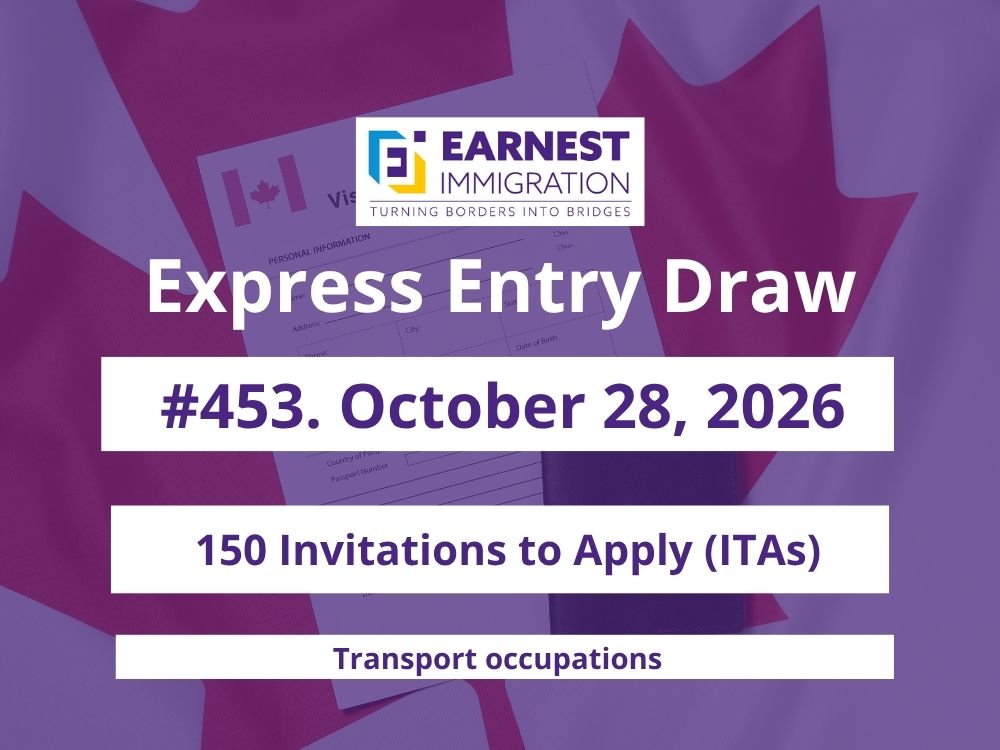
On October 28, 2026, Immigration, Refugees and Citizenship Canada (IRCC) held Express Entry Draw #453, issuing 150 Invitations to Apply (ITAs) to candidates in the transport occupations category at a minimum Comprehensive Ranking System (CRS) score of 477. It is the smallest transport-specific draw since the category was introduced, and only the second transport round of 2026.
A 150-invitation draw is easy to overlook next to the 5,000-ITA French rounds of the same week. But for the narrow group of candidates it targets, a transport draw is one of the most valuable events in the Express Entry calendar – a low-volume, lower-CRS inside track that most candidates cannot use and a few are perfectly placed for. The Earnest Immigration team sets out who qualifies, what the numbers mean, and a reform wrinkle that makes this category more interesting than its size suggests.
Table of Contents
ToggleExpress Entry Draw #453 at a Glance
| Detail | Information |
| Draw number | #453 |
| Date | October 28, 2026 |
| Category | Transport occupations (category-based) |
| Invitations issued | 150 (smallest transport draw on record) |
| CRS cut-off score | 477 |
| Change from August transport draw | +7 (from 470) |
| Tie-breaking rule | June 4, 2026 at 21:48:22 UTC |
| Draw position in 2026 | 65th Express Entry round; 2nd transport round |
| Transport ITAs in 2026 to date | 450 (300 in August + 150 now) |
| All-category ITAs in 2026 to date | 149,409 across 65 rounds |
| Application deadline | 60 days from the date of the invitation |
A Precision Tool, Not a Highway
The scale is the point. At 150 ITAs this is the smallest transport draw ever held, and the category’s whole 2026 output is just 450 invitations across two rounds. Compare that with French (60,500) or the Canadian Experience Class (57,750), and the difference in kind is obvious: transport is not a volume route, it is a periodic, targeted top-up for a specific labour need.
It is also irregular. The category ran in September and December 2023 and March 2024, was excluded from category-based selection entirely in 2025, and was revived for 2026. There is no published schedule, and IRCC has given no indication whether another transport draw will occur before the end of the year. For a candidate, that means two things: if you qualify, keep a complete profile active at all times, because a transport draw can come with no warning and clears only a small, specific pool; and never build your whole plan around it, because it may not run when you need it. The old tie-break on this round – June 4, nearly five months before the draw – is a quiet signal of how thin and specialised the qualifying pool is, reaching back months to fill just 150 seats.
Transport Draws in 2026
| Draw | Date | ITAs | CRS cut-off |
| #434 | August 2026 | 300 | 470 |
| #453 | October 28, 2026 | 150 | 477 |
Two rounds, 450 ITAs, cut-offs a few points apart in the high 470s – and draw sizes shrinking from 300 to 150. Historically the category drew at lower scores (430–435 in its 2023–2024 rounds), so the 2026 cut-offs are somewhat higher, reflecting a more competitive qualifying pool now that the category has been revamped.
The Reform Wrinkle: a Possible Double Benefit
Here is where this small draw becomes more interesting than its size. From November 3, IRCC’s high-wage occupation reform takes effect, awarding new CRS points for high-wage Canadian work experience and high-wage job offers. According to the draw coverage, two of the four transport NOCs – 72404 and 22313 – fall within the new high-wage category.
If that holds, candidates in those two occupations are unusually well positioned: they can qualify for transport category draws AND gain high-wage CRS points in the November 3 recalculation – a stacked advantage few candidates enjoy. A transport-qualified candidate in one of those NOCs could see their CRS rise under the reform, improving their standing not only in a future transport draw but across the general pool as well.
Two cautions. The high-wage occupation list is maintained by IRCC and tiered by wage, so confirm your specific NOC against the official list rather than assuming it qualifies – being in a transport NOC does not automatically mean high-wage status. And the reform pauses all rounds, transport included, for about two weeks from November 3; the next transport draw, if any, comes after that.
If You Received an ITA in Draw #453
You have 60 days from the date of your invitation to submit a complete permanent residence application. Your invitation is unaffected by the November 3 changes – act on it on the normal timeline. Work through the following in order; the police certificates and medical exam are the items most likely to break the deadline.
- Accept the invitation in your IRCC secure account and record your exact 60-day deadline.
- Assemble transport work-experience evidence that maps cleanly to your claimed NOC: reference letters on company letterhead stating job title, duties, hours per week, salary, and employment dates. Category eligibility rests on this documentation.
- Request police certificates from every country where you have lived six months or more since age 18. Start the same day; some jurisdictions take six to eight weeks.
- Book your medical exam with an IRCC-approved panel physician, or confirm a prior exam is still within its validity period.
- Confirm your language results are valid and correctly entered.
- Arrange certified translations for any document not in English or French.
- Budget the fees. As of April 30, 2026, an economic-class principal applicant pays $990 in processing fees plus a $600 Right of Permanent Residence Fee – $1,590 in total. Biometrics and accompanying family members are additional.
IRCC currently processes most Express Entry applications in about six months, so a candidate who submits promptly should plan for a decision in the first half of 2027.
If You Qualify but Were Not Invited
With only 150 seats this round, many qualified transport candidates will not have been invited. The right response is to maximise the factors you can still move and keep your profile complete, because the next transport draw is unscheduled and clears only a small pool. If you are in NOC 72404 or 22313, prioritise getting your profile correctly positioned for the November 3 recalculation – any high-wage points you gain help you across every route, not just transport. And keep a provincial nomination in view as a parallel path, since it does not depend on a category draw running.
How Earnest Immigration Can Help
Category draws reward candidates whose work experience is documented precisely to the qualifying NOC. A mismatch between your claimed occupation and your evidence is the most common reason a category-based application fails.
As a CICC-regulated, RCIC-licensed firm, Earnest Immigration supports candidates at every stage:
- Confirming whether your work experience qualifies under one of the four transport NOC codes
- Checking whether your occupation also falls within the new high-wage category, and how that affects your CRS after November 3
- Building your profile so your CRS reflects everything you can legitimately claim
- Weighing the transport category against CEC, French, and provincial nomination routes for your specific profile
- Preparing a complete, deadline-proof permanent residence application after an ITA
If you work in a transport occupation and want to know where Draw #453 – and the November 3 reform – leaves your profile, book a consultation with our team.
Frequently Asked Questions
What was the CRS cut-off for Express Entry Draw #453?
The minimum CRS score for Draw #453 on October 28, 2026 was 477, with 150 ITAs issued to transport-occupation candidates. It is a real competitive threshold – category draws rank by CRS with no nomination bonus – and sits 42 points below the Canadian Experience Class draw of October 15 (519).
How many transport invitations has Canada issued in 2026?
Just 450, across two rounds: 300 in August and 150 on October 28. Transport is one of the smallest Express Entry categories, with no fixed schedule. Across all categories, 2026 stands at 149,409 ITAs over 65 rounds.
What occupations qualify for the Express Entry transport category?
Eligibility requires at least 12 months of qualifying transport work experience in the past three years in one of four NOC codes – 72404, 72600, 22313, and 72410 – plus eligibility under the Canadian Experience Class, Federal Skilled Worker Program, or Federal Skilled Trades Program. Confirm your exact NOC against IRCC’s current category instructions.
Why was this the smallest transport draw ever?
At 150 ITAs it is below the 300-to-1,000 range of previous transport rounds. The category is a periodic, targeted top-up for a specific labour need rather than a volume route; IRCC sizes each draw to the pool it wants to clear, and the qualifying pool is small.
Does the November 3 reform affect transport candidates?
Possibly, and favourably for some. Two of the four transport NOCs (72404 and 22313) reportedly fall within the new high-wage occupation category, so candidates in those occupations could gain high-wage CRS points on November 3 in addition to transport category eligibility. Confirm your specific NOC against IRCC’s high-wage list, as being in a transport NOC does not automatically mean high-wage status.
Will there be another transport draw in 2026?
Unknown. Transport draws have no fixed schedule, and IRCC has given no indication whether another will occur before year-end. All rounds are also paused for about two weeks from November 3. If you qualify, keep a complete profile active so you are ready whenever a draw comes.
Is the transport category a reliable route?
No – it is a precision tool, not a highway. It was excluded entirely in 2025 and has issued only 450 ITAs in 2026. If you qualify it can be a genuine lower-CRS inside track, but never build your whole plan around it; keep a federal profile and, where possible, a provincial nomination route in parallel.
How long do I have to apply after receiving an ITA?
You have 60 days from the date of your invitation to submit a complete permanent residence application. Missing the deadline returns you to the pool.
What does a PR application cost in 2026?
As of April 30, 2026, an economic-class principal applicant pays $990 in processing fees plus a $600 Right of Permanent Residence Fee – $1,590 in total. Biometrics and accompanying family members cost extra.
Talk to a Licensed Consultant
Earnest Immigration and Citizenship Services Inc. is a CICC-regulated, RCIC-licensed Canadian immigration consultancy with offices in Windsor, Ontario and Regina, Saskatchewan, serving clients across North America and North India.
Book a consultation to have your transport-occupation eligibility and Express Entry options assessed by a licensed consultant.
Disclaimer: This article is general information about Canadian immigration programs and is current as of November 3, 2026. It is not legal advice and does not create a consultant-client relationship. Express Entry cut-off scores, invitation volumes, eligible occupations, processing times, government fees, and the November 3, 2026 program changes and draw pause are set by IRCC and may be revised. Verify all figures and NOC eligibility against official Government of Canada sources or consult a licensed RCIC about your specific circumstances.
Data sources: IRCC ministerial instructions and rounds-of-invitation records (canada.ca), corroborated via Moving2Canada, immigration.ca, CIC News, immigration2canada, VisaVerge, and Peerless; IRCC Express Entry category-based selection instructions (transport occupations); IRCC news release on the high-wage occupation reform (October 16, 2026); Government of Canada fee schedule notice dated March 27, 2026.