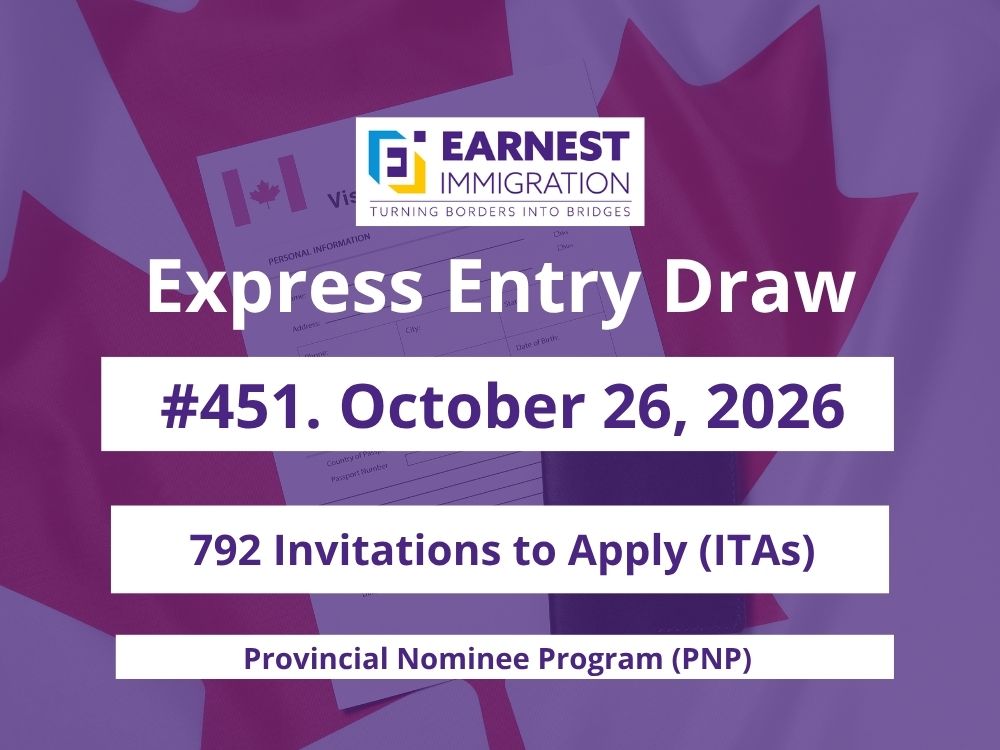
On October 26, 2026, Immigration, Refugees and Citizenship Canada (IRCC) held Express Entry Draw #451, issuing 792 Invitations to Apply (ITAs) to candidates in the Provincial Nominee Program (PNP). The minimum Comprehensive Ranking System (CRS) score was 761.
The round itself is familiar – the seventh PNP draw running to clear essentially the entire pool of nomination holders. What makes it worth a closer look is its place in the calendar. As of today, November 3, IRCC has paused all Express Entry rounds for roughly two weeks while it recalculates pool scores under the new high-wage reform. Draw #451 is therefore the last PNP round before the pause, and it is a useful moment to answer the question nomination holders are asking this week: does the reform change anything for me? The short answer, which the Earnest Immigration team sets out below, is no – and that reform-resistance is exactly what makes PNP valuable right now.
Table of Contents
ToggleExpress Entry Draw #451 at a Glance
| Detail | Information |
| Draw number | #451 |
| Date | October 26, 2026 |
| Program | Provincial Nominee Program (PNP) |
| Invitations issued | 792 |
| CRS cut-off score | 761 |
| Implied base score (minus 600-pt nomination) | 161 |
| Tie-breaking rule | April 3, 2026 at 18:00:26 UTC |
| Draw position in 2026 | 63rd Express Entry round; 21st PNP round |
| PNP ITAs in 2026 to date | 10,814 |
| All-category ITAs in 2026 to date | 144,259 across 63 rounds |
| Application deadline | 60 days from the date of the invitation |
The Cut-Off, Briefly
As with every PNP round this series has covered, the 761 cut-off is not a competitive threshold. A provincial nomination adds 600 CRS points; every candidate in a PNP draw holds one; the draw invites nearly all of them. As of October 25 there were 787 candidates above 600, and IRCC issued 792 ITAs – the pool was cleared, for the seventh PNP round running. The score fell 11 points from the last PNP draw’s 772, but as established on Draw #442, that movement is noise: both rounds cleared the pool, so no one competed on score. One footnote worth a glance: the tie-break dates to April 3, over six months back, meaning a long-standing nomination holder at the cut-off base score was finally drawn – a quirk of pool composition, nothing more. With the number settled, the context is what matters this round.
Why the November 3 Reform Does Not Touch PNP
From today, IRCC’s high-wage occupation reform takes effect. It awards substantial new CRS points for Canadian work experience in high-wage occupations (up to 70) and for high-wage job offers (up to 100, no LMIA), recalculates every score in the pool, and pauses all invitation rounds for about two weeks while that happens. For Canadian Experience Class and federal candidates, it is a significant reshuffling of the ranking.
For PNP, it changes nothing about how you are selected. Here is why. A provincial nomination confers 600 CRS points on its own, lifting any nomination holder above the entire general pool, and PNP rounds invite candidates by clearing that above-600 sub-pool. The reform’s new points operate below 600, among the CEC, FSW, and FST candidates competing on their base scores. They change who ranks where in that contest; they do not change who holds a nomination, and they do not change the mechanic by which a PNP draw clears its pool. A nomination was worth a near-certain invitation before November 3, and it is worth a near-certain invitation after.
There is one caveat, and it is about timing, not selection: PNP rounds pause along with every other round type during the roughly two-week recalculation. So the next PNP draw will come later than the usual bi-weekly rhythm. But when rounds resume, PNP resumes clearing the pool exactly as it did on October 26. In a month when the rules are changing under every other route, that stability is the headline.
PNP in 2026: 21 Rounds, 10,814 Invitations
Step back and the year’s pattern is unmistakable. PNP has now run 21 times in 2026 and issued 10,814 ITAs – roughly every two weeks, every recent round clearing the pool, and draw sizes that dipped mid-year then climbed back above 750. Against a backdrop of category draws that fire erratically and a CEC cut-off that has camped in the high 510s, PNP has been the steadiest high-volume route in the system. The reform does not change that; if anything, it sharpens the contrast.
| Draw | Date | ITAs | CRS |
| #427 | July 20, 2026 | 511 | 744 |
| #431 | August 4, 2026 | 507 | 768 |
| #435 | August 17, 2026 | 442 | 760 |
| #438 | August 31, 2026 | 562 | 697 |
| #442 | September 14, 2026 | 576 | 734 |
| #445 | September 28, 2026 | 733 | 725 |
| #448 | October 13, 2026 | 752 | 772 |
| #451 | October 26, 2026 | 792 | 761 |
Twenty-one rounds, 10,814 ITAs, every recent one clearing the pool. The cut-off has zigzagged across a wide range that signifies only pool composition; the volume and reliability are the real story.
The Pool Clears Every Time – Seven Rounds Running
| PNP round | Nomination holders in pool | ITAs issued | Outcome |
| #431 – Aug 4 | 500 | 507 | Pool cleared |
| #435 – Aug 17 | 439 | 442 | Pool cleared |
| #438 – Aug 31 | 559 | 562 | Pool cleared |
| #442 – Sep 14 | 574 | 576 | Pool cleared |
| #445 – Sep 28 | 728 | 733 | Pool cleared |
| #448 – Oct 13 | 749 | 752 | Pool cleared |
| #451 – Oct 26 | 787 | 792 | Pool cleared |
The practical rule has held for seven consecutive rounds: if you hold a valid nomination, you will almost certainly be invited in the next PNP draw, whatever your base score – and the November 3 reform does not change that. If you held one and were not invited this round, treat it as urgent: the cause is almost always an expired nomination certificate, a lapsed language result, or an incomplete profile field, not your CRS. Check your profile status today.
If You Received an ITA in Draw #451
You have 60 days from the date of your invitation to submit a complete permanent residence application. Your invitation is unaffected by the November 3 changes – act on it on the normal timeline. Work through the following in order; the police certificates and medical exam are the items most likely to break the deadline.
- Accept the invitation in your IRCC secure account and record your exact 60-day deadline.
- Confirm your provincial nomination certificate is still valid. Contact the nominating province immediately if the expiry date is anywhere near your submission window – a lapsed nomination invalidates the basis of your invitation.
- Request police certificates from every country where you have lived six months or more since age 18. Start the same day; some jurisdictions take six to eight weeks.
- Book your medical exam with an IRCC-approved panel physician, or confirm a prior exam is still within its validity period.
- Assemble employment evidence: reference letters on company letterhead stating job title, NOC-relevant duties, hours per week, salary, and employment dates.
- Arrange certified translations for any document not in English or French.
- Budget the fees. As of April 30, 2026, an economic-class principal applicant pays $990 in processing fees plus a $600 Right of Permanent Residence Fee – $1,590 in total. Biometrics and accompanying family members are additional.
IRCC currently processes Express Entry-linked PNP applications in about seven months, so a candidate who submits promptly should plan for a decision in the first half of 2027.
If You Are Working Toward a Nomination
The reform transition is, paradoxically, an argument for PNP. For a candidate whose occupation is not on the high-wage list – and who therefore gains little from the November 3 changes – a provincial nomination remains the most reliable way to convert a modest base score into an almost certain invitation. While the federal ranking is being reshuffled, the nomination route is unchanged and, once the pause lifts, continues on its steady bi-weekly rhythm.
The hard part remains securing the nomination, and it is selective: provinces target candidates by occupation, work experience, language, location, or ties to the province, and many streams require a job offer or in-province experience. The move is to identify the specific streams you qualify for and pursue them deliberately, while keeping a complete federal profile active in parallel – and, if your occupation is high-wage, making sure that profile is positioned to benefit from the recalculation as well.
How Earnest Immigration Can Help
PNP-linked permanent residence applications are unforgiving on documentation. The nomination has to be valid at submission, the work history has to map cleanly to the NOC you claimed, and the 60-day clock does not pause for a missing police certificate.
As a CICC-regulated, RCIC-licensed firm, Earnest Immigration supports candidates at every stage:
- Assessing which provincial streams you realistically qualify for, and in which order to pursue them
- Advising how the November 3 reform affects your overall strategy – and where PNP fits as the stable route
- Reviewing nomination validity and documentation before submission
- Building and optimising your Express Entry profile so your CRS reflects everything you can legitimately claim
- Preparing a complete, deadline-proof permanent residence application after an ITA
If you hold a nomination and want to know where you stand after Draw #451 – or you are working toward one during the transition – book a consultation with our team.
Frequently Asked Questions
What was the CRS cut-off for Express Entry Draw #451?
The minimum CRS score for Draw #451 on October 26, 2026 was 761, with 792 ITAs issued to PNP candidates. Because the draw cleared nearly all nomination holders, the 761 reflects the base scores present in the pool (implied base 161 once the 600-point nomination is removed), not a competitive threshold.
How many PNP invitations has Canada issued in 2026?
As of Draw #451, IRCC has issued 10,814 PNP ITAs across 21 rounds in 2026. Across all categories, 2026 stands at 144,259 ITAs over 63 rounds. PNP has been the most consistent draw type of the year.
Does the November 3 reform affect PNP draws?
Not in how candidates are selected. A provincial nomination confers 600 CRS points regardless of occupation, and PNP rounds invite nomination holders by clearing the above-600 pool. The reform’s new high-wage points affect the ranking below 600, where CEC and federal candidates compete. PNP rounds do pause for about two weeks with all other rounds during the score recalculation, but resume unchanged afterward.
When is the next PNP draw?
Later than the usual two-week rhythm. IRCC has paused all Express Entry rounds for roughly two weeks from November 3, 2026 while it recalculates pool scores. PNP rounds resume after the pause and are expected to continue clearing the pool as before.
Why did the cut-off fall from 772 to 761?
Pool composition, not a change in difficulty. Both rounds cleared the entire nomination pool, so no one competed on score. The October 26 batch of nomination holders simply carried slightly lower base scores than the October 13 batch. PNP cut-offs have swung widely all year without meaning.
Did this draw invite every nomination holder?
Very nearly. As of October 25 there were 787 candidates scoring above 600 (nomination holders), and IRCC issued 792 ITAs – effectively clearing the sub-pool, as the six previous PNP rounds also did.
I have a valid nomination but was not invited. Why?
With the pool cleared seven rounds running, almost every valid nomination holder should have received an invitation. A missed ITA usually indicates an expired nomination certificate, a lapsed language result, or an incomplete profile field – not an insufficient score. Check your profile immediately.
Does the reform affect an ITA I already received in Draw #451?
No. An invitation already issued is honoured on the normal 60-day timeline. The reform changes future score calculations and the timing of upcoming rounds; it does not affect invitations already in hand.
What does a PR application cost in 2026?
As of April 30, 2026, an economic-class principal applicant pays $990 in processing fees plus a $600 Right of Permanent Residence Fee – $1,590 in total. Biometrics and accompanying family members cost extra.
Talk to a Licensed Consultant
Earnest Immigration and Citizenship Services Inc. is a CICC-regulated, RCIC-licensed Canadian immigration consultancy with offices in Windsor, Ontario and Regina, Saskatchewan, serving clients across North America and North India.
Book a consultation to have your Express Entry profile and provincial nomination options assessed by a licensed consultant.
Disclaimer: This article is general information about Canadian immigration programs and is current as of November 3, 2026. It is not legal advice and does not create a consultant-client relationship. Express Entry cut-off scores, invitation volumes, processing times, government fees, and the November 3, 2026 program changes and draw pause are set by IRCC and may be revised. Verify all figures against official Government of Canada sources or consult a licensed RCIC about your specific circumstances.
Data sources: IRCC ministerial instructions and rounds-of-invitation records (canada.ca), corroborated via Canadim, immigCanada, and VisaVerge; IRCC Express Entry pool composition reports; IRCC news release on the high-wage occupation reform (October 16, 2026); IRCC 2026–2028 Immigration Levels Plan; Government of Canada fee schedule notice dated March 27, 2026.