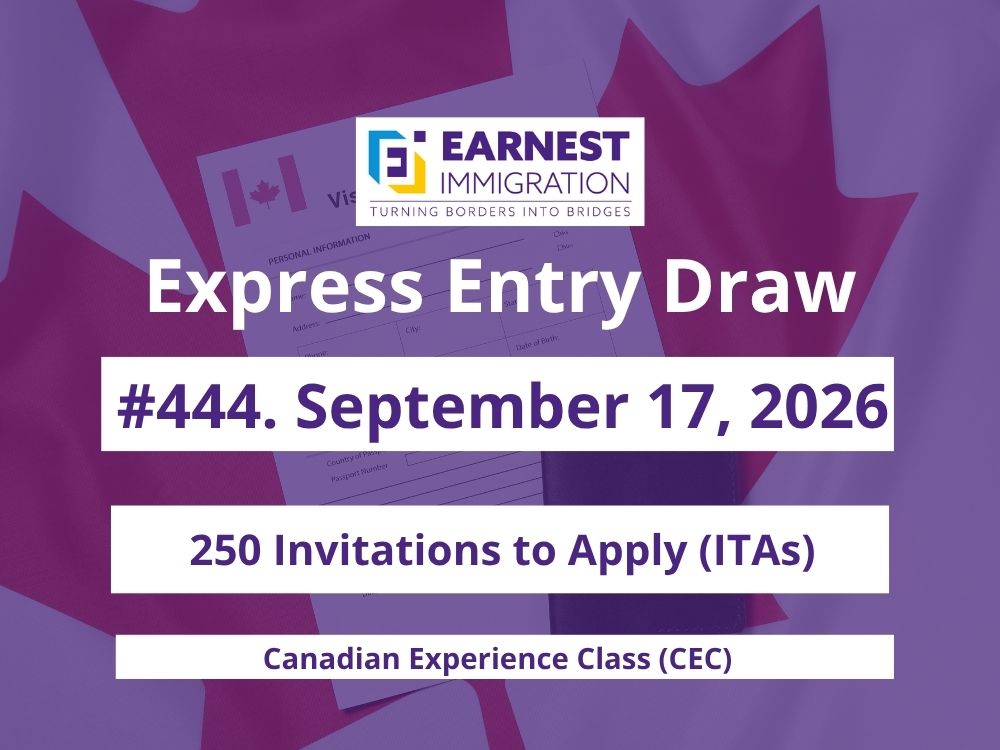
On September 16, 2026, Immigration, Refugees and Citizenship Canada (IRCC) held Express Entry Draw #444, issuing 250 Invitations to Apply (ITAs) to candidates in the Senior Managers with Canadian Work Experience category. The minimum Comprehensive Ranking System (CRS) score was 389 – the lowest in this category’s short history.
That number should stop you. The day before, a Canadian Experience Class round required 519. This round, aimed at senior executives – people who are typically highly educated, highly paid, and deeply experienced – cleared 130 points lower. You would expect executives to post the highest CRS scores in the pool, not among the lowest. The explanation reveals something important about how the CRS works, and about who this category is really built for. Below, the Earnest Immigration team explains it.
Table of Contents
ToggleExpress Entry Draw #444 at a Glance
| Detail | Information |
| Draw number | #444 |
| Date | September 16, 2026 |
| Category | Senior Managers with Canadian Work Experience (2026 – V1) |
| Invitations issued | 250 |
| CRS cut-off score | 389 |
| Tie-breaking rule | September 1, 2026 |
| Eligible NOC codes | 00012, 00013, 00014, 00015 (TEER 0) |
| Draw position in 2026 | 56th Express Entry round; 3rd Senior Managers round |
| Application deadline | 60 days from the date of the invitation |
The Age Paradox: Why Executives Score Low
The Comprehensive Ranking System rewards a specific profile: young, highly educated, fluent in English or French, with skilled work experience. The single largest block of points goes to candidates in their twenties. After age 30, the age points begin to fall. After about 45, they fall sharply, and by the early fifties the age factor contributes almost nothing.
Now consider who becomes a senior manager. You do not run a division, a department, or a company in your twenties. Senior management is, almost by definition, a role you reach after fifteen or twenty years of career progression – which means senior managers are, almost by definition, older. The very seniority that defines the category is tied to the age the CRS penalises most heavily.
The result is a paradox. A 50-year-old executive with a graduate degree, excellent English, and two decades of leadership experience can still post a CRS score in the low 400s, because the age factor alone strips away a hundred points or more that a 29-year-old would keep. On paper, in the general pool, that executive looks uncompetitive. In reality, they are exactly the kind of experienced leader Canada wants to retain.
The Gate: Canadian Experience in Four Executive NOC Codes
The low cut-off is the easy part. The eligibility is where this category is won or lost, and it is narrow in two specific ways.
First, the occupation. The category draws from just four National Occupational Classification codes, all of them TEER 0 top-management roles:
- NOC 00012 – senior government managers and officials
- NOC 00013 – senior managers in financial, communications, and other business services
- NOC 00014 – senior managers in trade, broadcasting, and other services
- NOC 00015 – senior managers in construction, transportation, production, and utilities
These are genuine executive classifications – the people at the top of an organisation’s structure, not middle managers or team leads. If your role does not map cleanly to one of these four codes, the category is not open to you regardless of your title.
Second, and this is the trap, the experience must be Canadian. The category name says it plainly, but it is routinely missed: foreign senior-management experience does not count toward eligibility – not even for an executive who transferred to Canada on an intra-company transfer and ran a major operation abroad for years. What qualifies is time spent in one of those four NOC roles while working in Canada. An executive who built a career leading companies overseas but has not yet accumulated Canadian managerial experience does not qualify, however impressive the résumé.
The Three Senior Managers Draws of 2026
| Draw | Date | ITAs | CRS |
| 1st (#402) | March 5, 2026 | 250 | 429 |
| 2nd | July 10, 2026 | 500 | 392 |
| 3rd (#444) | September 16, 2026 | 250 | 389 |
Three rounds, 1,000 ITAs, and a cut-off that has settled from 429 down into the high 380s. As with any small category, the exact number each round reflects the mix of candidates who happened to be eligible and in the pool – it is not a hard, stable threshold to aim at. But the trend is clear enough to be useful: this category consistently clears far below the CEC and general thresholds, which is the whole point of its existence.
If This Category Is Not Open to You Yet
Two groups of executives read a draw like this and need different advice.
Senior managers already working in Canada, below the CEC threshold:
This category is likely your strongest route, and the reason is exactly the age paradox above – it does not hold your age against you the way a CEC round does. Make sure your role is correctly classified under one of the four NOC codes, that your Canadian managerial experience is documented to IRCC’s standard, and that your profile is active. If your CRS is in the 380s or 390s, you are competitive here in a way you are not in the general pool.
Experienced executives without Canadian experience:
The honest answer is that no category-based draw will shortcut the Canadian-experience requirement for you. Your realistic routes run through other doors. A provincial nomination adds 600 CRS points and effectively guarantees an invitation – and several provinces run entrepreneur and senior-worker streams aimed at exactly this profile. Strong French opens the French-language category, which clears around 400 and does not require Canadian experience. And if your underlying profile is competitive despite the age penalty, a general or CEC pathway may still be reachable once you have a year of Canadian work behind you. The move is to build the Canadian experience that unlocks this category later, while pursuing a nomination or French route now.
If You Received an ITA in Draw #444
You have 60 days from the date of your invitation to submit a complete permanent residence application. For this category, documenting your senior-management role precisely is the priority.
- Accept the invitation in your IRCC secure account and record your exact 60-day deadline.
- Confirm your role maps to one of the four eligible NOC codes (00012–00015) and that your duties genuinely reflect senior-management responsibilities. The category eligibility rests on this, and executive titles vary widely between organisations.
- Assemble evidence of your Canadian senior-management experience: reference letters on company letterhead stating your title, scope of authority, NOC-relevant duties, hours, dates, and salary, plus organisational context showing the seniority of the role.
- Request police certificates from every country where you have lived six months or more since age 18. Start the same day; some jurisdictions take six to eight weeks.
- Book your medical exam with an IRCC-approved panel physician.
- Arrange certified translations for any document not in English or French.
- Budget the fees. As of April 30, 2026, an economic-class principal applicant pays $990 in processing fees plus a $600 Right of Permanent Residence Fee – $1,590 in total. Biometrics and accompanying family members are additional.
How Earnest Immigration Can Help
For senior managers, the decisive question is almost always classification: does your role genuinely sit in one of the four executive NOC codes, and can your Canadian experience be documented to prove it? That is where this category is won.
As a CICC-regulated, RCIC-licensed firm, Earnest Immigration supports executive candidates with:
- Confirming whether your role maps to NOC 00012–00015 and whether your Canadian experience meets the category requirement
- Assessing whether the senior managers category, a provincial stream, or another route is the strongest fit for your profile and timeline
- Building and optimising an Express Entry profile that claims every legitimate point despite the age factor
- Documenting senior-management responsibilities to IRCC’s evidentiary standard
- Preparing a complete, deadline-proof permanent residence application after an ITA
If you are a senior manager with Canadian experience and want to know whether this category fits you, book a consultation with our team.
Frequently Asked Questions
What was the CRS cut-off for Express Entry Draw #444?
The minimum CRS score for Draw #444 on September 16, 2026 was 389 – the lowest in the Senior Managers with Canadian Work Experience category’s history, down from 392 in July and 429 in March.
How many invitations were issued in Draw #444?
IRCC issued 250 Invitations to Apply to candidates in the Senior Managers with Canadian Work Experience category, bringing the category’s 2026 total to 1,000 across three rounds.
Why is the senior managers cut-off so much lower than CEC?
Largely because of the age factor in the CRS. Senior managers are typically older, and the CRS reduces age points steeply after 30 and sharply after about 45. The category is designed to invite experienced executives whose age suppresses their CRS below the level a CEC round requires – so it clears far lower.
Does a CRS of 389 mean this category is easy to enter?
No. The low cut-off makes it easy to be selected, but only for the narrow group who qualify. You must have Canadian work experience in one of four specific senior-management NOC codes (00012–00015). The bar to qualify is high and specific, even though the cut-off is low.
Does foreign management experience count for this category?
No. The experience must be Canadian. Foreign senior-management experience does not count toward eligibility – not even for executives who came to Canada on an intra-company transfer. Only time spent in an eligible NOC role while working in Canada qualifies.
Which occupations qualify for the senior managers category?
Four TEER 0 codes: NOC 00012 (senior government managers), 00013 (senior managers in financial, communications and other business services), 00014 (senior managers in trade, broadcasting and other services), and 00015 (senior managers in construction, transportation, production and utilities).
I am an experienced executive but have no Canadian experience. What can I do?
This category is not your near-term route, since it requires Canadian experience. Stronger options include a provincial nomination (which adds 600 CRS points and includes entrepreneur and senior-worker streams), or the French-language category if you can reach NCLC 7. Building Canadian managerial experience would unlock this category later.
How long do I have to apply after receiving an ITA?
You have 60 days from the date of your invitation to submit a complete permanent residence application.
What does a PR application cost in 2026?
As of April 30, 2026, an economic-class principal applicant pays $990 in processing fees plus a $600 Right of Permanent Residence Fee – $1,590 in total. Biometrics and accompanying family members cost extra.
Talk to a Licensed Consultant
Earnest Immigration and Citizenship Services Inc. is a CICC-regulated, RCIC-licensed Canadian immigration consultancy with offices in Windsor, Ontario and Regina, Saskatchewan, serving clients across North America and North India.
Book a consultation to have your senior-management eligibility and Express Entry profile assessed by a licensed consultant.