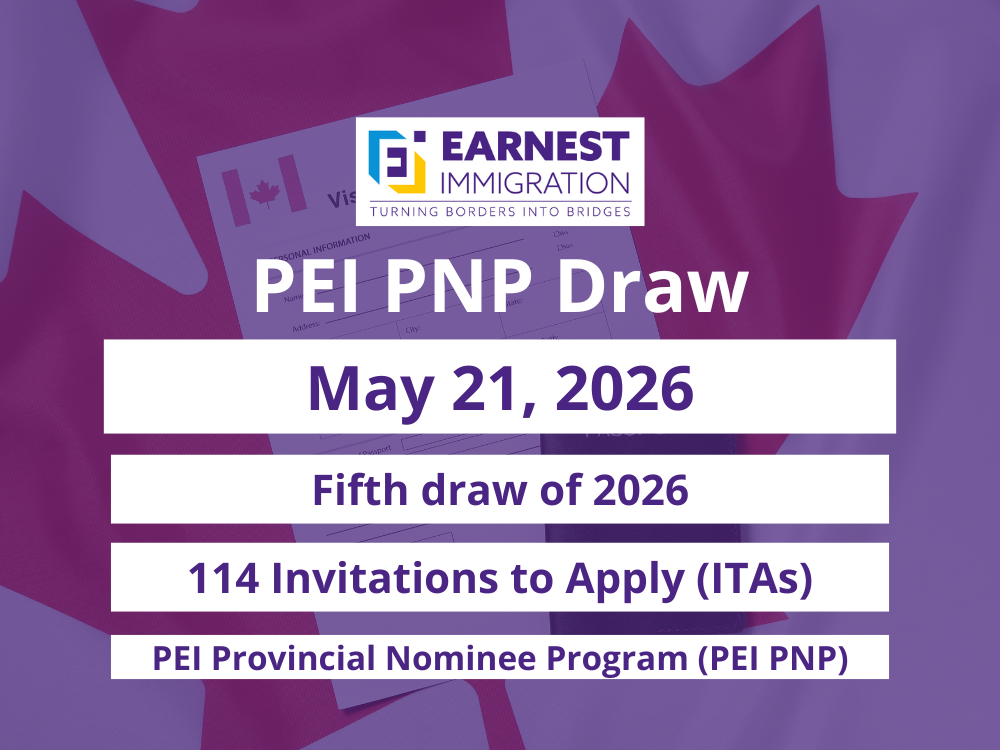
Prince Edward Island conducted its fifth Provincial Nominee Program (PEI PNP) draw of 2026 on May 21, 2026, issuing 114 Invitations to Apply (ITAs) to skilled workers and international graduates currently living and working in the province. The draw was conducted through two pathways — the Labour Impact category and the PEI Express Entry category — consistent with the selection approach used in all five 2026 PEI draws to date.
The May 21 draw brings PEI’s year-to-date total to 477 invitations across five draws — a steady and accelerating pace that reflects the province’s deliberate strategy of consistent monthly selection targeting candidates already embedded in its economy. International graduates from three designated post-secondary institutions — the University of Prince Edward Island (UPEI), Holland College, and Collège de l’Île — were again prioritised alongside in-demand skilled workers, continuing a pattern of strong support for provincial graduates that has characterised every PEI PNP draw in 2026.
PEI holds a unique distinction among all Canadian provinces and territories: it is the only one to publicly release its annual draw schedule in advance. With next draws anticipated on June 18 and July 16, 2026, candidates in the PEI EOI pool have a clearer planning horizon than any other provincial nominee program in Canada provides.
Table of Contents
ToggleKey Details of the May 21, 2026 PEI PNP Draw
| Draw Number | Fifth draw of 2026 |
| Date | May 21, 2026 |
| Program | PEI Provincial Nominee Program (PEI PNP) |
| Streams | Labour Impact; PEI Express Entry |
| Invitations Issued | 114 |
| 2026 Year-to-Date Total | 477 invitations (5 draws) |
| Next Scheduled Draw | June 18, 2026 |
| Application Window | 30 calendar days from invitation date |
All 2026 PEI PNP Draws
| Draw Date (2026) | Invitations | Streams Targeted |
| May 21 | 114 | Labour Impact + PEI Express Entry |
| April 16 | 127 | Labour Impact + PEI Express Entry |
| March 20 | 101 | Labour Impact + PEI Express Entry |
| Feb 19 | 109 | Labour Impact + PEI Express Entry |
| Jan 15 | 26 | Labour Impact + PEI Express Entry |
| Total | 477 | — |
The five 2026 PEI draws tell a consistent story. January’s draw was small (26 invitations), likely a calibration round to open the year. The subsequent four draws have all issued between 101 and 127 invitations, reflecting a stable monthly cadence of approximately 100-130 invitations targeted at employed workers and graduates in the province. The April draw at 127 was the largest of the year to date. May’s 114 reflects a slight moderation from April but is within the established range.
The consistency across draws — same two streams, same three priority institutions, same selection criteria every round — signals that PEI’s immigration office has a well-defined, stable program design in 2026. Candidates who meet the core criteria and are already in the province are receiving meaningful, regular selection opportunities approximately once per month.
The Streams: Labour Impact and PEI Express Entry
The May 21 draw, like all five 2026 PEI draws, operated through two pathways:
| Stream | Key Eligibility Criteria |
| Labour Impact — Skilled Worker | Skilled workers currently employed in PEI in a qualifying occupation who hold a permanent or temporary resident status (or are authorized to work in Canada). Must work in a priority sector or occupation with high economic impact for PEI. |
| Labour Impact — International Graduate | International graduates from UPEI, Holland College, or Collège de l’Île who are currently working in PEI in a qualifying occupation. Demonstrates strong ties to PEI through both study and employment. |
| PEI Express Entry — Skilled Worker | Skilled workers with an active Express Entry profile (FSWP, CEC, or FSTP), currently employed in PEI, working in a priority occupation. A PEI nomination adds 600 CRS points to the Express Entry profile, virtually guaranteeing a federal PNP draw ITA. |
| PEI Express Entry — International Graduate | International graduates from UPEI, Holland College, or Collège de l’Île with an active Express Entry profile who are currently working in PEI. Combines local educational ties with Express Entry pool eligibility. |
The Labour Impact and PEI Express Entry categories are not entirely separate — a candidate may qualify under both simultaneously if they are employed in PEI in a qualifying occupation and have an active Express Entry profile. For such candidates, PEI Express Entry is the more strategically valuable pathway: a PEI nomination adds 600 CRS points to the federal Express Entry profile, turning a competitive-but-waiting Express Entry candidate into a near-certain recipient of a PNP-specific federal draw ITA.
Candidates without an Express Entry profile (including some temporary foreign workers and post-graduation work permit holders who have not yet created a federal profile) can still access the PEI PNP through the Labour Impact category directly, without the Express Entry connection. The Labour Impact nomination pathway leads to a permanent residence application through the non-Express Entry base nomination process — a longer but viable route.
Priority Institutions: UPEI, Holland College, and Collège de l’Île
PEI’s consistent prioritisation of graduates from three specific institutions reflects a deliberate strategy to retain talent developed within the province. International students who study in PEI, complete their degree or diploma, and then find employment in the province represent exactly the kind of candidate PEI is most eager to nominate: locally educated, locally employed, and with demonstrated commitment to the province as a place to build a career.
• University of Prince Edward Island (UPEI): PEI’s primary university, offering bachelor’s, master’s, and doctoral programs. UPEI graduates in fields like computer science, nursing, business, and veterinary medicine are among the most sought-after by PEI employers
• Holland College: A polytechnic institution offering diplomas and applied degrees in practical fields including culinary arts, technology, healthcare, and business. Holland College graduates often fill in-demand technical and vocational roles that align closely with PEI’s labour market priorities
• Collège de l’Île: The Francophone community college in PEI, serving PEI’s Acadian and Francophone communities. Graduates from Collège de l’Île contribute to PEI’s French-language minority community and align with Canada’s Francophone immigration targets
Graduating from one of these institutions does not guarantee a PEI PNP invitation — candidates must also be currently employed in the province in a qualifying occupation. But it provides a significant advantage in the EOI scoring system that translates into earlier and more frequent selection over candidates without PEI educational ties.
How the PEI EOI System Works
Unlike the federal Express Entry system (which uses the transparent CRS ranking to order candidates), the PEI PNP uses an Expression of Interest system that scores candidates on a proprietary points grid. Candidates create a profile on PEI’s Office of Immigration website and are ranked based on multiple factors:
| Factor | What It Covers | Why It Matters |
| Language proficiency | English or French test scores (IELTS, CELPIP, TEF Canada, TCF Canada) | Directly affects ability to integrate into workforce and community |
| Education | Level (bachelor’s, master’s, diploma), field of study, country of completion | Higher education in in-demand fields scores more favourably |
| Work experience | Skill level, occupation, and relevance to PEI labour market needs | Priority occupations in agriculture, healthcare, tourism, and technology |
| Strategic priorities | Whether occupation or sector addresses urgent PEI labour market gaps | PEI publishes priority sector lists; aligning occupation is critical |
| Employment factors | Valid job offer from PEI employer; prior Canadian work experience | Job offer in PEI is among the strongest positive signals in the system |
| Institutional ties | Graduation from UPEI, Holland College, or Collège de l’Île | Explicitly prioritised in all five 2026 PEI PNP draws to date |
The EOI score is not publicly disclosed to candidates — PEI does not publish the minimum score needed to receive an invitation in any given draw, unlike some other provinces. This means candidates cannot calculate exactly where they stand relative to others. However, the consistent pattern of prioritising local employment, provincial institutional ties, and occupations in PEI’s priority sectors gives clear strategic signals for what a competitive PEI EOI profile looks like in 2026.
Priority Sectors and Occupations in 2026
PEI selects candidates based on their ability to contribute to the province’s economy. In 2026, the sectors consistently prioritised across all PEI PNP draws include:
| Priority Sector | Example Occupations Prioritised |
| Agriculture and Agri-food | Farm operators, agricultural technicians, food processing supervisors, equipment operators |
| Food Processing | Meat cutters, food and beverage processing workers, quality control technicians |
| Healthcare | Registered nurses, licensed practical nurses, personal support workers, healthcare aides, physicians, dentists |
| Tourism and Hospitality | Accommodation managers, chefs, tourism operations workers (particularly off-season roles) |
| Technology | Software developers, IT project managers, systems analysts, cybersecurity professionals |
| Construction and Trades | Electricians, plumbers, carpenters, heavy equipment operators, HVAC mechanics |
| Education | Early childhood educators, teachers (especially for minority-language schools) |
| Business and Finance | Accountants, financial analysts, business services workers in growing sectors |
PEI’s labour market challenges are particularly acute in healthcare, where an aging population creates growing demand for medical professionals and personal support workers. Agriculture and food processing remain foundational to PEI’s economy — the island’s potato industry, seafood sector, and growing agri-food processing base need a steady supply of workers from skilled technicians to supervisors. Tourism has rebounded significantly post-pandemic, creating demand particularly in off-season roles that test genuine commitment to year-round residence in the province.
PEI’s Unique Advance Draw Schedule
The May 21 draw is the fifth consecutive PEI draw to align with the province’s publicly announced schedule — a feature that no other Canadian province or territory offers. PEI’s Office of Immigration publishes anticipated draw dates for the full year, giving candidates a concrete planning framework:
| Scheduled Date (2026) | Invitations Issued | Status |
| January 15 | 26 | Completed — on schedule |
| February 19 | 109 | Completed — on schedule |
| March 19 | 101 | Completed — one day late (held March 20) |
| April 16 | 127 | Completed — on schedule |
| May 21 | 114 | Completed — on schedule (this draw) |
| June 18 | TBD | Next scheduled draw |
| July 16 | TBD | Scheduled |
The practical value of this schedule for candidates and immigration professionals is substantial. With draws occurring on known dates, candidates can time their EOI profile submissions, language test sittings, and employment documentation to be ready before each draw date. The one deviation in 2026 — the March 20 draw occurring one day after the scheduled March 19 date — is the only exception across five draws, demonstrating PEI’s exceptional adherence to its published calendar.
Candidates who are not yet in the PEI EOI system but want to be considered in the June 18 draw have a clear window: submitting an EOI profile as soon as possible before June 18 maximises the time the profile has to be assessed before the next draw. PEI’s Office of Immigration processes EOI profiles continuously, not in batches, which means a profile submitted in late May could be considered in the June 18 draw if it meets the current selection threshold.
The 30-Day Application Window: A Critical Constraint
Candidates who receive a PEI PNP invitation have 30 calendar days to submit a complete application for provincial nomination — a reduction from the prior 60-day window that applies in many other provincial programs and in the federal Express Entry process. This compressed timeline creates significant practical urgency:
• Gather employment documentation immediately: A letter from your current PEI employer confirming your position, duties, hours, salary, and employment start date is typically the most time-consuming document to obtain. Request it on the day you receive your invitation
• Prepare language test results: Ensure your IELTS, CELPIP, TEF Canada, or TCF Canada results are within their validity window and available for submission. If your test expired recently, an expedited retest may be needed within the 30-day window
• Compile educational credentials: Degree certificates, transcripts, and — if applicable — PEI institution graduation records must be assembled and submitted in the correct format
• Police clearance certificates: Begin the RCMP fingerprint-based Canadian criminal record check and any international clearances immediately upon receiving your invitation. Some international clearances take 3-4 weeks, which is the entire 30-day window
• Immigration status documentation: Current work permit or study permit, PGWP, or other authorisation to work in Canada. Ensure all status documentation is current and valid
• Proof of residence and employment in PEI: Utility bills, lease agreements, pay stubs, and ROE (Record of Employment if applicable) confirming physical residence and active employment in Prince Edward Island
The 30-day window is firm — there is no standard extension process. Candidates who miss the deadline must re-enter the EOI pool and wait for a future draw. The best preparation is to have all documents gathered and ready before receiving an invitation, which the publicly available draw schedule makes possible. Candidates targeting the June 18 draw should begin collecting documents now.
Why PEI: A Strategic Choice for Immigration Candidates
PEI’s Immigration Advantages Compared to Larger Provinces
For immigration candidates weighing provincial pathways, PEI offers a combination of advantages that is genuinely distinctive in the Canadian context:
• Lower competition: With a population of approximately 180,000 and a much smaller applicant base than Ontario, BC, or Alberta, PEI’s program is less overwhelmed with applicants. Candidates with strong PEI ties — especially PEI employment and education — face meaningful but manageable competition rather than the intense volumes seen in OINP or BC PNP
• Transparent scheduling: The published annual draw calendar removes the unpredictability that characterises most other provincial programs. Candidates can plan their immigration journey against known dates rather than guessing
• Consistent criteria: All five 2026 draws have used the same selection criteria — same streams, same priority institutions, same sector focus. Candidates know what they are being evaluated on and can build their profiles accordingly
• Genuine community: PEI’s size — the smallest province by land area — creates a genuinely tight-knit community experience. Newcomers report strong integration support through Immigrant and Refugee Services Association PEI (IRSA), employers who actively engage in welcoming new employees, and communities where newcomers are known as individuals rather than statistics
• Affordable cost of living: Compared to Toronto (average rent for a one-bedroom: $2,400+) or Vancouver ($2,800+), Charlottetown’s average one-bedroom rent of $1,200-1,500 is substantially more affordable. Homeownership, while rising in price, remains more accessible than in major metropolitan areas
• Quality of life: Consistently ranked as one of Canada’s safest provinces with high satisfaction rates among newcomers, low crime rates, and strong natural environment access
The Connection to Federal Express Entry
For candidates with an active Express Entry profile, a PEI nomination through the PEI Express Entry stream is the most direct and high-value immigration pathway available in the province. The mechanics work as follows:
• PEI selects the candidate through the PEI PNP EOI system based on provincial criteria
• PEI issues an invitation and the candidate submits a provincial nomination application within 30 days
• If nominated, PEI issues an enhanced nomination certificate
• The candidate adds the nomination to their federal Express Entry profile — the CRS score immediately increases by 600 points
• At 600+ base CRS, the candidate is virtually guaranteed to receive an ITA in the next federal PNP-specific Express Entry draw (which have cleared at CRS 786-805 in 2026, requiring a base score of only 186-205)
• The candidate submits a federal permanent residence application within 60 days of the federal ITA
This two-step process — provincial nomination followed by federal ITA — is more complex than a direct CEC draw, but for candidates whose base CRS is below the CEC threshold (currently 518) and who are employed in PEI in a qualifying occupation, it represents a far more reliable route to permanent residence than waiting for a CEC draw to drop to their score. A candidate at CRS 450 who receives a PEI nomination becomes eligible for federal PNP draws at effectively any CRS level — their combined score of 1,050 would clear any threshold IRCC has ever set.
After Receiving a PEI PNP Invitation
If you receive an invitation from PEI’s Office of Immigration, the 30-day clock starts immediately. The provincial application requires:
• Completed PEI PNP application form (submitted through the provincial online portal)
• Employment letter from PEI employer: On company letterhead, confirming position title, NOC code (or equivalent), employment start date, hours per week, annual salary, and confirmation that the position is permanent or long-term
• Proof of legal status in Canada: Current work permit, PGWP, study permit, or other authorisation with expiry date visible
• Educational credentials: Degree/diploma certificates and transcripts. If a PEI institution graduate, include proof of graduation from UPEI, Holland College, or Collège de l’Île
• Language test results: Current, valid language test scores in English (IELTS, CELPIP) or French (TEF Canada, TCF Canada)
• Proof of residence in PEI: Utility bill, lease agreement, or official correspondence to your PEI address
• Police clearance certificates: RCMP fingerprint-based check; international clearances for all countries of residence for 6+ months since age 18
• Passport copy
After provincial nomination, the federal application for permanent residence (through either Express Entry or the base non-Express Entry pathway) adds its own document requirements. For Express Entry nominees, the federal application must be submitted within 60 days of receiving the federal ITA. Having federal documents (reference letters, ECAs, medical examinations) prepared before receiving the federal ITA can save critical time in that window.
Frequently Asked Questions
I am an international graduate from UPEI and currently working in Charlottetown. Am I automatically invited in PEI PNP draws?
No — graduation from UPEI and current employment in PEI are strong positive factors in PEI’s EOI scoring system, but they do not guarantee an invitation. You must first submit an Expression of Interest profile through PEI’s Office of Immigration website. Once your profile is in the system, it will be assessed and ranked against other candidates based on all the factors in the EOI grid. UPEI graduation and current PEI employment will score favourably, but you need to be above whatever threshold PEI uses in each draw. The threshold is not published, so there is no way to know in advance if you are above it — but given the consistent prioritisation of PEI institution graduates in every 2026 draw, your chances as a UPEI graduate currently employed in the province are meaningfully stronger than candidates without those ties. Create your EOI profile as soon as possible to ensure you have the longest possible time in the system before the June 18 draw.
I am working in PEI in healthcare but I do not have an Express Entry profile. Can I still apply for the PEI PNP?
Yes. The Labour Impact category is accessible without an Express Entry profile. If you are currently employed in PEI in a qualifying healthcare occupation, with appropriate immigration status (work permit, PGWP, or other authorisation), you can submit an EOI for the PEI PNP through the Labour Impact pathway. If nominated under Labour Impact, your pathway to permanent residence is through the base nomination process — which involves submitting a permanent residence application directly to IRCC without the Express Entry mechanism. The base nomination process typically takes longer than the Express Entry pathway (12-18 months versus 6-8 months), and you cannot benefit from the 600-point CRS boost, but it is a fully valid route to permanent residence. That said, if you meet the requirements of any Express Entry program (particularly CEC if you have qualifying Canadian work experience), creating an Express Entry profile and applying through PEI Express Entry would give you access to the faster Express Entry pathway after nomination.
The 30-day application window seems very short. What happens if I cannot gather all documents in time?
The 30-day window is firm and PEI does not routinely grant extensions. If you miss the deadline, your invitation lapses and you return to the EOI pool — subject to being re-selected in a future draw, but without any guarantee of when that will occur. The best protection against this risk is to begin gathering documents before you receive an invitation, using the published draw schedule to plan. If the next draw is June 18, begin collecting your employer letter, police clearances, and educational documents now. If you receive an invitation, you will already have most documents ready. If you face a genuine emergency after receiving an invitation that makes compliance impossible, contact PEI’s Office of Immigration immediately — while extensions are not standard, provinces occasionally accommodate exceptional documented circumstances. Never let a deadline pass without at least making contact.
How many invitations does PEI typically issue in a year, and how does that affect my chances?
PEI has issued 477 invitations in the first five months of 2026 — on pace for approximately 1,000-1,150 invitations for the full year if the current rate continues. In 2025, PEI issued approximately 800-900 invitations total. The increased pace in 2026 reflects both PEI’s expanded provincial nomination allocation and the province’s growing economic activity. Your individual chances depend entirely on how your EOI score compares to other candidates in the pool at each draw date — PEI does not publish this threshold. Candidates with PEI employment, PEI institutional ties, and occupations in priority sectors have the strongest profiles. Candidates who are in PEI on a work permit without a job offer or institutional connection from PEI face more challenging odds. The most actionable advice is: ensure your EOI profile is complete and accurate, update it promptly when anything changes (new job, improved language scores, completed education), and remain patient — monthly draws mean a fresh opportunity every four to five weeks.
I received a PEI nomination last month. How do I use it in Express Entry and how long will it take?
Congratulations on your nomination. The process from here has two steps. First, add your provincial nomination to your Express Entry profile in your GCKey/IRCC account — this immediately adds 600 CRS points to your profile. Second, wait for IRCC to hold a PNP-specific federal Express Entry draw. In 2026, these draws have occurred approximately every two weeks. With 600 points added, your total CRS will almost certainly exceed the cut-off in the next PNP draw (which have cleared at CRS 786-805 in 2026). When you receive a federal ITA, you have 60 days to submit a complete permanent residence application to IRCC, which includes your PEI nomination certificate plus federal documentation. IRCC’s target processing time for PNP applications in Express Entry is approximately 6 months from a complete application. The complete timeline from nomination to landing can typically be 8-12 months when provincial nomination, federal draw, application submission, and processing are all factored in.
PEI is a small province and I am concerned about job availability. Can I move to another province after receiving PR through PEI PNP?
Legally, as a permanent resident of Canada, you have the right to live and work anywhere in Canada — including moving from PEI to Ontario, BC, or any other province after receiving your PR. The PEI PNP nomination does come with an ‘intent to reside’ condition: when you apply for and receive the nomination, you are committing to genuine intent to settle in PEI. This intent must be genuine and substantiated at the time of your nomination and PR application — it is not acceptable to apply through PEI with the known plan to immediately move upon landing. However, the Canadian Charter of Rights and Freedoms guarantees mobility rights to permanent residents, and IRCC cannot legally prevent you from moving after landing. The practical and ethical position is: apply to PEI only if you genuinely intend to live and work there, at least initially; once you have established yourself in PEI and later decide to move for professional or personal reasons, that is your legal right as a PR. Using the PEI program purely as a stepping stone with no genuine provincial commitment is a misrepresentation risk that can affect the integrity of the application.
The Bottom Line
PEI’s fifth PNP draw of 2026 issued 114 invitations on May 21, 2026 — the fifth consecutive monthly draw targeting skilled workers and international graduates already embedded in the province through employment and education. The consistent selection criteria (Labour Impact and PEI Express Entry streams, three priority institutions, priority sectors), transparent published schedule, and manageable competition levels make PEI one of the most accessible and predictable provincial nomination pathways in Canada for candidates who meet the core eligibility requirements.
With 477 invitations issued in five draws and the next draw scheduled for June 18, 2026, PEI is running one of the most active and transparent provincial immigration programs in the country. For candidates currently employed in PEI in a priority sector, studying or having graduated from UPEI, Holland College, or Collège de l’Île, and with qualifications that align with PEI’s labour market needs, this program offers a clear and well-defined route to provincial nomination and — through either the Express Entry or base nomination pathway — to Canadian permanent residence.
At Earnest Immigration, our licensed consultants help candidates evaluate their PEI PNP eligibility, prepare a competitive EOI profile, gather the documentation required within the 30-day invitation window, and navigate both the provincial nomination and subsequent federal permanent residence application. If you are currently in PEI and want to understand your chances in the June 18 draw, or if you are considering PEI as part of your broader immigration strategy, contact the Earnest Immigration team today for a comprehensive assessment.