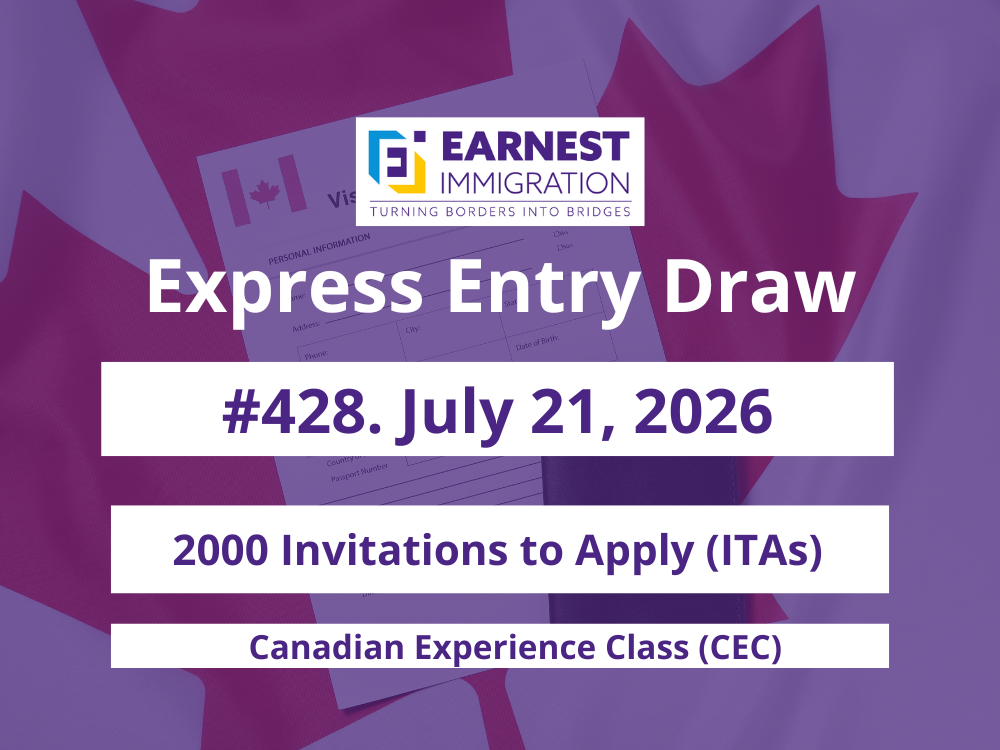
On July 21, 2026, Immigration, Refugees and Citizenship Canada (IRCC) held Express Entry Draw #428, issuing 2,000 Invitations to Apply (ITAs) to candidates in the Canadian Experience Class (CEC). The minimum Comprehensive Ranking System (CRS) score was 516.
That is a one-point drop from the July 7 round and the twelfth consecutive CEC draw of 2026 to land inside the same narrow 507–518 band. On the surface, nothing moved. Underneath, one number changed sharply — and it is the one most coverage of this draw has skipped. Below, the Earnest Immigration team breaks it down.
Table of Contents
ToggleExpress Entry Draw #428 at a Glance
| Detail | Information |
| Draw number | #428 |
| Date | July 21, 2026 |
| Program | Canadian Experience Class (CEC) |
| Invitations issued | 2,000 |
| CRS cut-off score | 516 |
| Tie-breaking rule | May 26, 2026 at 17:33:03 UTC |
| Draw position in 2026 | 40th Express Entry round; 12th CEC round |
| Previous CEC draw | Draw #424 — July 7, 2026 — 2,000 ITAs at CRS 517 |
| Application deadline | 60 days from the date of the invitation |
The Number Everyone Missed: the Tie-Breaking Date Jumped Five Months
Draw #424 on July 7 used a tie-breaking timestamp of December 29, 2025. Draw #428, fourteen days later, used May 26, 2026.
That is a five-month advance in a two-week window, and it is the most recent tie-breaking date any CEC round has used in 2026.
Here is why it matters. The tie-breaking date tells you how deep into the queue IRCC has reached among candidates sitting at exactly the cut-off score. A December 2025 timestamp meant candidates at 517 who entered the pool in, say, March 2026 were still waiting behind a backlog of earlier profiles. A May 26, 2026 timestamp means that backlog at 516 and above has now been substantially cleared — IRCC is reaching profiles submitted less than two months before the draw.
For a CEC candidate at or just above 516 who entered the pool this spring, this is the most encouraging data point in months. You are no longer queued behind a deep reserve of older profiles at your score.
Why the Cut-Off Is Not Falling: It Is Draw Size, Not Competition
The CEC cut-off has now sat at 516 or 517 for three consecutive rounds. The reason is arithmetic, not a stiffening pool.
IRCC issued 4,000 ITAs in the June 23 round and the cut-off came in at 516. It then halved the draw size to 2,000 on July 7 and the cut-off rose to 517. It held at 2,000 on July 21 and the cut-off settled back to 516. Smaller draws reach a shorter way down the ranked list, which lifts the minimum qualifying score. Larger draws reach further down and pull it back.
This is the single most useful thing a CEC candidate can understand right now. Your score is not being outcompeted by a surge of stronger profiles. The threshold is being set by how many invitations IRCC chooses to issue on a given day.
The practical consequence is uncomfortable but worth stating plainly: while draw sizes stay at 2,000, the CEC cut-off is unlikely to fall into the low 500s. Independent analysts tracking the 2026 record expect a 515–520 range to hold for the rest of the year if the current volume persists. If your CRS is in the 505–514 band, waiting for the cut-off to come down to you is not a strategy.
Every CEC Draw of 2026
| Draw | Date | ITAs | CRS |
| #390 | January 7, 2026 | 8,000 | 511 |
| #392 | January 21, 2026 | 6,000 | 509 |
| #396 | February 17, 2026 | 6,000 | 508 |
| #400 | March 3, 2026 | 4,000 | 508 |
| #404 | March 17, 2026 | 4,000 | 507 |
| #407 | March 31, 2026 | 2,250 | 509 |
| #410 | April 14, 2026 | 2,000 | 515 |
| #413 | April 28, 2026 | 2,000 | 514 |
| #417 | May 27, 2026 | 3,000 | 518 |
| #420 | June 23, 2026 | 4,000 | 516 |
| #424 | July 7, 2026 | 2,000 | 517 |
| #428 | July 21, 2026 | 2,000 | 516 |
Twelve rounds, 45,250 ITAs, and an eleven-point band from 507 to 518. Read the ITA column alongside the CRS column and the inverse relationship is visible in almost every pair of consecutive draws.
Cadence: CEC Is Back on a Two-Week Rhythm
Draw #428 came exactly fourteen days after Draw #424. That matters because CEC rounds drifted to roughly four-week intervals through May and June — #417 on May 27, then nothing until #420 on June 23.
July has restored the twice-monthly pattern that governed the first quarter. For candidates near the threshold, a two-week cycle is materially better than a four-week one: it doubles the number of chances per quarter and keeps the tie-breaking date advancing rather than letting a backlog build behind your profile.
Where the Pool Stands
The Express Entry pool held 231,533 candidates as of July 19, 2026 — down from 235,127 two weeks earlier, reflecting the pace of invitations across July’s draws.
In the most recent published band-level breakdown, 18,611 candidates sat in the 501–600 range — the band CEC draws invite from. That figure was 20,012 a fortnight before it. The band is thinning, which is consistent with the tie-breaking date advancing. The much larger 451–500 band, at over 73,000 candidates, is the cohort that only benefits if IRCC returns to 4,000-plus CEC rounds.
Across all draw types, 2026 now stands at roughly 99,612 ITAs over 40 rounds. The next Express Entry draw of any category will push the year past 100,000. No general all-program round has been held in 2026; every draw this year has been program-specific or category-based.
If You Received an ITA in Draw #428
You have 60 days from the date of your invitation to submit a complete permanent residence application. Work in this order — the items that most often break the deadline are the ones you do not control.
1. Accept the invitation in your IRCC secure account and record your exact 60-day deadline.
2. Request police certificates from every country where you have lived six months or more since age 18. Start the same day; some jurisdictions take six to eight weeks.
3. Book your medical exam with an IRCC-approved panel physician. If you hold a valid exam from a prior application, confirm it is still within its validity period before rebooking.
4. Assemble Canadian work-experience evidence. This is where CEC applications most often fail: reference letters must be on company letterhead and state your job title, the NOC-relevant duties you actually performed, hours per week, dates, and salary. Duties that do not map to the NOC you claimed will trigger scrutiny.
5. Gather pay records, T4 slips, and Notices of Assessment covering the qualifying period.
6. Arrange certified translations for any document not in English or French.
7. Budget the fees. As of April 30, 2026, an economic-class principal applicant pays $990 in processing fees plus a $600 Right of Permanent Residence Fee — $1,590 in total. Biometrics and accompanying family members are additional.
CEC processing has been averaging around seven months against a substantial inventory of applications, so a candidate invited now who submits promptly should plan for permanent residence in the first half of 2027.
If You Were Not Invited
What to do depends on how far you are from 516.
Within a few points (510–515):
You are close enough that a single lever may be enough. A language retest is usually the fastest — moving from CLB 8 to CLB 9 across all four abilities produces a meaningful gain, and results arrive in days rather than months. Check whether you have unclaimed points: a sibling in Canada who is a citizen or permanent resident is worth 15, and a Canadian credential adds adaptability points many candidates overlook.
Meaningfully below (below 505):
Incremental CRS work is unlikely to close the gap before the current draw pattern changes. The higher-yield moves are structural. A provincial nomination adds 600 points and effectively guarantees an invitation in a subsequent PNP round. Adding a French test result through TEF Canada or TCF Canada opens eligibility for French-language proficiency draws, which have run all year at cut-offs 100 or more points below CEC. If your occupation falls within an active category — healthcare and social services, trades, education, physicians, senior managers — you are drawing from a separate sub-pool with its own, lower threshold.
For everyone:
Keep your profile current. An expired language result, an unreported promotion, or a lapsed credential assessment can cost you points or eligibility in a round you would otherwise have cleared — and with CEC now running fortnightly, a stale profile costs you more chances than it used to.
One Thing to Watch
IRCC has published proposed changes to Express Entry eligibility that would set CLB/NCLC 6 as the minimum language threshold. Candidates working in TEER 2 or TEER 3 occupations currently need only CLB/NCLC 5, so some people who qualify for the pool today would need to raise their language scores to remain eligible. No implementation timeline has been confirmed and the change is unlikely to take effect before early 2027 — but if you are sitting at CLB 5 in a TEER 2 or 3 role, treat a language retest as time-sensitive.
How Earnest Immigration Can Help
CEC applications are decided on how precisely your Canadian work history is documented. The score gets you the invitation; the reference letters get you the approval.
As a CICC-regulated, RCIC-licensed firm, Earnest Immigration supports CEC candidates with:
• Confirming eligibility and the correct NOC/TEER classification for your role
• Building and optimising an Express Entry profile so your CRS reflects every point you can legitimately claim
• Identifying the fastest realistic routes to add points before the next round
• Assessing whether a provincial nomination, a French test, or a category-based pathway is the better play for your profile
• Preparing a complete, deadline-proof permanent residence application after an ITA
If you have Canadian work experience and want to know where you stand after Draw #428, book a consultation with our team.
Frequently Asked Questions
What was the CRS cut-off for Express Entry Draw #428?
The minimum CRS score for Draw #428 on July 21, 2026 was 516 — one point below the July 7 CEC round.
How many invitations were issued in Draw #428?
IRCC issued 2,000 Invitations to Apply to Canadian Experience Class candidates.
Who was eligible for the July 21, 2026 CEC draw?
Canadian Experience Class candidates with a CRS score of at least 516 who submitted their Express Entry profile before 17:33:03 UTC on May 26, 2026.
Why did the cut-off only move one point?
Because IRCC held the draw size at 2,000 for a second consecutive CEC round. Cut-off movement in CEC draws tracks invitation volume far more closely than it tracks competition in the pool.
What CRS range have CEC draws stayed within during 2026?
All twelve CEC rounds of 2026 have landed between 507 and 518 points, making that band a reliable planning benchmark.
Will the CEC cut-off drop below 510 in 2026?
Not while draw sizes remain at 2,000. The cut-off reached 507 in March only because IRCC was issuing 4,000 ITAs per round. A return to larger draws is the mechanism that would move the threshold down.
What does the tie-breaking date of May 26, 2026 tell me?
It means IRCC has cleared the backlog of candidates at 516 who entered the pool before that timestamp — the most recent tie-breaking date used in any 2026 CEC round. Candidates who joined the pool this spring at or above 516 are now being reached.
How long do I have to apply after receiving an ITA?
You have 60 days from the date of your invitation to submit a complete permanent residence application. Missing the deadline returns you to the pool.
What does a PR application cost in 2026?
As of April 30, 2026, an economic-class principal applicant pays $990 in processing fees plus a $600 Right of Permanent Residence Fee — $1,590 in total. Biometrics and accompanying family members cost extra.
When would I receive permanent residence if invited now?
With CEC processing averaging around seven months, a candidate invited in this round who submits promptly should plan for permanent residence in the first half of 2027.