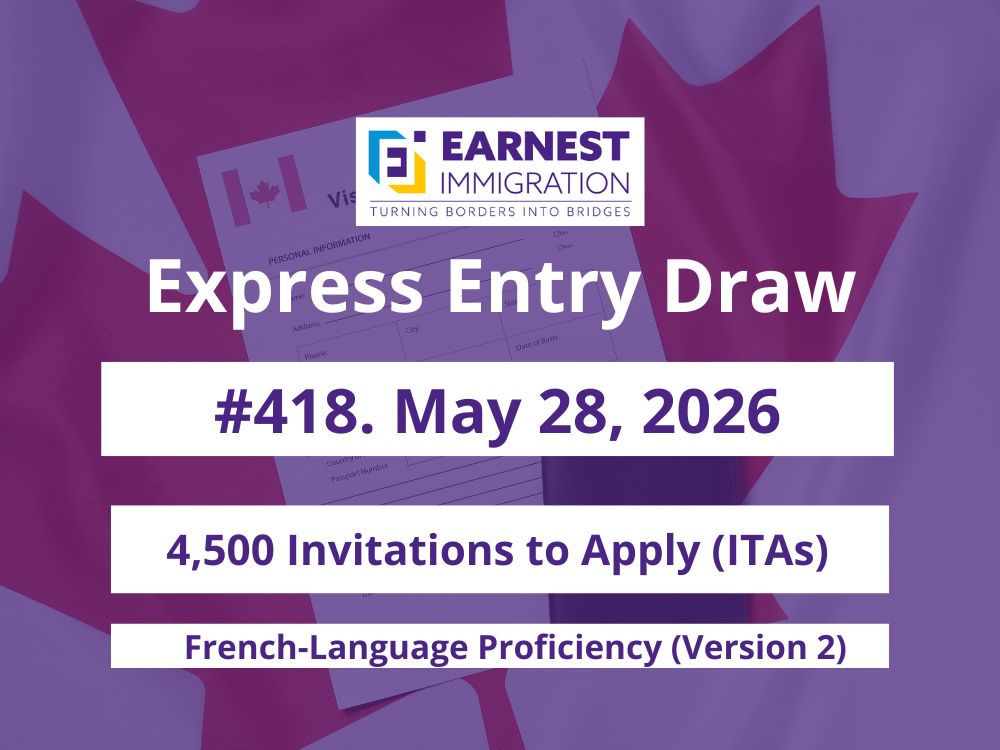
Immigration, Refugees and Citizenship Canada (IRCC) held Express Entry Draw 418 on May 28, 2026, issuing 4,500 Invitations to Apply (ITAs) to candidates under the French-Language Proficiency category (Version 2). The minimum CRS cut-off was 409 points, with a tie-breaking date of April 29, 2026, at 22:20:00 UTC.
Draw 418 is the sixth French-Language Proficiency draw of 2026 and the thirtieth Express Entry draw of the year, arriving one day after Draw 417 (the May 27 CEC draw at CRS 518). The 4,500 ITAs issued is the largest French draw since Draw 401 (March 4, 5,500 ITAs) and the highest single-draw volume since the February mega-draw of 8,500. The CRS of 409 — 9 points above the April 29 draw (CRS 400) — reflects the 29-day inter-draw gap since Draw 414 combined with the counterbalancing effect of 500 additional ITAs.
Draw 418 carries a significant additional dimension that every eligible candidate should be aware of: IRCC has confirmed a technical error in this draw that caused some eligible candidates with CRS 409 or above to not receive invitations. IRCC has acknowledged the issue and is actively reviewing it. Affected candidates have been advised that they do not need to take any action at this time. This glitch — the first of its kind acknowledged for a French-language draw in 2026 — is covered in detail below. With 79,841 total ITAs across 30 draws, IRCC has now issued 73.2% of its 109,000 federal high-skilled annual target by late May.
Table of Contents
ToggleKey Details of Express Entry Draw 418
| Draw Number | 418 |
| Date | May 28, 2026 |
| Category | French-Language Proficiency (Version 2) |
| Invitations Issued | 4,500 |
| CRS Cut-off Score | 409 |
| Tie-breaking Rule | April 29, 2026, at 22:20:00 UTC |
IMPORTANT: Technical Glitch in Draw 418 — Some Eligible Candidates Did Not Receive ITAs
IRCC has officially confirmed a technical error in Draw 418. The issue: some candidates who were fully eligible for an ITA in this French-language draw — with CRS scores at or above 409 and profiles submitted before the tie-breaking date of April 29, 2026 — did not receive their invitations due to a system-level error.
IRCC’s position as of June 2026: the department is actively reviewing the situation and has stated that affected candidates do not need to take any action at this time. Official updates will be shared as the review continues.
What this means for potentially affected candidates:
• If you had a CRS of 409 or above on May 28, 2026 with a French-eligible profile (NCLC 7+ in all four abilities) and a profile submission date before April 29, 2026 at 22:20:00 UTC — and you did not receive an ITA — you may be among the affected candidates
• Do not delete and resubmit your profile. Doing so would reset your submission date and likely remove you from any remedial action IRCC applies to affected profiles
• Document your profile status as of May 28, 2026: screenshot or record your CRS score, language scores, and profile submission date. If you are working with a licensed immigration consultant, ask them to document the same
• Monitor IRCC’s official announcements at Canada.ca for updates on remedial action — whether through retroactive ITAs, profile adjustments, or priority treatment in the next French draw
• IRCC has resolved similar technical issues in past draws through out-of-cycle ITA issuance or priority treatment in the immediately following draw for the same category
For candidates who did receive an ITA in Draw 418: your invitation is valid and unaffected by the review. Proceed with your permanent residence application within the 60-day window as normal. The glitch does not invalidate issued ITAs — it affected only candidates who should have received one but did not.
Why CRS 409 With 4,500 ITAs: The Gap and Volume Interplay
Draw 418’s CRS of 409 — 9 points above Draw 414’s 400 — results from the combined effect of the 29-day inter-draw gap and the larger-than-usual 4,500 ITA volume. These two forces work in opposite directions:
| Draw | Date | CRS | ITAs | Gap | Mechanism |
| Draw 414 | Apr 29 | 400 | 4,000 | 14 days | Short gap — CRS stays at 400 |
| Draw 418 | May 28 | 409 | 4,500 | 29 days | Longer gap raises CRS; 500 extra ITAs pull it down from ~413-415 to 409 |
Without the 500 additional ITAs (had IRCC issued 4,000 as in Draws 405, 411, and 414), the CRS would likely have settled around 413-415 — reflecting four weeks of pool accumulation at higher CRS scores. The extra 500 ITAs reached deeper into the ranked pool, pulling the threshold down from ~413-415 to 409. The net result — 9 points above Draw 414 but well below Draw 411’s 419 — reflects IRCC’s apparent strategy of using ITA volume as a lever to keep the French CRS accessible while managing the longer inter-draw gap.
The tie-breaking date of April 29, 2026 — the same day as Draw 414 — is notable. It indicates that the French-eligible pool at CRS 409 turns over very rapidly. The last day of profiles that cleared in Draw 414 was April 7; just 22 days later (April 29) is already the margin for Draw 418 at a 9-point higher threshold. This rapid turnover confirms that French-proficient candidates are entering the pool at CRS 409+ at a high rate — new test completions, profile updates, and first-time entries are continuously refreshing this tier.
All 2026 French Draws: Six Rounds, 30,500 ITAs
| Draw # | Date | CRS | ITAs | Days Since Prev. | Tie-breaking Date |
| 418 | May 28 | 409 | 4,500 | 29 days | Apr 29, 2026 |
| 414 | Apr 29 | 400 | 4,000 | 14 days | Apr 7, 2026 |
| 411 | Apr 15 | 419 | 4,000 | 28 days | Nov 14, 2025 |
| 405 | Mar 18 | 393 | 4,000 | 14 days | Dec 29, 2025 |
| 401 | Mar 4 | 397 | 5,500 | 26 days | Oct 10, 2025 |
| 394 | Feb 6 | 400 | 8,500 | — | Jan 30, 2026 |
Six French draws have now issued a combined 30,500 ITAs in 2026 — an average of 5,083 per draw. Draw 418 at 4,500 ITAs is the second-largest of the year and confirms the upward volume trend since the 4,000-ITA rounds of March-April. The CRS oscillation pattern (400 → 397 → 393 → 419 → 400 → 409) perfectly tracks the inter-draw interval: longer gaps produce higher CRS, shorter gaps produce lower CRS. The 29-day gap before Draw 418 produced 409 (versus 400 for the 14-day gap before Draw 414), and the 500 extra ITAs moderated what would otherwise have been a ~413-415 threshold.
2026 Express Entry ITAs by Category (as of May 28, 2026)
| Category | Draws | ITAs | % of Total |
| Canadian Experience Class | 9 | 37,250 | 46.6% |
| French-Language Proficiency | 6 | 30,500 | 38.2% |
| Healthcare and Social Services | 1 | 4,000 | 5.0% |
| Trades Occupations | 1 | 3,000 | 3.8% |
| Provincial Nominee Program | 11 | 4,450 | 5.6% |
| Physicians with Canadian Work Exp. | 1 | 391 | 0.5% |
| Senior Managers with Canadian Work Exp. | 1 | 250 | 0.3% |
| Total | 30 | 79,841 | 100% |
Draw 418 brings the French category total to 30,500 ITAs across six draws — 38.2% of the 79,841 year-to-date total. French is now decisively the second-largest category, nearly catching up to CEC (46.6%). Together, CEC and French account for 84.8% of all 2026 Express Entry ITAs — a combined dominance that has held remarkably steady throughout the year. The milestone of 30,500 French ITAs in 2026 by late May is extraordinary by historical standards and reflects Canada’s deliberate policy commitment to the 9.3% Francophone immigration target outside Quebec.
Key Statistics: 2026 Express Entry (as of May 28, 2026)
• Total ITAs issued in 2026: 79,841 across 30 draws (Draws 389-418)
• Draw 418: 6th French draw of 2026; 30th Express Entry draw overall; largest French draw since Draw 401 (5,500 ITAs, March 4)
• CRS 409 — 9 points above Draw 414 (400); explained by 29-day gap offset by 500 extra ITAs
• Tie-breaking date April 29, 2026 — same day as Draw 414; rapid pool turnover at CRS 409
• French draws have issued 30,500 ITAs in 2026 — 38.2% of total year-to-date
• LMIA job offer points removed in early 2026 — French proficiency now even more critical as a CRS booster
• Annual target: 109,000 federal high-skilled admissions; 79,841 already issued (73.2% of target by May 28)
• IRCC confirmed technical glitch in Draw 418 — some eligible candidates did not receive ITAs; review underway; no action required by affected candidates
Understanding the French Draw Context in Late May 2026
LMIA Points Removed: French Proficiency Becomes Even More Valuable
A structural change in early 2026 significantly amplified the advantage of French proficiency in the Express Entry CRS. IRCC removed LMIA-based job offer points from the CRS calculation — specifically, the 200-point bonus previously available to candidates with a positive Labour Market Impact Assessment (LMIA) from their employer, and the 50-point bonus for candidates working on LMIA-exempt closed work permits.
This change had an immediate and significant effect on candidate strategies:
• Candidates who previously relied on the 200-point LMIA bonus to reach the CEC threshold suddenly lost that advantage — many profiles that were competitive at 707+ CRS (for general draws) or 505-510 (for CEC draws with LMIA points) dropped by 200 points
• The 50-point closed work permit bonus removal similarly affected PGWP holders and other workers who had employer-specific permits in LMIA-exempt categories
• French proficiency — through the bilingualism bonus (25-50 points) and the French-language category draw eligibility (clearing at 393-419 vs CEC’s 507-518) — became the highest-value accessible CRS addition remaining in the system
• French is now the primary alternative for the large population of PGWP holders and skilled workers who previously supplemented their CRS with job offer points
The removal of LMIA points has particularly affected South Asian and other internationally sourced candidate populations, who often relied on LMIA-backed job offers as a pathway to reach CEC draw thresholds. For these candidates, investing in French language development is now a more viable path to a competitive CRS than securing a new LMIA-backed position — especially given the French draw’s 109-point accessibility advantage over the current CEC cut-off.
The May 27-28 Two-Day Burst: CEC then French
Draw 418 (French, May 28) follows Draw 417 (CEC, May 27) by exactly one day, restoring the CEC-then-French consecutive-day cluster pattern that IRCC used repeatedly in Q1 2026 (April 13-14-15 was PNP-CEC-French; April 27-28-29 was PNP-CEC-French). The May 27-28 two-day burst issued:
• Draw 417 (May 27): CEC — 3,000 ITAs at CRS 518
• Draw 418 (May 28): French — 4,500 ITAs at CRS 409
Together: 7,500 ITAs in two days, serving two fundamentally different candidate populations. The CEC draw served high-CRS candidates with Canadian work experience at 518. The French draw served French-proficient candidates at 409 — 109 points lower — including many who would not qualify for the CEC draw at any near-term volume. The two draws are not alternatives; they are parallel pathways. A French-proficient CEC candidate at 509 would have received a French ITA but not a CEC one — the French pathway delivered the invitation that the CEC pathway could not.
After Receiving a French Category ITA in Draw 418
Candidates who received an ITA in Draw 418 have 60 days from May 28, 2026 (approximately until July 27, 2026) to submit a complete permanent residence application. Key documents for French category applicants:
• Valid French language test results: TEF Canada or TCF Canada results showing NCLC 7+ in all four abilities within their two-year validity window. Confirm each ability individually — a shortfall in any single ability disqualifies the French category claim regardless of others
• Valid English language test results (if claiming English CRS points): IELTS General Training or CELPIP-General within two-year validity
• Work experience reference letters: On company letterhead, confirming job title, NOC code, duties, hours per week, salary, and employment dates for all qualifying positions
• Educational Credential Assessment (ECA) if applying under FSWP with foreign credentials
• Police clearance certificates: Canada (RCMP fingerprint-based) and all countries of 6+ months residence since age 18 — international clearances can take 4-12 weeks
• Medical examination from an IRCC-designated physician
• Proof of settlement funds (FSWP applicants without a Canadian job offer)
• Valid passport
For offshore FSWP applicants in the French category: verify your FSWP 67-point minimum is met at time of application submission (not just at time of ITA). The FSWP points grid is different from the CRS — a candidate can have sufficient CRS for a French draw ITA but fall short of the FSWP 67-point minimum. Confirming this before submitting is essential to avoid a refusal on program ineligibility grounds.
Frequently Asked Questions
I had CRS 410 and my profile was submitted March 15, 2026. I did not receive an ITA in Draw 418. Was this the glitch?
Possibly — but first verify: the tie-breaking date was April 29, 2026 at 22:20:00 UTC. Your profile submission date of March 15, 2026 is before this tie-breaking cutoff, and your CRS of 410 is above the 409 threshold. In theory, you should have received an ITA in Draw 418. If you did not, this is consistent with the technical glitch IRCC has confirmed. Follow these steps: first, log into your GCKey/IRCC account and confirm your CRS and language scores are accurately reflecting NCLC 7+ French in all four abilities — occasionally candidates discover that a test result was entered incorrectly or expired. If everything looks correct and you still did not receive an ITA, document your profile details (screenshot with date and time) and wait for IRCC’s official remedial action announcement. Do not delete and resubmit your profile. Work with a licensed immigration consultant to formally document your case if you do not receive a resolution within the next draw cycle.
The CRS was 409 in Draw 418 but 400 in Draw 414. Does this mean French draws are getting harder?
No. The 9-point difference reflects the 29-day inter-draw gap between Draw 414 (April 29) and Draw 418 (May 28) — a longer wait allows more high-scoring profiles to enter the pool. Had IRCC also issued 4,000 ITAs (the same as Draw 414), the cut-off would have landed around 413-415. IRCC issued 500 more ITAs — 4,500 instead of 4,000 — which pulled the cut-off from ~413-415 down to 409. The French draw CRS fluctuates with the inter-draw interval and ITA volume, not with underlying demand. All six 2026 French draws have cleared at 393-419 — a 26-point range. Draw 418 at 409 is solidly in the middle of that range. The pathway remains highly accessible for NCLC 7+ candidates.
With 79,841 ITAs already issued against a 109,000 target, will French draws continue in Q3 and Q4?
Yes — French draws are expected to continue throughout 2026, though the pace may moderate. The Francophone immigration target (9.3% of economic class admissions outside Quebec) is a policy commitment backed by $137.2 million in Official Languages Action Plan funding, and it has not yet been met in prior years. IRCC will not simply stop French draws because CEC draws are slowing. The more likely Q3 scenario is: French draws every 3-4 weeks (slightly less frequent than the recent 2-week cadence), volumes of 3,500-4,500 ITAs per draw, and CRS thresholds in the 400-419 range depending on the inter-draw gap. A complete halt of French draws would directly contradict IRCC’s stated Francophone immigration commitments and is highly unlikely.
My French NCLC scores are: Speaking 8, Listening 9, Reading 7, Writing 6. Am I eligible for French category draws?
No. You need NCLC 7 in all four abilities simultaneously, and your Writing score of NCLC 6 falls below the minimum. Despite strong scores in the other three abilities, the shortfall in Writing disqualifies you from the French-Language Proficiency category. This is a hard minimum — there is no averaging, no partial credit, and no exception. The path forward is targeted preparation for the French writing test. Review the TEF Canada or TCF Canada written expression task format: you will be asked to produce structured, formal French text (usually two tasks — one shorter, one longer). Most candidates who score NCLC 8-9 in oral skills but 5-6 in writing have not specifically practiced the test writing format. Six to eight weeks of focused preparation targeting Written Expression task types for your test can often bridge a one-to-two level gap. Once you reach NCLC 7 in writing and have confirmed results, resubmit your language scores in your Express Entry profile.
I am a PGWP holder in Canada and lost the 200-point LMIA bonus when it was removed. My CRS dropped from 510 to 310. What are my options now?
This is a significant change for many PGWP holders, and the options depend on your profile’s underlying human capital scores. At a base CRS of 310 without job offer points, you face a large gap to any federal draw threshold. The most effective recovery pathways are: First, French proficiency — if you have any French background, developing NCLC 7 adds both the 25-50 point bilingualism bonus and access to French draws at CRS 393-419. A candidate at base CRS 360 with NCLC 7 French and the bilingualism bonus would reach approximately 385-410 — within range of recent French draws. Second, language score improvement — improving English from CLB 8 to CLB 9 across multiple abilities can add 20-30 CRS points. Third, provincial nomination — a provincial nomination adds 600 CRS points through the Express Entry PNP pathway regardless of base CRS. Saskatchewan SINP, Nova Scotia NSNP, and New Brunswick NBPNP have streams that may be accessible depending on your occupation and provincial ties. Fourth, occupation category eligibility — if your NOC code qualifies under Trades (477) or Healthcare (467), these category draws are accessible at far lower thresholds than CEC. Consulting a licensed immigration consultant to build a tailored recovery strategy is strongly recommended given the complexity of your situation.
The Bottom Line
Express Entry Draw 418 issued 4,500 ITAs to French-Language Proficiency candidates at CRS 409 on May 28, 2026 — the largest French draw since March and the sixth of the year, bringing the French category total to 30,500 ITAs (38.2% of all 2026 Express Entry invitations). The CRS of 409 reflects the balance between a 29-day inter-draw gap (which raised the threshold from 400 toward ~413-415) and the larger 4,500-ITA volume (which pulled it back down to 409). The April 29 tie-breaking date — same day as Draw 414 — confirms that the French pool at this CRS level turns over extremely rapidly.
The draw is defined by two significant developments: the largest French volume of 2026 outside February’s mega-draw, and IRCC’s confirmed technical glitch that left some eligible candidates without ITAs. The glitch is under active review; affected candidates are advised to document their profiles and wait for IRCC’s remedial action announcement without taking independent action. The structural story of the French pathway in 2026 remains unchanged and powerful: six draws, 30,500 ITAs, CRS consistently 100+ points below the CEC threshold, backed by a $137.2 million government commitment and an unmet 9.3% Francophone settlement target.
At Earnest Immigration, our licensed consultants help French-eligible candidates verify their NCLC eligibility, calculate the bilingualism bonus impact on their CRS, assess their FSWP 67-point minimum, and prepare complete permanent residence applications within the 60-day ITA window. For candidates potentially affected by the Draw 418 technical glitch, we can help document profile status and monitor IRCC’s remedial action. Contact us today for a comprehensive profile assessment.
– Earnest Immigration | Your Trusted Canadian Immigration Partner