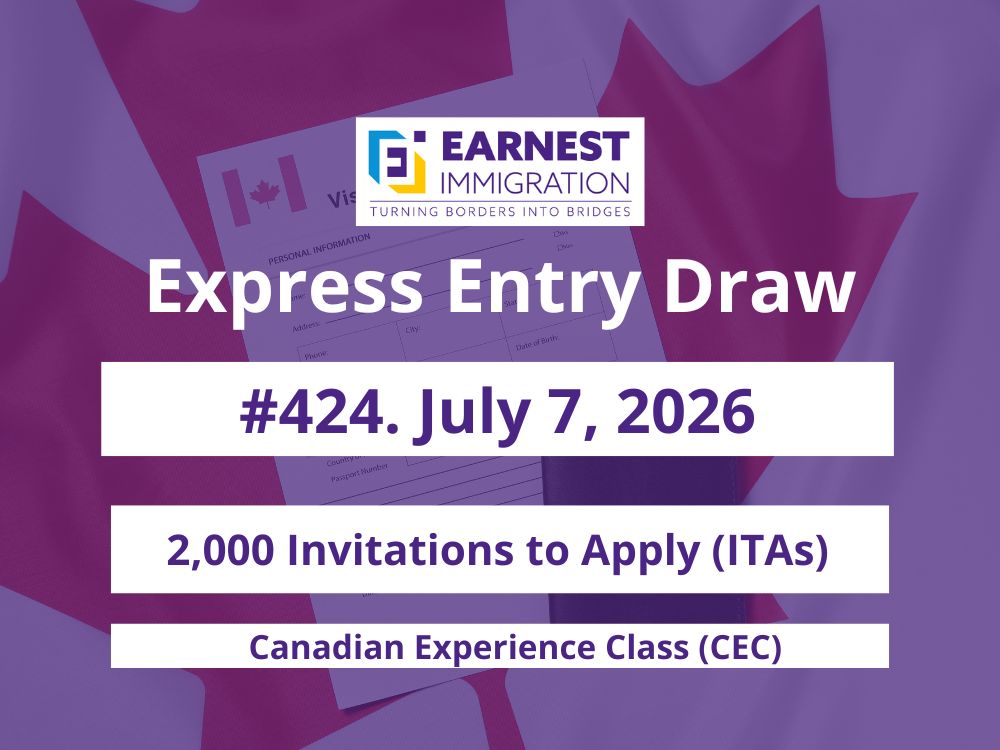
On July 7, 2026, Immigration, Refugees and Citizenship Canada (IRCC) held Express Entry Draw #424, issuing 2,000 Invitations to Apply (ITAs) to candidates in the Canadian Experience Class (CEC). The minimum Comprehensive Ranking System (CRS) score was 517.
Coming just one day after the July 6 Provincial Nominee Program round, this draw kept up an active start to the month and offered a fresh benchmark for candidates already working in Canada. Below, the Earnest Immigration team breaks down what the numbers mean and how you should respond.
Table of Contents
ToggleExpress Entry Draw #424 at a Glance
| Draw number | #424 |
| Date | July 7, 2026 |
| Category | Canadian Experience Class (CEC) |
| Invitations issued (ITAs) | 2,000 |
| Minimum CRS score | 517 |
| Tie-breaking rule | December 29, 2025 at 17:49:27 UTC |
| Application deadline | 60 days from receiving the ITA |
If you had a CRS score of 517 or higher and submitted your Express Entry profile before 17:49:27 UTC on December 29, 2025, you were in the invited pool for this round.
A Stable but Slowly Rising Cut-Off
At 517, this draw sits right inside the narrow 507–518 band that has defined every CEC round of 2026. That consistency is useful – it gives candidates a dependable target to aim for. But it’s worth noting that cut-offs have been inching upward since May.
Two forces are driving that gentle climb. First, competition is building in the upper-middle of the pool: candidates scoring between 501 and 600 remain plentiful. Second, the pace of invitations has eased as the year moves into its second half. Even so, the pool in that band is actually thinning – there were 18,611 candidates scoring 501–600 as of July 5, down from 20,012 on June 21. As those candidates are invited, the pressure on cut-offs should stay in check.
The Bigger CEC Picture in 2026
This was the eleventh CEC draw of 2026, bringing the year’s CEC total to 43,250 ITAs. To put that in perspective, by mid-July of last year IRCC had issued only 18,850 CEC invitations – this year’s pace is more than double.
The rhythm has moderated since the explosive start to 2026, when a single January round issued 8,000 ITAs. That slowdown is by design, not a cause for concern: IRCC remains on track to meet its targets. Canada’s 2026 federal high-skilled admissions target is 109,000, spanning not just CEC but other skilled pathways including category-based selection.
Plan for realistic timelines. Around 60,900 CEC applications are currently waiting to be processed, with an average processing time of roughly seven months. In practical terms, a candidate who receives an ITA now and submits a complete application should expect permanent residence in early 2027.
What This Means for CEC Candidates
With the 507–518 range now holding across eleven consecutive draws, you have a clear, realistic benchmark for where your score needs to be. Because the 501-plus segment of the pool is still deep, IRCC can keep inviting qualified candidates without cutting the threshold – so aiming comfortably above 517 is the safest strategy.
If you’re sitting below that range, there are concrete moves worth making before your next profile update:
• Retake a language test – often the fastest route to more points.
• Build or improve scores in a second official language, especially French.
• Log additional skilled work experience to lift your CRS.
• Strengthen a spouse or common-law partner’s profile – their language, education, and Canadian work experience can all add points to your total.
• Explore a Provincial Nominee Program. A nomination adds 600 CRS points and effectively guarantees an ITA.
What’s Next for CEC Draws
Because of the six-to-seven-month processing window, applications submitted in the back half of 2026 will largely count toward Canada’s 2027 admissions targets rather than 2026. That could mean slower draw activity through the rest of the year.
Last year offers a useful template: between August and November 2025, IRCC held six CEC draws of just 1,000 ITAs each, then delivered two December draws totalling 11,000 combined. Whether 2026 repeats that pattern remains to be seen, but it’s worth watching if you’re tracking the draws closely.
A Major Reform on the Horizon
CEC candidates should keep a close eye on IRCC’s proposed overhaul of Express Entry. If it proceeds, the Canadian Experience Class – along with the Federal Skilled Worker and Federal Skilled Trades programs – would be folded into a single federal high-skilled program. No timeline has been confirmed, and it’s unlikely to take effect before early 2027.
One detail matters especially for CEC applicants: the proposal would set CLB/NCLC 6 as the minimum language threshold. Candidates in TEER 2 or 3 occupations currently need only CLB/NCLC 5, so some people who qualify for the pool today may need to raise their language scores to stay eligible under the new rules.
How Earnest Immigration Can Help
The Canadian Experience Class rewards candidates who present their Canadian work history precisely and time their profile updates well. At Earnest Immigration, we help CEC candidates:
• Confirm eligibility and the correct NOC/TEER classification for your role
• Build and optimize an Express Entry profile that maximizes your CRS
• Identify the fastest legitimate ways to add points before your next draw
• Assemble a complete, deadline-proof PR application after an ITA
If you have Canadian work experience and want to know where you stand after Draw #424, book a consultation with our team and let’s map your fastest route to permanent residence.
Frequently Asked Questions
What was the CRS cut-off for Express Entry Draw #424?
The minimum CRS score for Draw #424 on July 7, 2026 was 517.
How many ITAs were issued in Draw #424?
IRCC issued 2,000 Invitations to Apply to candidates in the Canadian Experience Class.
Who was eligible for the July 7, 2026 CEC draw?
Candidates in the Canadian Experience Class with a CRS score of at least 517 who submitted their Express Entry profile before 17:49:27 UTC on December 29, 2025.
What CRS range have CEC draws stayed within during 2026?
Every CEC draw in 2026 has landed between 507 and 518 points, making that band a reliable benchmark.
How long do I have to apply after receiving an ITA?
You have 60 days from the date of your invitation to submit a complete permanent residence application.
When can I expect permanent residence if invited now?
With CEC processing averaging around seven months, a candidate invited in this round who submits promptly should expect PR in early 2027.
What can I do if my CRS is below 517?
Options include retaking a language test, improving French, adding skilled work experience, strengthening a partner’s profile, or pursuing a Provincial Nominee Program nomination worth 600 CRS points.