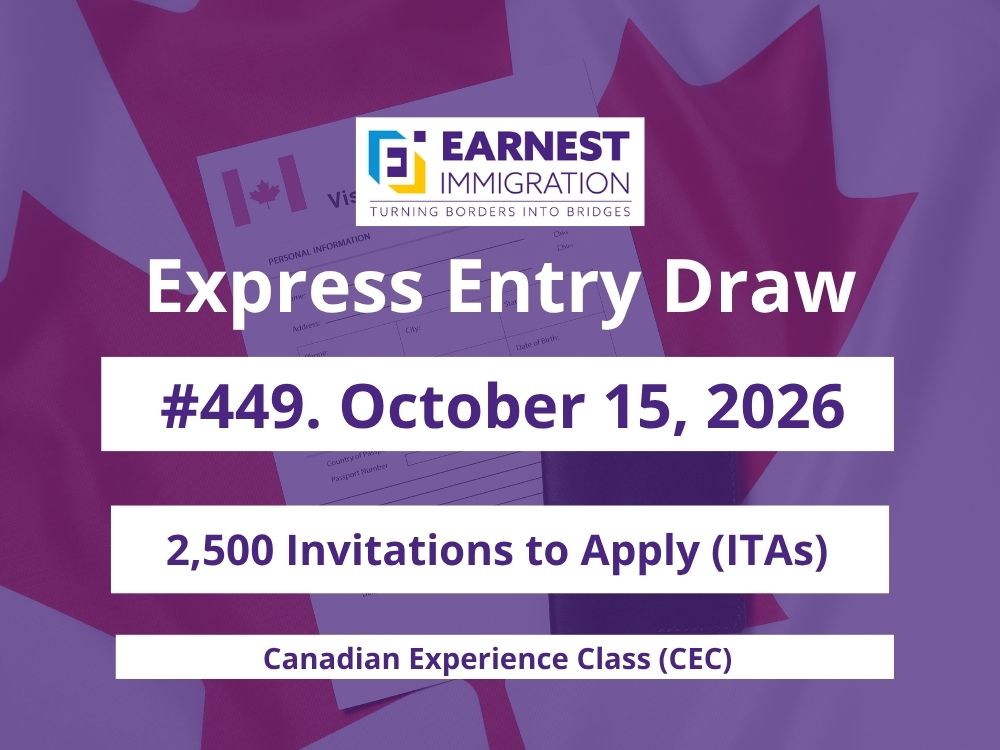
On October 15, 2026, Immigration, Refugees and Citizenship Canada (IRCC) held Express Entry Draw #449, issuing 2,500 Invitations to Apply (ITAs) to candidates in the Canadian Experience Class (CEC). The minimum Comprehensive Ranking System (CRS) score was 519.
On its own, the round reads as more of the same: a CEC cut-off camped just below 520, where it has sat for months, and a draw size on the smaller end of the year’s range. But the timing makes this round unusual. One day later, on October 16, IRCC announced the largest change to Express Entry selection in years a high-wage occupation reform that takes effect November 3. That almost certainly makes Draw #449 the last ordinary CEC round before the system is reweighted. Below, the Earnest Immigration team covers the verified numbers and then what the final pre-reform draw means for CEC candidates.
Table of Contents
ToggleExpress Entry Draw #449 at a Glance
| Detail | Information |
| Draw number | #449 |
| Date | October 15, 2026 |
| Program | Canadian Experience Class (CEC) |
| Invitations issued | 2,500 |
| CRS cut-off score | 519 |
| Change from previous CEC draw | +1 point (from 518) |
| Tie-breaking rule | September 21, 2026 at 19:00:47 UTC |
| Draw position in 2026 | 61st Express Entry round of the year |
| CEC ITAs in 2026 to date | 57,750 (about 42% of all 2026 invitations) |
| All-category ITAs in 2026 to date | 138,467 across 61 rounds |
| Application deadline | 60 days from the date of the invitation |
The Cut-Off: 519, and Why It Is a Real Number This Time
Readers of our PNP coverage will have seen us wave away the cut-off as meaningless. That logic does not apply here, and the distinction is worth stating plainly. PNP draws invite nomination holders who each carry a 600-point bonus, so their cut-off only reflects pool composition. CEC draws carry no such bonus. The 519 score is a genuine competitive bar: every candidate below it was left in the pool. It rose one point from the previous CEC draw’s 518 and continues to hold just under 520 exactly the plateau this series has tracked since the summer.
The mechanics behind the plateau are unchanged. As of October 12 there were 21,638 candidates scoring between 501 and 600 in the pool, up from 19,542 at the end of August and 18,133 in July. More competitive candidates are entering the pool than IRCC draws from it each round, so a draw of 2,500 is, in the source’s phrase, “just enough” to hold the line a shade below 520 rather than push it down. The tie-break tells the same story quietly: the September 21 timestamp sits about three and a half weeks before the draw date, indicating the queue of 519-point candidates reaches back roughly three weeks. It is a mild backlog signal, not a crisis but it confirms the pool is running ahead of the draws.
CEC Is the Backbone Category of 2026 for Now
For all the hand-wringing about a high cut-off, CEC has been the dominant route of the year by volume. Its 57,750 ITAs account for roughly 42% of all 2026 Express Entry invitations more than any other category over the full year, even though French-language draws briefly out-issued it during an August surge. The draw sizes have shrunk as the year progressed from the 4,000-to-8,000 range of early 2026, to 2,000 in each of the three September rounds, to 2,500 now but the cadence has held and the cumulative total is large.
That “for now” matters, because the ground is about to shift under this category specifically.
Why #449 Is the Last CEC Draw That Will Look Like This
On November 3, 2026, IRCC’s high-wage occupation reform takes effect. It rewrites the CRS itself: candidates gain substantial new points for Canadian work experience in a high-wage occupation (up to 70) and for a qualifying high-wage job offer (up to 100, with no LMIA required). Every profile already in the pool will have its score recalculated automatically, and invitation rounds will be paused for up to about two weeks while that happens.
CEC candidates sit squarely in the path of this change, because the Canadian Experience Class pool is full of exactly the profiles the reform rewards: people with Canadian experience in health care, the skilled trades, engineering, and technology the named high-wage fields. A large share of today’s CEC candidates will therefore see their scores rise on November 3. That has a counter-intuitive consequence: when draws resume, the effective cut-off for this cohort is likely to go up, not down, because so many candidates gain points at once. A 519 that felt stubbornly high this week could look modest by late November.
There is a second structural change on the horizon. IRCC has signalled it intends to replace the Canadian Experience Class, Federal Skilled Worker, and Federal Skilled Trades programs with a single federal high-skilled program, with no timeline yet attached. Taken together, the message to a CEC candidate is clear: the “CEC draw” as a distinct, predictable event with a stable ~519 cut-off is ending. Draw #449 is the last clean look at the old pattern.
What This Means If You Just Missed the Cut
If your CRS is in the 515–518 band and you were not invited in Draw #449, your next move depends entirely on your occupation, and November 3 is the hinge.
- If you work in a high-wage occupation (health, trades, engineering, technology): the recalculation may lift you above the cut-off automatically on November 3. Your priority is to make sure your profile correctly reflects your Canadian experience, and if you also hold a job offer to record the required job-offer details before November 3, because those points are not applied automatically.
- If your occupation is not high-wage: expect the bar to rise around you as others gain points, and lean on the routes that bypass the general CEC ranking a provincial nomination, or a category-based draw such as French-language if you can reach NCLC 7.
If You Received an ITA in Draw #449
You have 60 days from the date of your invitation to submit a complete permanent residence application. Work through the following in order the police certificates and medical exam are the items most likely to break the deadline.
- Accept the invitation in your IRCC secure account and record your exact 60-day deadline.
- Confirm your work experience evidence maps cleanly to the NOC you claimed: reference letters on company letterhead stating job title, duties, hours per week, salary, and employment dates.
- Request police certificates from every country where you have lived six months or more since age 18. Start the same day; some jurisdictions take six to eight weeks.
- Book your medical exam with an IRCC-approved panel physician, or confirm a prior exam is still within its validity period.
- Confirm your language test results are still valid and correctly entered an expired result is a common cause of a rejected application.
- Arrange certified translations for any document not in English or French.
- Budget the fees. As of April 30, 2026, an economic-class principal applicant pays $990 in processing fees plus a $600 Right of Permanent Residence Fee $1,590 in total. Biometrics and accompanying family members are additional.
IRCC currently processes most Express Entry applications in about six months, so a candidate who submits promptly should plan for a decision in the first half of 2027. An invitation already in hand from Draw #449 is unaffected by the November 3 changes act on it on the normal timeline.
If You Were Not Invited
A missed invitation at 519 is not the end of the road, and this is an unusually consequential moment to reassess. Before the next rounds resume under the new rules, it is worth getting a clear read on how the November 3 recalculation will treat your specific profile, and whether a provincial nomination or a category-based route is a faster path than waiting on the general CEC ranking. Keep your profile complete and current: language results, work history, and if applicable job-offer details all need to be accurate in the system before the recalculation runs.
How Earnest Immigration Can Help
The window between now and November 3 is short, and for CEC candidates it is decisive. The difference between a profile that correctly captures high-wage Canadian experience or a recorded job offer and one that does not can be dozens of CRS points at the moment scores are recalculated.
As a CICC-regulated, RCIC-licensed firm, Earnest Immigration supports candidates at every stage:
- Assessing how the November 3 recalculation will affect your CRS, based on your occupation and wage tier
- Reviewing and correctly updating your Express Entry profile before the deadline including job-offer details, which must be entered to count
- Building your profile so your CRS reflects everything you can legitimately claim
- Weighing CEC, provincial nomination, and category-based routes against each other for your specific profile
- Preparing a complete, deadline-proof permanent residence application after an ITA
Note that Earnest provides guidance and assessment on your immigration pathway; securing a job offer is a matter between you and an employer. If you want to know where Draw #449 and the November 3 reform leaves your profile, book a consultation with our team before the deadline.
Frequently Asked Questions
What was the CRS cut-off for Express Entry Draw #449?
The minimum CRS score for Draw #449 on October 15, 2026 was 519, up one point from the previous Canadian Experience Class draw’s 518. IRCC issued 2,500 ITAs to CEC candidates. Unlike a PNP draw, this cut-off is a genuine competitive threshold candidates below 519 were not invited.
How many CEC invitations has Canada issued in 2026?
As of Draw #449, IRCC has issued 57,750 CEC ITAs in 2026 about 42% of all Express Entry invitations for the year, making CEC the largest category by volume over the full year. Across all categories, 2026 stands at 138,467 ITAs over 61 rounds.
Why is Draw #449 described as the last CEC draw before the rules change?
IRCC announced its high-wage occupation reform on October 16, 2026 one day after this draw taking effect November 3. The reform recalculates all pool scores and pauses invitation rounds for about two weeks. Draw #449 is therefore the last CEC round held under the current rules before the system is reweighted.
Will the CEC cut-off go up or down after November 3?
For the CEC cohort, likely up. Much of the CEC pool holds Canadian experience in high-wage occupations (health, trades, engineering, technology), so many candidates will gain points in the November 3 recalculation. When draws resume, so many candidates gaining points at once tends to push the effective cut-off higher, not lower.
I scored 515–518 and was not invited. What should I do?
Your next move depends on your occupation. If it is a high-wage occupation, the November 3 recalculation may lift you above the cut-off automatically make sure your profile reflects your Canadian experience and record any job offer before the deadline. If it is not high-wage, expect the bar to rise and consider a provincial nomination or a category-based route.
Does the November 3 reform affect an invitation I already received in Draw #449?
No. An ITA already issued is honoured on the normal 60-day timeline. The reform changes how future scores are calculated and when rounds resume; it does not retroactively affect invitations already in hand.
What does the tie-break date of September 21 mean?
Among candidates tied at exactly 519, those who submitted their profile before September 21, 2026 at 19:00:47 UTC were invited. The roughly three-and-a-half-week gap between that timestamp and the draw date indicates a backlog of candidates at the cut-off score consistent with a pool growing faster than the draws clear it.
How long do I have to apply after receiving an ITA?
You have 60 days from the date of your invitation to submit a complete permanent residence application. Missing the deadline returns you to the pool.
What does a PR application cost in 2026?
As of April 30, 2026, an economic-class principal applicant pays $990 in processing fees plus a $600 Right of Permanent Residence Fee $1,590 in total. Biometrics and accompanying family members cost extra.
Talk to a Licensed Consultant
Earnest Immigration and Citizenship Services Inc. is a CICC-regulated, RCIC-licensed Canadian immigration consultancy with offices in Windsor, Ontario and Regina, Saskatchewan, serving clients across North America and North India.
The November 3 changes reward acting early. Book a consultation to have your Express Entry profile, occupation, and CEC options assessed by a licensed consultant before the deadline.
Disclaimer: This article is general information about Canadian immigration programs and is current as of October 17, 2026. It is not legal advice and does not create a consultant-client relationship. Express Entry cut-off scores, invitation volumes, processing times, government fees, and the November 3, 2026 program changes are set by IRCC and may be revised. Verify all figures against official Government of Canada sources or consult a licensed RCIC about your specific circumstances.