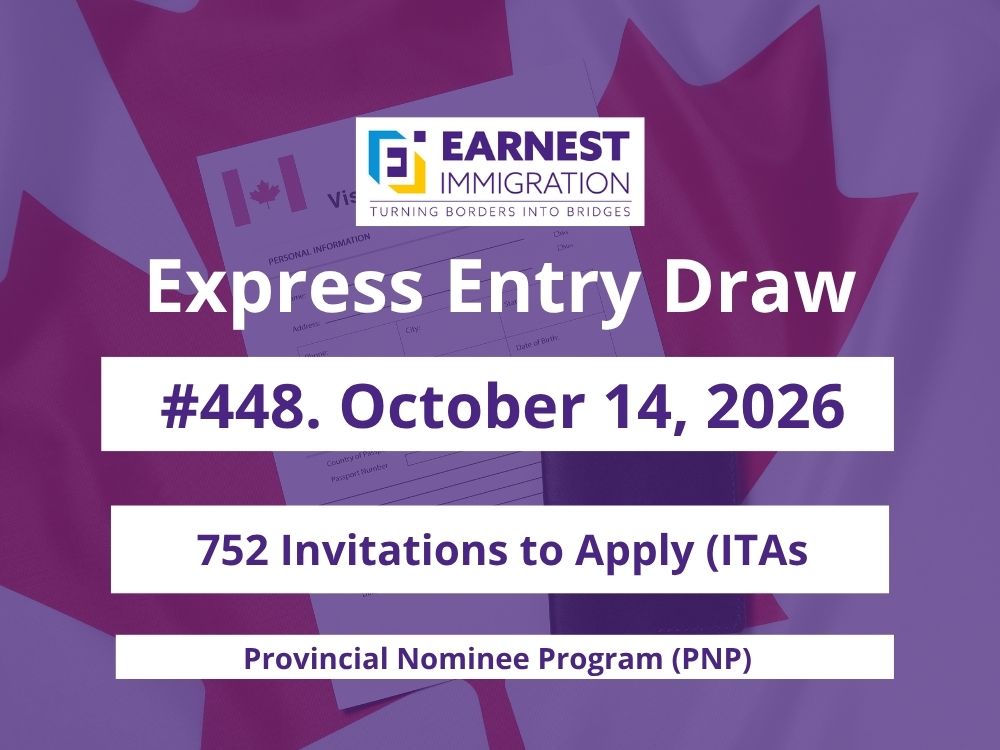
On October 13, 2026, Immigration, Refugees and Citizenship Canada (IRCC) held Express Entry Draw #448, issuing 752 Invitations to Apply (ITAs) to candidates in the Provincial Nominee Program (PNP). The minimum Comprehensive Ranking System (CRS) score was 772.
The round is routine in itself – a familiar PNP draw that, like the five before it, cleared essentially the entire pool of nomination holders. The milestone behind it is not. With these 752 invitations, PNP has now issued 10,022 ITAs across 20 rounds in 2026, crossing ten thousand for the year. That number is worth pausing on, because it marks the point at which the Provincial Nominee Program has quietly become the backbone of Express Entry in 2026 – the most dependable high-volume route in a year when every other category has been volatile. Below, the Earnest Immigration team looks at what the 20-round record tells a prospective nominee.
Table of Contents
ToggleExpress Entry Draw #448 at a Glance
| Detail | Information |
| Draw number | #448 |
| Date | October 13, 2026 |
| Program | Provincial Nominee Program (PNP) |
| Invitations issued | 752 |
| CRS cut-off score | 772 |
| Implied base score (minus 600-pt nomination) | 172 |
| Tie-breaking rule | July 15, 2026 at 13:57:33 UTC |
| Draw position in 2026 | 60th Express Entry round; 20th PNP round |
| PNP ITAs in 2026 to date | 10,022 (crossed 10,000 this round) |
| Application deadline | 60 days from the date of the invitation |
The Cut-Off, Briefly
We will keep this short, because this series has covered it across five previous PNP rounds. A provincial nomination adds 600 CRS points; every candidate in a PNP draw holds one; the draw invites nearly all of them. So the 772 cut-off is not a competitive bar – it is simply the lowest base score (172, once you strip the 600-point bonus) that happened to be in the pool this round. It jumped 47 points from the last PNP draw’s 725, but as we demonstrated on Draw #442, that movement is noise: both rounds cleared the pool, so nobody competed on score. This batch of nomination holders simply carried stronger underlying profiles than September’s. As of October 12 there were 749 candidates above 600; IRCC issued 752 ITAs. The pool was cleared, for the sixth PNP round running.
With that settled, the number that actually matters this round is 10,022.
PNP Has Become the Backbone of Express Entry 2026
Step back and look at the year. PNP has now run 20 times in 2026 – roughly every two weeks, without a prolonged gap – and issued 10,022 invitations. No other draw type has been as steady. Consider what the alternatives did over the same year:
- The Canadian Experience Class shifted onto a higher plateau mid-year, its cut-off climbing from the low 510s to the high 510s, and its draw sizes swung from 8,000 down to 1,000.
- French-language proficiency surged to overtake CEC in August, then went silent for weeks at a time.
- The occupation categories fired erratically – physicians three times, trades twice (six months apart), transport and military once each, senior managers three times at wildly different volumes.
Against all that, PNP simply kept going. Twenty rounds, bi-weekly, every recent one clearing the pool. For a candidate, that metronomic reliability is the single most valuable property any route can have – more valuable than a lower cut-off or a bigger headline draw. It means the question in PNP is never “will a draw come in time?” It reliably will. The only question is whether you hold a nomination when it does.
The 20-Round Record, in Two Numbers
The full-year PNP picture comes down to two figures that pull in opposite directions, and understanding both is what makes the route legible.
Volume is rising.
After dipping into the 440–580 range through mid-year, PNP draw sizes have climbed back up: 733 on September 28, and 752 now. This cuts against the broad late-2026 slowdown most analysts expected, and the reason is supply – provincial allocation top-ups granted earlier in the year (British Columbia and Alberta among them) are converting into more nominations entering the pool. More nominations mean larger draws. PNP is expanding, not contracting, into the final stretch of the year.
The cut-off is meaningless.
Across the 20 rounds, the published cut-off has swung between 697 and 805 with no trend, because – as established – it only ever reports the base scores of whoever held a nomination that week. A prospective nominee should ignore it entirely. Your base CRS does not need to be high to be invited in a PNP round; it needs a nomination attached to it. The 10,022 ITAs of 2026 went to candidates across a wide spread of base scores, many of them modest.
PNP Draws Across 2026
| Draw | Date | ITAs | CRS |
| #427 | July 20, 2026 | 511 | 744 |
| #431 | August 4, 2026 | 507 | 768 |
| #435 | August 17, 2026 | 442 | 760 |
| #438 | August 31, 2026 | 562 | 697 |
| #442 | September 14, 2026 | 576 | 734 |
| #445 | September 28, 2026 | 733 | 725 |
| #448 | October 13, 2026 | 752 | 772 |
Twenty rounds, 10,022 ITAs. Draw sizes dipped mid-year and have climbed back above 700; the cut-off zigzagged across a 108-point range that signifies nothing but pool composition. Read the pattern, not the individual number: PNP is the steadiest, and now one of the largest, routes in Express Entry.
The Pool Clears Every Time – Six Rounds Running
| PNP round | Nomination holders in pool | ITAs issued | Outcome |
| #431 – Aug 4 | 500 | 507 | Pool cleared |
| #435 – Aug 17 | 439 | 442 | Pool cleared |
| #438 – Aug 31 | 559 | 562 | Pool cleared |
| #442 – Sep 14 | 574 | 576 | Pool cleared |
| #445 – Sep 28 | 728 | 733 | Pool cleared |
| #448 – Oct 13 | 749 | 752 | Pool cleared |
The practical rule has held for six consecutive rounds: if you hold a valid nomination, you will almost certainly be invited in the next PNP draw, whatever your base score. If you held one and were not invited this round, treat it as urgent – the cause is almost always an expired nomination certificate, a lapsed language result, or an incomplete profile field, not your CRS. Check your profile status today.
If You Received an ITA in Draw #448
You have 60 days from the date of your invitation to submit a complete permanent residence application. Work through the following in order – the police certificates and medical exam are the items most likely to break the deadline.
- Accept the invitation in your IRCC secure account and record your exact 60-day deadline.
- Confirm your provincial nomination certificate is still valid. Contact the nominating province immediately if the expiry date is anywhere near your submission window – a lapsed nomination invalidates the basis of your invitation.
- Request police certificates from every country where you have lived six months or more since age 18. Start the same day; some jurisdictions take six to eight weeks.
- Book your medical exam with an IRCC-approved panel physician. If you hold a valid exam from a prior application, confirm it is still within its validity period before rebooking.
- Assemble employment evidence: reference letters on company letterhead stating job title, NOC-relevant duties, hours per week, salary, and employment dates.
- Arrange certified translations for any document not in English or French.
- Budget the fees. As of April 30, 2026, an economic-class principal applicant pays $990 in processing fees plus a $600 Right of Permanent Residence Fee – $1,590 in total. Biometrics and accompanying family members are additional.
IRCC currently processes Express Entry-linked PNP applications in about seven months, so a candidate who submits promptly should plan for a permanent residence decision in the first half of 2027.
If You Do Not Yet Have a Nomination
The 10,000-ITA milestone is, in effect, an argument for pursuing one. In a year when the federal routes have been a moving target – CEC’s rising plateau, French’s stop-start volume, the unpredictable occupation categories – PNP has been the one constant, and it is growing. For a candidate whose base CRS is not competitive in a CEC or category draw, a nomination converts that modest score into an almost certain invitation through the most reliable draw stream in the system.
The hard part remains securing the nomination, and it is selective: provinces target candidates by occupation, work experience, language, location, or ties to the province, and many streams require a job offer or in-province experience. The growing allocation widens the opportunity but does not remove the selectivity. The move is to identify the specific streams you qualify for and pursue them deliberately, while keeping a complete federal profile active in parallel – through the Canadian Experience Class if your score and Canadian experience support it, the French-language category if you can reach NCLC 7, or a stable occupation category such as healthcare or trades if your work qualifies.
How Earnest Immigration Can Help
PNP-linked permanent residence applications are unforgiving on documentation. The nomination has to be valid at submission, the work history has to map cleanly to the NOC you claimed, and the 60-day clock does not pause for a missing police certificate.
As a CICC-regulated, RCIC-licensed firm, Earnest Immigration supports candidates at every stage:
- Assessing which provincial streams you realistically qualify for, and in which order to pursue them as allocations expand
- Building and optimising your Express Entry profile so your CRS reflects everything you can legitimately claim
- Reviewing nomination validity and documentation before submission
- Preparing a complete, deadline-proof permanent residence application after an ITA
- Weighing PNP, CEC, and category-based routes against each other for your specific profile
If you hold a nomination and want to know where you stand after Draw #448 – or you are working toward one – book a consultation with our team.
Frequently Asked Questions
What was the CRS cut-off for Express Entry Draw #448?
The minimum CRS score for Draw #448 on October 13, 2026 was 772. The 752 figure often seen refers to the number of invitations issued. Because the draw cleared nearly all nomination holders, the 772 cut-off reflects the base scores present in the pool, not a competitive threshold.
How many PNP invitations has Canada issued in 2026?
With this round, IRCC has issued 10,022 PNP ITAs across 20 rounds in 2026 – crossing ten thousand for the year. PNP has been the most consistent draw type of 2026, running roughly every two weeks.
Why did the cut-off jump from 725 to 772?
Pool composition, not competition. Both rounds cleared the entire nomination pool, so no one competed on score. The October batch of nomination holders simply carried higher base scores than September’s. PNP cut-offs have swung between 697 and 805 all year without meaning.
Did this draw invite every nomination holder?
Very nearly. As of October 12, there were 749 candidates scoring above 600 (nomination holders) in the pool, and IRCC issued 752 ITAs – effectively clearing the sub-pool, as the five previous PNP rounds also did.
Is PNP still growing late in 2026?
Yes. After dipping mid-year, PNP draw sizes have climbed back above 700 (733, then 752), driven by provincial allocation increases converting into more nominations. This runs against the broader late-2026 slowdown affecting other draw types.
I have a valid nomination but was not invited. Why?
With the pool cleared six rounds running, almost every valid nomination holder should have received an invitation. A missed ITA usually indicates an expired nomination certificate, a lapsed language result, or an incomplete profile field – not an insufficient score. Check your profile immediately.
Do I need a high CRS score to be invited in a PNP draw?
No. A provincial nomination adds 600 points, so even a modest base score clears the cut-off. The 10,022 PNP invitations of 2026 went to candidates across a wide range of base scores. The barrier is securing the nomination, not your CRS.
How long do I have to apply after receiving an ITA?
You have 60 days from the date of your invitation to submit a complete permanent residence application. Missing the deadline returns you to the pool.
What does a PR application cost in 2026?
As of April 30, 2026, an economic-class principal applicant pays $990 in processing fees plus a $600 Right of Permanent Residence Fee – $1,590 in total. Biometrics and accompanying family members cost extra.
Talk to a Licensed Consultant
Earnest Immigration and Citizenship Services Inc. is a CICC-regulated, RCIC-licensed Canadian immigration consultancy with offices in Windsor, Ontario and Regina, Saskatchewan, serving clients across North America and North India.
Book a consultation to have your Express Entry profile and provincial nomination options assessed by a licensed consultant.