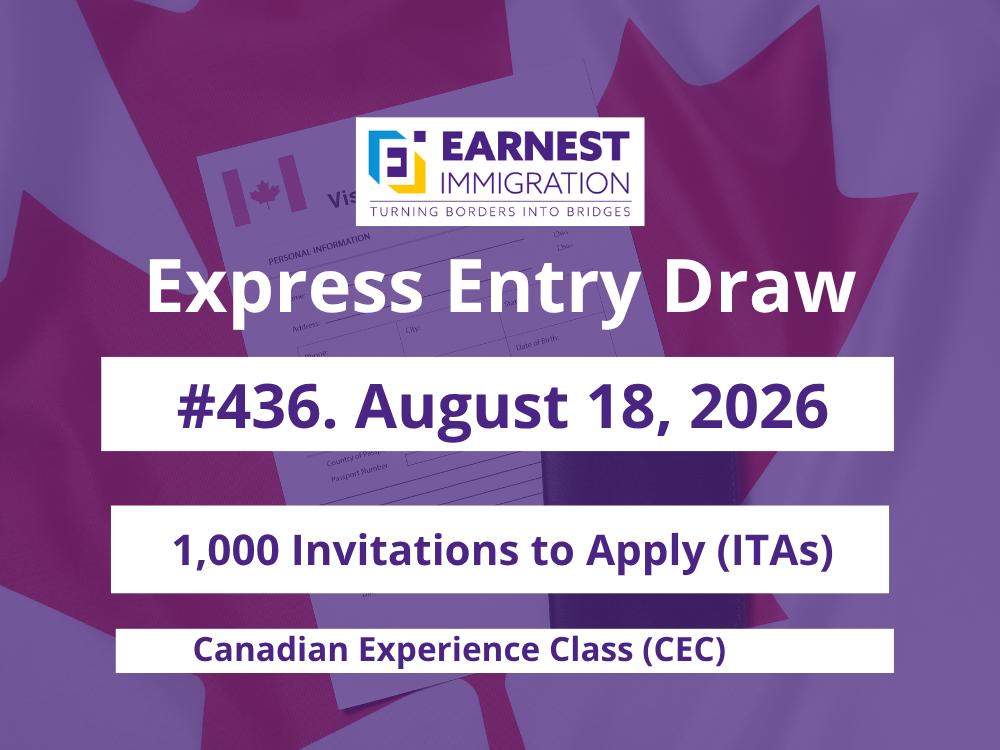
On August 18, 2026, Immigration, Refugees and Citizenship Canada (IRCC) held Express Entry Draw #436, issuing 1,000 Invitations to Apply (ITAs) to candidates in the Canadian Experience Class (CEC). The minimum Comprehensive Ranking System (CRS) score was 523.
Two numbers make this draw notable. First, 523 is the highest CEC cut-off of 2026 – it broke above the 507–518 band that had held for every CEC round all year. Second, this round made 2026 the biggest year in Express Entry history, pushing the annual total past a record that had stood since 2021. The two facts are connected, and the connection is the same lever we analysed after Draw #432 two weeks ago. Below, the Earnest Immigration team explains it.
Table of Contents
ToggleExpress Entry Draw #436 at a Glance
| Detail | Information |
| Draw number | #436 |
| Date | August 18, 2026 |
| Program | Canadian Experience Class (CEC) |
| Invitations issued | 1,000 |
| CRS cut-off score | 523 |
| Tie-breaking rule | August 17, 2026 at 22:09:00 UTC |
| Draw position in 2026 | 48th Express Entry round |
| Previous CEC draw | Draw #432 – August 5, 2026 – 3,000 ITAs at CRS 516 |
| Milestone | 2026 becomes the highest-ITA year ever (114,865) |
| Application deadline | 60 days from the date of the invitation |
Why 523 Broke the Band: the Draw Shrank
Every CEC round of 2026 before this one cleared somewhere between 507 and 518 – an unusually tight eleven-point band for a full calendar year. Draw #436 pushed through the top of it, to 523. The reason is not that CEC candidates suddenly became more competitive. The reason is that this was the smallest CEC draw of the year.
At 1,000 ITAs, this round was half the size of the previous CEC draw and a fraction of the 4,000-, 6,000-, and 8,000-ITA rounds IRCC ran earlier in 2026. A smaller draw reaches a shorter way down the ranked list before its seats are full, so the last candidate invited sits higher. Fewer invitations, higher cut-off. That is the entire mechanism.
This is the exact counterpart to what we showed after Draw #432. There, IRCC increased the draw size by 50% – to 3,000 – and the cut-off did not move at all, holding at 516. A bigger draw that does not lower the bar tells you the pool is deep. A smaller draw that raises the bar tells you the same thing from the other direction. In both cases the conclusion is identical: the CEC cut-off is set by how many invitations IRCC issues, not by a shifting level of competition.
The Pool Confirms It
As of August 16, 18,657 candidates sat in the 501–600 CRS band – the tier CEC draws invite from. That is down slightly from 19,705 on August 3, but up from 18,133 a month earlier on July 19.
The read is that the number of candidates being drawn out of the competitive band is roughly matching the number entering it. The pool is neither draining nor flooding at the top – it is in equilibrium. That equilibrium is what has kept the CEC cut-off pinned so tightly all year, and it is why the 523 reading should be understood as a function of the small draw size rather than a new, higher competitive floor.
Every CEC Draw of 2026
| Draw | Date | ITAs | CRS |
| #390 | January 7, 2026 | 8,000 | 511 |
| #396 | February 17, 2026 | 6,000 | 508 |
| #404 | March 17, 2026 | 4,000 | 507 |
| #410 | April 14, 2026 | 2,000 | 515 |
| #417 | May 27, 2026 | 3,000 | 518 |
| #420 (June) | June 23, 2026 | 4,000 | 516 |
| #428 | July 21, 2026 | 2,000 | 516 |
| #432 | August 5, 2026 | 3,000 | 516 |
| #436 | August 18, 2026 | 1,000 | 523 |
Read the ITA and CRS columns together. The largest draws of the year – 8,000, 6,000, 4,000 ITAs – produced the lowest cut-offs, 507 to 511. The two smallest – this round at 1,000 and the April 2,000-ITA round – produced the highest, 523 and 515. Draw size and cut-off move inversely, round after round. 523 is what the smallest draw of the year looks like.
The Record: 2026 Is Now the Biggest Express Entry Year Ever
With this draw, IRCC has issued 114,865 ITAs in 2026 – the most in any single year since Express Entry launched in 2015. The previous all-time record was 114,224, set in 2021.
The scale is worth sitting with. IRCC reached an all-time annual record with more than four months of 2026 still to run. The Canadian Experience Class has been the largest single driver, accounting for 49,250 ITAs this year, roughly 42% of the total as of this draw. French-language proficiency has run a very close second and, in the days after this round, overtook CEC to become the year’s largest category.
There is an important caveat behind the record, though, and it points the other way. Because IRCC front-loaded so many invitations into the first half of the year, most analysts – including our team – expect draw volumes to ease in the closing months of 2026. The record was set by an extraordinary early pace that is unlikely to be sustained. For candidates still in the pool, that means the realistic expectation for the rest of the year is fewer invitations per round, not more.
A Structural Change on the Horizon
IRCC has announced plans for a major overhaul that would replace the Canadian Experience Class, the Federal Skilled Worker Program, and the Federal Skilled Trades Program with a single federal high-skilled immigration stream.
No launch date has been confirmed, and current draws continue under the existing categories in the meantime. It is possible that draws are paused temporarily during any transition, as has happened during past category changes. On what has been signalled so far, candidates with genuine Canadian work experience should expect to remain competitive under whatever replaces CEC – but the detailed eligibility rules have not been published. This is a watch item, not a reason to change course. If you are CEC-eligible today, acting on that eligibility while the current framework is in force is the sound move.
If You Received an ITA in Draw #436
You have 60 days from the date of your invitation to submit a complete permanent residence application. Work in this order – the items you do not control are the ones that break the deadline.
- Accept the invitation in your IRCC secure account and record your exact 60-day deadline.
- Request police certificates from every country where you have lived six months or more since age 18. Start the same day; some jurisdictions take six to eight weeks.
- Book your medical exam with an IRCC-approved panel physician. If you hold a valid exam from a prior application, confirm it is still within its validity period before rebooking.
- Assemble Canadian work-experience evidence. This is where CEC applications most often fail: reference letters must be on company letterhead and state your job title, the NOC-relevant duties you actually performed, hours per week, dates, and salary. Duties that do not map to the NOC you claimed will trigger scrutiny.
- Gather pay records, T4 slips, and Notices of Assessment covering the qualifying period.
- Arrange certified translations for any document not in English or French.
- Budget the fees. As of April 30, 2026, an economic-class principal applicant pays $990 in processing fees plus a $600 Right of Permanent Residence Fee – $1,590 in total. Biometrics and accompanying family members are additional.
CEC applications are processed within IRCC’s six-month service standard in most cases, so a candidate invited now who submits promptly should plan for permanent residence in early to mid-2027.
If You Were Not Invited
What to do depends on how far you are from 523 – and on the likelihood that the cut-off eases back into the mid-510s when draw sizes recover.
In the 514–522 range:
You were above the CEC band that held all year and were only excluded by this round’s unusually small size. A return to larger CEC draws would likely bring you into range. In the meantime, a language retest is the fastest way to build a cushion – moving from CLB 8 to CLB 9 across all four abilities produces a meaningful gain, and results arrive in days. Check for unclaimed points too: a sibling in Canada who is a citizen or permanent resident is worth 15, and spousal factors are commonly overlooked.
Below 510:
Waiting for the cut-off to fall to you is not a plan, because the pool equilibrium keeps the band stable rather than declining. The higher-yield moves are structural. A provincial nomination adds 600 points and effectively guarantees an invitation in a subsequent PNP round. A French test result through TEF Canada or TCF Canada opens the French-language category, which has cleared around 120 points below CEC all year and has now become the largest category of 2026. If your occupation sits in an active category – healthcare, trades, transport, and others draw from separate sub-pools – that is worth assessing.
For everyone:
Keep your profile current and accurate. With a system-wide overhaul on the horizon and draw volumes expected to ease, an expired language result or an unreported job change is a more costly mistake than usual – it can cost you a round you would otherwise clear at a moment when rounds may become scarcer.
How Earnest Immigration Can Help
CEC applications are decided on how precisely your Canadian work history is documented. The score gets you the invitation; the reference letters get you the approval.
As a CICC-regulated, RCIC-licensed firm, Earnest Immigration supports CEC candidates with:
- Confirming eligibility and the correct NOC/TEER classification for your role
- Building and optimising an Express Entry profile so your CRS reflects every point you can legitimately claim
- Identifying the fastest realistic routes to add points before the next round
- Assessing whether a provincial nomination, a French test, or a category-based pathway is the better play for your profile
- Preparing a complete, deadline-proof permanent residence application after an ITA
If you have Canadian work experience and want to know where you stand after Draw #436, book a consultation with our team.
Frequently Asked Questions
What was the CRS cut-off for Express Entry Draw #436?
The minimum CRS score for Draw #436 on August 18, 2026 was 523 – the highest CEC cut-off of 2026, above the 507–518 band that had held for every prior CEC round this year.
How many invitations were issued in Draw #436?
IRCC issued 1,000 Invitations to Apply to Canadian Experience Class candidates – the smallest CEC round of 2026.
Why was the cut-off higher than every other 2026 CEC draw?
Because it was the smallest draw of the year. A 1,000-ITA round reaches only a short way down the ranked list before its seats fill, so the last candidate invited sits higher. The high cut-off reflects the small draw size, not a rise in candidate competitiveness.
Will the CEC cut-off stay at 523?
Probably not. 523 is a small-draw artefact. If IRCC returns to 2,000-or-larger CEC rounds, the cut-off would likely fall back toward the 514–518 range that held all year. That said, the pool is in equilibrium, so the band is stable rather than falling – waiting for a much lower cut-off is not a reliable plan.
Is 2026 really a record year for Express Entry?
Yes. With this draw, IRCC has issued 114,865 ITAs in 2026 – the most in any single year since Express Entry launched, surpassing the previous record of 114,224 set in 2021, with more than four months still remaining in the year.
What does the tie-breaking date of August 17, 2026 tell me?
It means IRCC reached candidates at exactly 523 whose profiles were submitted before 22:09:00 UTC on August 17. The very recent timestamp is consistent with a small, selective draw at a high cut-off.
Are Express Entry draws going to slow down?
Most analysts expect so. IRCC front-loaded a large share of 2026 invitations into the first half of the year, and that pace is widely expected to ease in the closing months. Candidates should plan for fewer invitations per round for the rest of the year.
Will the Canadian Experience Class be replaced?
IRCC has proposed folding CEC, the Federal Skilled Worker Program, and the Federal Skilled Trades Program into a single federal high-skilled stream. No launch date is confirmed, and draws continue under the current categories for now. Candidates with Canadian work experience are expected to remain competitive under any replacement.
How long do I have to apply after receiving an ITA?
You have 60 days from the date of your invitation to submit a complete permanent residence application. Missing the deadline returns you to the pool.
What does a PR application cost in 2026?
As of April 30, 2026, an economic-class principal applicant pays $990 in processing fees plus a $600 Right of Permanent Residence Fee – $1,590 in total. Biometrics and accompanying family members cost extra.