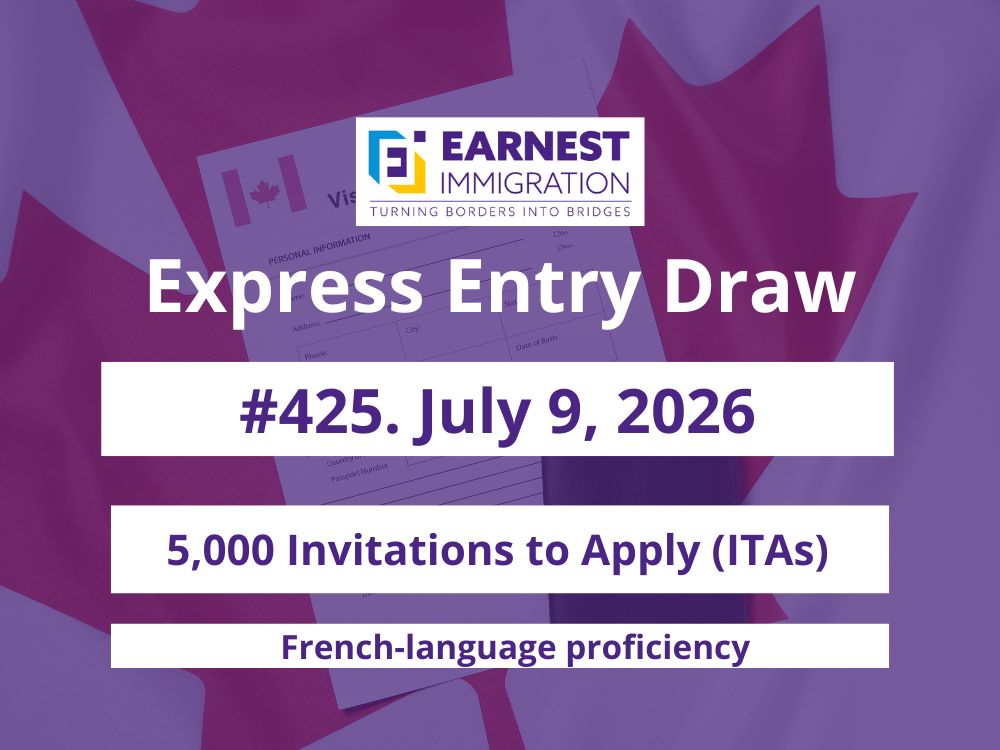
On July 9, 2026, Immigration, Refugees and Citizenship Canada (IRCC) held Express Entry Draw #425, issuing 5,000 Invitations to Apply (ITAs) to candidates in the French-language proficiency category. The minimum Comprehensive Ranking System (CRS) score was 420.
This was the third Express Entry draw in just four days, following the July 6 Provincial Nominee Program round and the July 7 Canadian Experience Class round. It was also the largest of the three, and it reinforced a message that has held all year: for French-speaking candidates, this is one of the most accessible routes to Canadian permanent residence. Below, the Earnest Immigration team breaks down what the numbers mean.
Table of Contents
ToggleExpress Entry Draw #425 at a Glance
| Draw number | #425 |
| Date | July 9, 2026 (10:32:58 UTC) |
| Category | French-language proficiency |
| Invitations issued (ITAs) | 5,000 |
| Minimum CRS score | 420 |
| Tie-breaking rule | May 15, 2026 at 08:04:00 UTC |
| Application deadline | 60 days from receiving the ITA |
If you had a CRS score of 420 or higher, qualifying French-language results, and submitted your Express Entry profile before 08:04:00 UTC on May 15, 2026, you were in the invited pool for this round.
Why a Cut-Off of 420 Is Still Good News
At 420, this was the highest cut-off any French-language draw has posted in 2026, edging just past the previous high of 419 set on April 15. But context matters enormously here. Compare 420 to the same week’s other rounds -517 for Canadian Experience Class and 708 for PNP -and the advantage is obvious. French proficiency remains the lane where a comparatively modest base score can still earn an invitation.
The cut-off has been climbing steadily. French draws bottomed out at 393 on March 18, and nearly every round since has come in higher than the one before it. That gentle rise signals a French-speaking pool that is getting deeper and more competitive at the top -but it is still, by a wide margin, the friendliest category-based path for eligible candidates.
A Larger Draw, Part of a Deliberate Cluster
IRCC raised the volume to 5,000 from 4,500 in the previous French round, continuing a gradual rebuild in draw sizes since the spring. Earlier in the year, French draws ran larger but pulled deeper into the pool at lower cut-offs; the current approach favours steady, sizeable draws with slowly rising thresholds.
Draw #425 also fits IRCC’s now-familiar “cluster” rhythm -concentrating several draws into a short window rather than spacing them evenly. The July cluster opened with PNP on the 6th (534 ITAs), CEC on the 7th (2,000 ITAs), and this French round on the 9th, together delivering 7,534 invitations in the first nine days of the month. A smaller occupation-based round may still follow to round out the cluster.
Who Qualifies for a French-Language Draw
French-language proficiency is a category-based selection stream, and eligibility hinges on your French ability rather than your occupation. To be considered, you generally need:
• French-language test results (TEF Canada or TCF Canada) at NCLC 7 or higher across all four abilities -reading, writing, listening, and speaking.
• Eligibility for one of the core Express Entry programs (Canadian Experience Class, Federal Skilled Worker, or Federal Skilled Trades).
• A valid Express Entry profile submitted before the tie-breaking cut-off.
Importantly, French does not have to be your first language. Candidates who have invested in reaching a strong French level -whether or not they also speak English -are exactly who this category is designed to reward.
What This Means for You
If your CRS sits below the general or CEC cut-offs, strong French can change everything. A candidate with a base score well under 500 can still receive an ITA through a French draw, because the category threshold (420 in this round) is so much lower. In effect, French proficiency can substitute for the points many candidates struggle to earn through age, education, or work experience alone.
This is unlikely to be a passing trend. Canada has set a federal target for French-speaking immigration outside Quebec -currently around 9% of admissions in that category -and French draws have been the single largest category-based stream by invitation volume in 2026. Expect this pathway to remain a priority.
If you received an ITA in Draw #425. Congratulations. You have 60 days to submit a complete permanent residence application with all supporting documents and fees. Make sure your French test results and program eligibility are fully documented before you submit.
Building Toward a French Draw
If you’re close but not yet eligible, French is often the highest-leverage investment you can make in your profile:
• Take or retake the TEF Canada or TCF Canada with the goal of reaching NCLC 7 in every ability.
• Even beyond category eligibility, strong French and English together can add substantial CRS points.
• Keep your Express Entry profile current so you’re captured the moment the next French round runs.
The payoff is significant: few investments move a candidate’s odds as much as reaching French proficiency.
A Reform to Keep in View
IRCC has proposed consolidating its three federal high-skilled programs into a single program and revising the CRS. While details are still being worked out and any change is unlikely before early 2027, the government’s strong and repeated commitment to Francophone immigration suggests French-language selection will remain central under any new structure. For French-speaking candidates, that’s a reason for confidence.
How Earnest Immigration Can Help
French-language draws reward candidates who plan ahead and document their proficiency precisely. At Earnest Immigration, we help French-speaking candidates:
• Confirm category eligibility and the NCLC levels your test results translate to
• Build and optimize an Express Entry profile that maximizes your CRS
• Time your profile and test results to line up with likely French rounds
• Assemble a complete, deadline-proof PR application after an ITA
If you speak French and want to know where you stand after Draw #425, book a consultation with our team and let’s map your fastest route to permanent residence.
Frequently Asked Questions
What was the CRS cut-off for Express Entry Draw #425?
The minimum CRS score for Draw #425 on July 9, 2026 was 420 -the highest for any French-language draw in 2026.
How many ITAs were issued in Draw #425?
IRCC issued 5,000 Invitations to Apply to candidates in the French-language proficiency category.
Who was eligible for the July 9, 2026 French draw?
Candidates with qualifying French-language results (generally NCLC 7 across all four abilities), eligibility for a core Express Entry program, a CRS score of at least 420, and a profile submitted before 08:04:00 UTC on May 15, 2026.
Does French have to be my first language to qualify?
No. French does not need to be your first language. You need French-language test results at the required level, regardless of what other languages you speak.
Why is the French cut-off so much lower than CEC or PNP draws?
French-language proficiency is a category-based stream that selects for a priority attribute. Because Canada prioritizes Francophone immigration, the cut-off sits far below general and CEC rounds.
How long do I have to apply after receiving an ITA?
You have 60 days from the date of your invitation to submit a complete permanent residence application.
How can I qualify for a future French draw?
Take the TEF Canada or TCF Canada and aim for NCLC 7 or higher in reading, writing, listening, and speaking, then keep your Express Entry profile current.