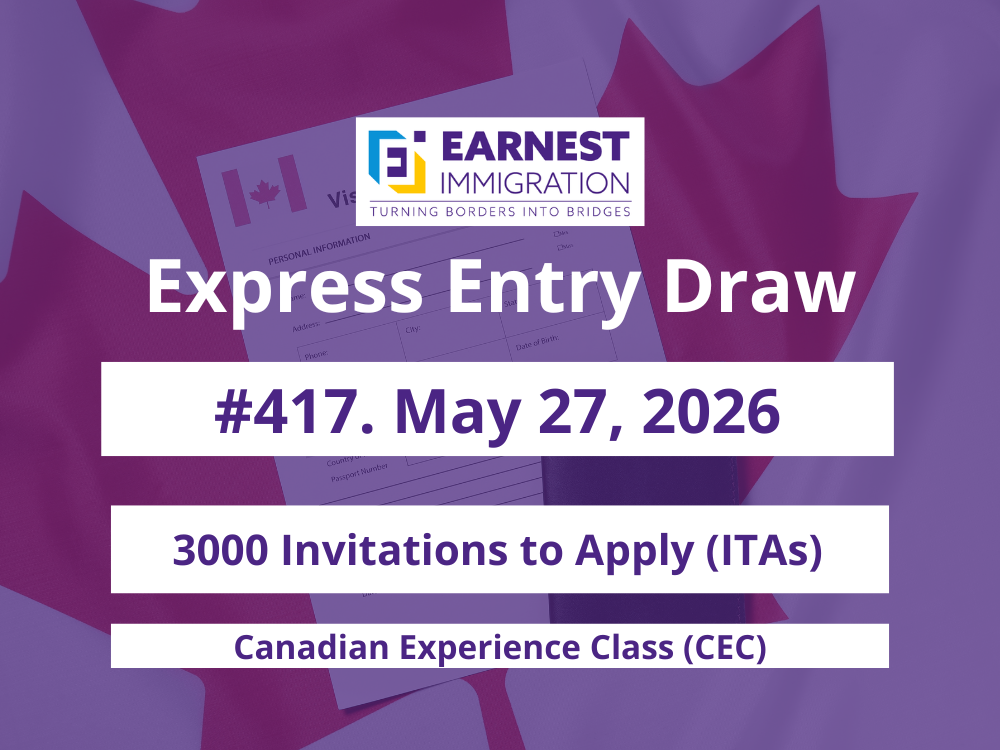
Immigration, Refugees and Citizenship Canada (IRCC) held Express Entry Draw 417 on May 27, 2026, issuing 3,000 Invitations to Apply (ITAs) to candidates under the Canadian Experience Class (CEC). The minimum CRS cut-off was 518 points, with a tie-breaking date of April 30, 2026, at 03:16:01 UTC.
Draw 417 ends a 29-day pause in CEC draws — the longest gap between CEC draws in 2026 — and breaks a 26-day drought for non-PNP draws that had left the majority of the Express Entry pool without an invitation since April 29. The CRS of 518 is the highest CEC cut-off of 2026 to date, surpassing the previous high of 515 set in Draw 410 (April 14). The 3,000 ITA volume is notably larger than the two consecutive 2,000-ITA draws that preceded it (Draws 410 and 413), reflecting the larger pool that accumulated during the 29-day gap.
Draw 417 is the ninth CEC draw of 2026 and the twenty-ninth Express Entry draw of the year, bringing the year-to-date total to approximately 75,341 ITAs. Canada’s federal high-skilled immigration target for 2026 is 109,000 admissions, and with over 75,000 ITAs already issued by May 27 — representing more than 68% of the annual target in just under five months — IRCC is managing pace carefully heading into Q3.
Table of Contents
ToggleKey Details of Express Entry Draw 417
| Draw Number | 417 |
| Date | May 27, 2026 |
| Program | Canadian Experience Class (CEC) |
| Invitations Issued | 3,000 |
| CRS Cut-off Score | 518 |
| Tie-breaking Rule | April 30, 2026, at 03:16:01 UTC |
CRS 518: New 2026 High — The 29-Day Gap Explains It
The CRS of 518 is 4 points above the previous 2026 CEC record of 515 (Draw 410, April 14) and 4 points above the most recent CEC draw (Draw 413, April 28, CRS 514). The cause is unambiguous: the 29-day gap between the last CEC draw (April 28) and Draw 417 (May 27) allowed a large cohort of new profiles in the 515-520 CRS range to accumulate in the pool. When IRCC issued 3,000 ITAs on May 27, it had to reach deeper into a pool refreshed by four weeks of new entries, and the 3,001st candidate fell below 518 — setting the cut-off at 518.
This is the gap-CRS relationship in action. The 501-600 band grew from approximately 13,400 profiles on April 26 to 15,659 on May 10 to 17,945 on May 24 — a gain of 4,545 profiles in roughly four weeks. Those 4,545 new entrants in the 501-600 band represent the accumulated demand that a 29-day gap produces. With 3,000 ITAs issued, IRCC cleared the top tier of this band, but the CRS threshold needed to select 3,000 from a pool that had grown by 4,500+ was higher than when the band was smaller.
3,000 ITAs: Larger But Not a Return to Large-Volume CEC
The 3,000 ITAs of Draw 417 is an increase from the two consecutive 2,000-ITA draws of April, but it does not signal a return to the 4,000-8,000 ITA volumes of Q1 2026. The increase to 3,000 is best understood as a calibrated response to the larger pool — IRCC needed more ITAs to clear the top of a pool that had grown significantly during the 29-day gap. If the next CEC draw is held 14 days later (as has been the norm), the pool at 515+ will be smaller and 2,000-3,000 ITAs would likely produce a CRS in the 515-520 range again.
| Draw | Date | ITAs | CRS | Interpretation |
| Draw 390 | Jan 7 | 8,000 | 511 | Largest CEC draw of 2026 |
| Draw 392 | Jan 21 | 6,000 | 509 | Large volume |
| Draw 396 | Feb 17 | 6,000 | 508 | Large volume |
| Draw 400 | Mar 3 | 4,000 | 508 | Medium — stable |
| Draw 404 | Mar 17 | 4,000 | 507 | Medium — 2026 CEC low |
| Draw 407 | Mar 31 | 2,250 | 509 | Small — CRS rises |
| Draw 410 | Apr 14 | 2,000 | 515 | Smaller — CRS higher |
| Draw 413 | Apr 28 | 2,000 | 514 | Same size — minor drop |
| Draw 417 | May 27 | 3,000 | 518 | Bigger than last 3 — but longer gap raised CRS |
The overall 2026 CEC draw trajectory tells a clear story: large Q1 draws (6,000-8,000 ITAs) drove the CRS to a low of 507. As draws shrank to 2,000-4,000 ITAs in Q2, the CRS crept upward from 507 to 518. Draw 417 represents the current equilibrium: at 3,000 ITAs with a 29-day accumulated pool, 518 is the clearing threshold. This is not a permanent new floor — it reflects the specific conditions of this draw cycle.
The Pool Growth: 29 Days Without a CEC Draw
| Date | Total Pool | 501-600 Band | Context |
| April 26 | 234,452 | ~13,400 (est.) | Between Draw 413 (Apr 28) and Draw 417 (May 27) |
| May 10 | 233,770 | 15,659 | After Draw 415 (May 11 PNP); still growing despite PNP clears |
| May 24 | ~233,600 | 17,945 | After Draw 416 (May 25 PNP); 29 days since last CEC draw |
The 501-600 band grew by approximately 4,545 profiles in the roughly four weeks between the last CEC draw (April 28) and the May 24 pool snapshot. This growth rate — averaging approximately 160 new profiles per day in the 501-600 band — is consistent with the steady inflow of candidates preparing for Express Entry: completing language tests, updating NOC codes, and entering the pool for the first time. The 3,000 ITAs in Draw 417 cleared the top fraction of this accumulated band, but leaves approximately 14,945 candidates in the 501-600 range still waiting.
Full CEC Draw History for 2026
| Draw # | Date | CRS | ITAs | Tie-break Date | Profile Age at Draw |
| 417 | May 27 | 518 | 3,000 | Apr 30, 2026 | 27 days |
| 413 | Apr 28 | 514 | 2,000 | Sep 24, 2025 | ~7 months |
| 410 | Apr 14 | 515 | 2,000 | Jun 10, 2025 | ~10 months |
| 407 | Mar 31 | 509 | 2,250 | Mar 18, 2026 | 13 days |
| 404 | Mar 17 | 507 | 4,000 | May 11, 2025 | ~10 months |
| 400 | Mar 3 | 508 | 4,000 | Jun 24, 2025 | ~8 months |
| 396 | Feb 17 | 508 | 6,000 | Mar 16, 2025 | ~11 months |
| 392 | Jan 21 | 509 | 6,000 | Oct 29, 2025 | ~3 months |
| 390 | Jan 7 | 511 | 8,000 | Jun 10, 2025 | ~7 months |
The nine 2026 CEC draws reveal an evolving pattern with a clear new chapter. Draws 1-6 (January to March) were high-volume rounds of 2,250-8,000 ITAs that drove the CRS from 511 to a record low of 507. Draws 7-8 (April) were small 2,000-ITA rounds that stabilised the CRS at 514-515 as IRCC moderated pace. Draw 9 (Draw 417, May) is larger at 3,000 ITAs but produces a higher CRS of 518 due to the 29-day accumulated pool. The tie-breaking date pattern is equally revealing: Draw 417’s April 30 tie-break is significantly more recent than Draws 410 and 413’s June/September 2025 dates, confirming that at CRS 518, the pool turns over quickly — new entrants at this score level are reaching the front of the queue within weeks.
2026 Express Entry ITAs by Category (as of May 27, 2026)
| Category | Draws | ITAs | % of Total |
| Canadian Experience Class | 9 | 37,250 | 49.4% |
| French-Language Proficiency | 5 | 26,000 | 34.5% |
| Healthcare and Social Services | 1 | 4,000 | 5.3% |
| Trades Occupations | 1 | 3,000 | 4.0% |
| Provincial Nominee Program | 11 | 4,450 | 5.9% |
| Physicians with Canadian Work Exp. | 1 | 391 | 0.5% |
| Senior Managers with Canadian Work Exp. | 1 | 250 | 0.3% |
| Total | 29 | 75,341 | 100% |
Draw 417 brings CEC’s 2026 total to 37,250 ITAs — 49.4% of the 75,341 year-to-date total. CEC has now issued 37,250 ITAs in nine draws in 2026; by contrast, only 9,850 CEC ITAs had been issued by mid-May 2025 — a nearly fourfold increase year-over-year. French (34.5%) remains the second-largest category. Together, CEC and French account for 83.9% of all 2026 ITAs. With 75,341 ITAs issued against a 109,000 target, IRCC has used approximately 69% of its annual federal high-skilled quota by May 27. The Q3-Q4 pace must be measured to avoid overshooting the target.
Key Statistics: 2026 Express Entry (as of May 27, 2026)
• Total ITAs issued in 2026: ~75,341 across 29 draws (Draws 389-417)
• Draw 417: 9th CEC draw of 2026; 29th Express Entry draw overall
• CRS 518 — new 2026 CEC high; 4 points above Draw 410’s previous record of 515
• 3,000 ITAs — larger than the last two draws (2,000 each); calibrated to the 29-day accumulated pool
• Tie-breaking date April 30, 2026 — only 27 days prior; rapid pool turnover at CRS 518
• 501-600 band: 17,945 (May 24), up from 15,659 on May 10 and ~13,400 on April 26
• 60,900 CEC applications currently in processing pipeline
• Annual federal high-skilled target: 109,000; already at ~75,341 (69% of target by May 27)
• Year-over-year: 9,850 CEC ITAs by mid-May 2025 vs 37,250 CEC ITAs by late-May 2026
What Draw 417 Means: CEC in a Slower Q3 Environment
Why the CRS Is 518 When the Draw Is Larger
A natural question arises: Draw 417 issued 3,000 ITAs (50% more than the prior two draws), so why is the CRS 3-4 points higher rather than lower? The answer is the pool composition effect of the 29-day gap. In a typical 14-day draw cycle, approximately 2,200-2,800 new profiles enter the 501-600 band. At 2,000 ITAs, this produces a CRS of 514-515 because the threshold where the 2,001st candidate falls stays in that range. With a 29-day gap, approximately 4,500 new profiles entered the 501-600 band — but the top tier of those 4,500 skews higher, toward 516-520, because the most competitive new candidates (recent language test completions, upgraded educational credentials) tend to enter at the higher end of the range. Issuing 3,000 ITAs from a top-heavy accumulated pool still produces a CRS of 518 because the 3,001st candidate is at 517.
In short: the longer the gap, the more the top of the pool concentrates with high-CRS profiles, raising the threshold even when more ITAs are issued. This is the opposite of what most candidates intuitively expect, and it explains why a larger-volume Draw 417 has a higher CRS than the smaller-volume Draws 410 and 413.
The Express Entry Reform Proposals: A CLB/NCLC 6 Minimum
One of the most significant details emerging from the Express Entry reform consultation (which closed May 24) is IRCC’s proposal to introduce a unified CLB/NCLC 6 language proficiency threshold for all candidates in the new unified pathway. This is materially different from the current CEC requirement, which allows candidates in TEER 2 and TEER 3 occupations to qualify with only CLB 5 in speaking and listening and CLB 4 in reading and writing.
The proposed CLB 6 minimum across all abilities would affect candidates currently eligible under CEC at CLB 5:
• Affected candidates: CEC-eligible workers in TEER 2 occupations (technical occupations in natural and applied sciences, healthcare technical occupations, technical sales and services) and TEER 3 occupations (intermediate occupations) who currently meet the CLB 5 threshold
• Not affected: Candidates who already meet CLB 7+ across all abilities (who represent the majority of recent CEC draw recipients, given the CRS scoring incentive for higher language scores)
• The practical impact: Any candidate currently in the pool at CLB 5 in any ability who does not improve to CLB 6 before reforms take effect may lose eligibility to remain in the pool
• Timeline: No reforms have been confirmed or dated. The consultation period has closed; implementation — if it proceeds — is realistically late 2026 to 2027
The strategic implication for CEC candidates currently at CLB 5 is clear regardless of the reform timeline: improving language scores to CLB 6 or above serves two purposes simultaneously. It improves your CRS score (adding 5-15 points per ability improvement, which is valuable even in the current system) and it future-proofs your eligibility under any proposed reform. Language test improvement is the one action that is unambiguously beneficial under both the current and proposed framework.
What to Do After Receiving a CEC ITA in Draw 417
Candidates who received an ITA in Draw 417 have 60 days from May 27, 2026 (approximately until July 26, 2026) to submit a complete permanent residence application. Key actions by timeline:
• Days 1-3: Request all employer reference letters immediately. On company letterhead, signed by supervisor or HR, confirming job title, NOC code, hours per week, salary, employment dates, and main duties. Allow 2-3 weeks minimum. This is the highest lead-time document in most CEC applications
• Days 1-7: Initiate police clearance certificates from Canada (RCMP fingerprint-based) and all countries of residence for 6+ months since age 18. International clearances can take 4-12 weeks
• Days 1-7: Book medical examination from an IRCC-designated physician
• Days 1-14: Verify all language test results remain valid (2-year window). If IELTS, CELPIP, TEF Canada, or TCF Canada results expire before July 26, arrange an expedited retest immediately
• Days 7-14: Audit your Express Entry profile for accuracy — NOC codes, employment dates, education, language scores must match supporting documents exactly. Discrepancies are the leading cause of procedural fairness letters
• Days 14-45: Assemble all documents and complete the e-APR forms
• Days 45-60: Submit with buffer time remaining. Never wait until the final days
With 60,900 CEC applications currently in IRCC’s processing pipeline, expect a processing timeline of approximately 6-8 months for complete applications. Complete, consistent, thoroughly documented applications experience fewer delays than those with missing or inconsistent documentation.
Frequently Asked Questions
CRS jumped to 518 but IRCC issued more ITAs (3,000 vs 2,000). Why is the CRS higher when more invitations were issued?
The 29-day gap between CEC draws explains this counterintuitive result. With no CEC draw for 29 days, the 501-600 pool band accumulated approximately 4,500 new profiles. The top tier of this accumulated cohort — candidates who entered at 515-520+ CRS — is proportionally larger than in a typical 14-day cycle because the most competitive new entrants (fresh language test completers, candidates who recently hit milestones like 3 years of Canadian work experience) all entered during those 29 days. When IRCC issued 3,000 ITAs from this top-heavy accumulated pool, the clearing threshold landed at 518. A 2,000-ITA draw from the same pool would have cleared at 520-521. The longer the inter-draw gap, the higher the CRS — regardless of how many ITAs are issued — because more time means more high-scoring profiles building up at the top of the competitive band.
My CRS is 518 and my profile was submitted on May 2, 2026. Was I invited in Draw 417?
No — May 2 is after the tie-breaking date of April 30, 2026, at 03:16:01 UTC. Despite having a CRS of exactly 518, your profile was not selected because it was submitted after the tie-breaking cutoff. You are now very close to the front of the queue at CRS 518. If the next CEC draw uses a tie-breaking date after April 30, 2026 — which is almost certain given that the pool at 518 continues to replenish — your May 2 profile will be among the first reached. Maintain your profile without deleting and resubmitting. Your May 2 date is your tie-breaking asset — resetting it to today would push you significantly further back.
The article mentions a proposed CLB 6 minimum language threshold. I currently qualify for CEC with CLB 5 in some abilities. What should I do?
Your most effective action is to improve your language scores to CLB 6 in all abilities as soon as possible, regardless of whether the reform is confirmed. The reasons are: First, in the current system, moving from CLB 5 to CLB 6 adds CRS points — typically 3-8 points per ability — which directly improves your competitiveness for all CEC draws including the next one. Second, if the proposed CLB 6 minimum is implemented, candidates at CLB 5 will lose eligibility to be in the Express Entry pool. Improving now ensures continuous eligibility. Third, CLB 6 is the minimum — improving to CLB 7 or above produces a significantly larger CRS gain and greater competitiveness. A language test retake targeting CLB 6-7 is a low-cost, high-return investment under both the current system and any reformed version. Book your next IELTS or CELPIP sitting as soon as possible.
I have CRS 510. With CRS 518, how realistic is it that I receive a CEC ITA in Q3 2026?
At CRS 510, you are 8 points below the current CEC threshold. Whether a Q3 draw reaches 510 depends on two factors: draw volume and draw frequency. If IRCC returns to bi-weekly 2,000-ITA draws, the CRS is likely to remain in the 514-520 range — your score remains out of reach. If IRCC issues a larger 4,000+ ITA draw, the CRS could drop to 507-509, bringing you into range. The most reliable Q3 strategy for candidates at 510 is: pursue a language retest to close the 8-point gap (achievable with CLB 8 to CLB 9 improvement in 1-2 abilities); verify whether your occupation qualifies for any active category draws (Trades at 477, Healthcare at 467) where your CRS is above the threshold; or pursue a provincial nomination in parallel. Relying solely on a CEC draw reaching 510 in Q3 is a low-certainty strategy in the current draw environment.
IRCC has now issued 75,000+ ITAs against a 109,000 target. Will Express Entry effectively pause for the rest of 2026?
A complete pause is unlikely, but a significant moderation is expected. With approximately 33,659 ITAs remaining in the annual target (109,000 minus 75,341) and roughly seven months left in 2026, IRCC would need to issue approximately 4,800 ITAs per month to hit the target — compared to the roughly 18,300 per month it has averaged through May. The pace must slow dramatically. In practice, this likely means: fewer CEC draws per month (one every 3-4 weeks rather than bi-weekly), smaller CEC draw volumes (1,500-2,500 rather than 3,000-4,000), continued regular PNP draws (which are pipeline-driven and less discretionary), continued French draws (tied to the Francophone immigration target), and a possible return of category-based draws for Healthcare or Trades at conservative ITA volumes. A complete pause is not the approach IRCC uses — it modulates frequency and volume rather than stopping entirely. Candidates should expect slower but continued draw activity through Q3-Q4 2026.
My PGWP expires in 8 weeks and my CRS is 515. I just missed Draw 417. What are my most urgent options?
With 8 weeks until PGWP expiry and CRS 515 (3 below Draw 417’s threshold), your situation requires immediate parallel action across multiple tracks. First: assess your BOWP eligibility. A Bridging Open Work Permit requires that your PR application be submitted before your current PGWP expires. To submit a PR application, you need an ITA first. With CRS 515 and Draw 417 at 518, you narrowly missed. Second: immediately check your profile submission date. If it predates April 30, 2026, you were already in range for Draw 417 at CRS 515 — but the cut-off was 518. The next CEC draw may clear at 515-518, and if your profile date is early, you could receive an ITA before your PGWP expires. Third: explore PGWP extension. If you have a valid job offer, you may be eligible for a PGWP extension or employer-specific work permit to bridge the gap. Consult a licensed consultant immediately — processing time is critical here. Fourth: Saskatchewan SINP has been processing nominations in 2-3 weeks; a nomination adds 600 CRS points and would produce a PNP ITA in the next round. If your occupation qualifies, initiate the SINP application today. Do not prioritise one track over another — act on all simultaneously.
The Bottom Line
Express Entry Draw 417 issued 3,000 ITAs to CEC candidates at a CRS of 518 on May 27, 2026 — ending a 29-day non-PNP draw drought and setting a new 2026 CEC CRS record. The 29-day gap explains both the CRS increase and the slightly larger 3,000-ITA volume: a four-week accumulated pool of over 17,945 candidates in the 501-600 band required more invitations to clear the top tier, but the top-heavy nature of a longer accumulation also pushed the threshold higher. The tie-breaking date of April 30 — just 27 days prior — confirms that the pool at CRS 518 turns over rapidly, with new entrants reaching the front of the queue within weeks.
With 75,341 ITAs issued against a 109,000 annual target, IRCC has consumed approximately 69% of its federal high-skilled quota in five months. Q3 and Q4 will require a measured pace — likely slower draw frequency and more conservative volumes than Q1’s extraordinary cadence. For candidates at CRS 507-517, the next CEC draw remains their most direct route, but parallel strategies — language improvement, provincial nominations, and occupation category eligibility — provide meaningful insurance against an uncertain Q3 schedule.
At Earnest Immigration, our licensed consultants help CEC candidates calculate their precise CRS, identify the fastest available score improvements, assess eligibility for French draws and occupation category draws, evaluate proposed reform implications for their specific profile, and prepare complete permanent residence applications within the 60-day ITA window. Whether you received an ITA in Draw 417 or are strategising for a slower Q3 2026, the Earnest Immigration team is here to guide you. Contact us today for a comprehensive profile assessment.