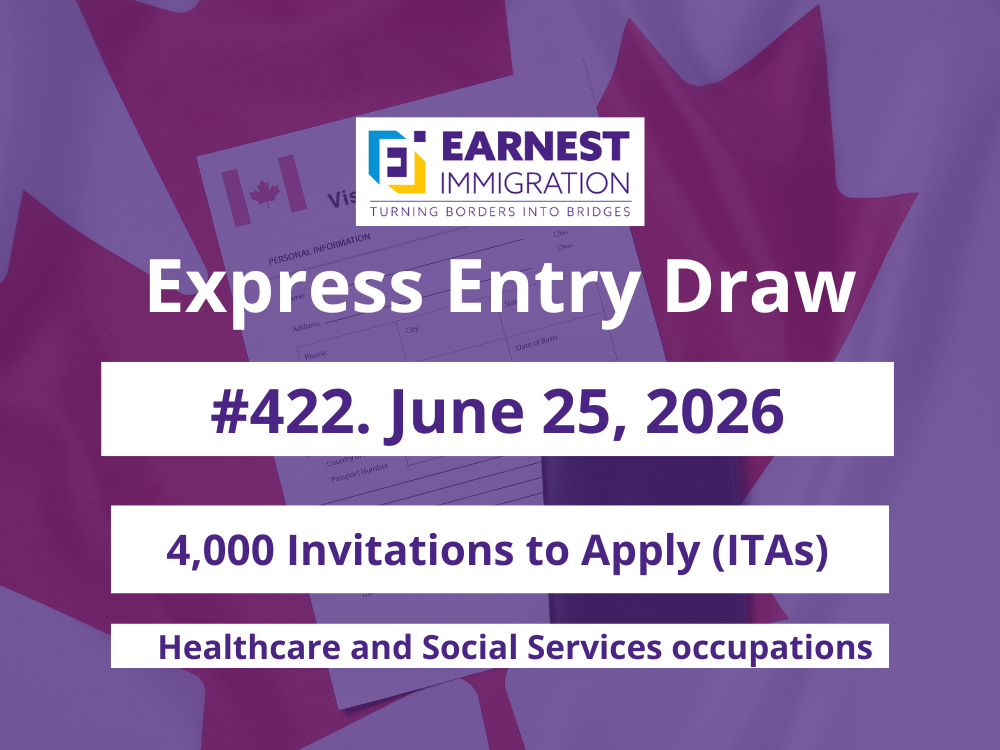
On June 25, 2026, Immigration, Refugees and Citizenship Canada (IRCC) held Express Entry Draw #422, issuing 4,000 Invitations to Apply (ITAs) to candidates in the Healthcare and Social Services Occupations category. The minimum Comprehensive Ranking System (CRS) score was 475.
This was the second healthcare draw of 2026 and the 15th ever in this category, and it capped off a remarkable run – four separate Express Entry draws in a single week. Below, the Earnest Immigration team breaks down the numbers, the trends behind them, and what your next move should be.
Table of Contents
ToggleExpress Entry Draw #422 at a Glance
| Draw number | #422 |
| Date | June 25, 2026 |
| Category | Healthcare and Social Services Occupations |
| Invitations issued (ITAs) | 4,000 |
| Minimum CRS score | 475 |
| Tie-breaking rule | May 21, 2026 at 12:14:09 UTC |
| Application deadline | 60 days from receiving the ITA |
If you had a CRS score of 475 or higher and submitted your Express Entry profile before 12:14:09 UTC on May 21, 2026, you were in the invited pool for this round.
A Four-Draw Week: How #422 Fits In
Draw #422 was the final round in an unusually busy stretch. Between June 22 and June 25, IRCC ran four back-to-back draws – including a physicians draw (#421) on June 24 and this healthcare draw the very next day. It was the third four-draw week of 2026 and, given that this was the only draw week in June, a welcome burst of activity for candidates sitting in the pool.
The pattern of running a separate physicians draw immediately before the broader healthcare draw is now established. In February, IRCC invited 391 in-Canada physicians on the 19th before the larger healthcare round on the 20th. June mirrored that exactly – 271 physicians on the 24th, then 4,000 healthcare and social services candidates on the 25th. The effect is that physicians are increasingly pulled out of the general healthcare pool and selected on their own track.
How #422 Compares to Recent Healthcare Draws
At 4,000 ITAs, Draw #422 ties for the largest healthcare round in the category’s history – matching the February 20, 2026 draw and the July 22, 2025 draw.
On the cut-off side:
• 475 is up just 8 points from the 467 set in the first 2026 healthcare draw on February 20.
• The last six healthcare draws have all landed in a tight 462–475 band, so this result is squarely in line with the recent trend.
• For historical context, the highest-ever healthcare cut-off was 510 (May 2025) and the lowest was 422 (February 2024).
The takeaway: cut-offs in this category have been remarkably stable, and 475 is a reliable benchmark to plan around.
Who Qualifies – and an Important Eligibility Change
The healthcare and social services category covers a wide spread of roles – including registered nurses, pharmacists, social workers, dental hygienists, and medical laboratory technologists, among many others.
One detail trips up a lot of candidates, so it’s worth stating plainly: your primary qualifying occupation for Express Entry does not have to be in healthcare. Whether you’re in the Federal Skilled Worker, Federal Skilled Trades, or Canadian Experience Class program, you simply need at least one year of healthcare or social services work experience within the required timeframe to be considered in this category.
That said, the bar moved this year. As of February 18, 2026, the minimum work experience requirement rose from six months to one year within the past three years. If your qualifying experience is now under a year, or has aged beyond the three-year window, you may no longer be eligible – and this is exactly the kind of detail worth confirming before you rely on it.
What This Means for You
If you received an ITA in Draw #422. Congratulations. You have 60 days to submit a complete application for permanent residence, including all supporting documents and fees. Healthcare applications often hinge on properly documented work experience and credential recognition, so getting everything airtight before you submit is critical.
If you didn’t receive an ITA. If your score is near 475, this draw gives you a clear benchmark to aim for. The most valuable thing you can do while waiting is keep your profile current and make sure you continue to meet the one-year experience requirement. If your score sits well below recent cut-offs, it’s time to look at score-boosting moves – or a different pathway entirely.
Below the Cut-Off? Your Options
• Provincial Nominee Programs (PNPs): A provincial nomination adds 600 CRS points to your score and all but guarantees an ITA. Many provinces run streams aligned with in-demand healthcare and social services roles.
• Improve your base CRS: Strengthen your language results (in English or French), add a second official language, complete additional education credentials, gain more qualifying work experience, or add a spouse/common-law partner to your profile.
• Reassess your category fit: If you’re a physician, you may be better served by the dedicated physicians draws, which run at far lower cut-offs.
Which route is fastest depends on your occupation, province, language ability, and timeline – and that’s where a tailored strategy beats a generic checklist.
What’s Next for Healthcare Draws
Predicting this category is genuinely difficult. Draws have been inconsistent since the category launched in June 2023 – three draws each in 2023 and 2024, then seven in 2025. In 2026, by contrast, this was only the second healthcare draw, more than four months after the February round. That gap suggests IRCC may be shifting toward fewer, but larger, draws.
What has held steady is the year-on-year growth in total volume: 5,600 ITAs in 2023, 10,250 in 2024, and 14,500 in 2025. There’s little reason to expect 2026 to break that upward trend.
A likely driver of the fewer-but-bigger approach: IRCC has named 10 categories for selection but has only run draws in five so far this year – healthcare and social services, physicians, senior managers, trades, and French-language proficiency. Spreading larger draws across the year may let IRCC work through more of those categories.
How Earnest Immigration Can Help
The healthcare and social services category is one of the most accessible routes to Canadian permanent residence right now – but the eligibility rules tightened in 2026, and a misread can cost you a round. At Earnest Immigration, we help healthcare and social services professionals:
• Confirm eligibility under the updated one-year experience rule and the correct NOC code
• Build and optimize an Express Entry profile that maximizes CRS
• Identify PNP streams aligned with your occupation and province
• Assemble a complete, deadline-proof PR application after an ITA
If you work in healthcare or social services and want to know where you stand after Draw #422, book a consultation with our team and let’s map your fastest route to permanent residence.
Frequently Asked Questions
What was the CRS cut-off for Express Entry Draw #422?
The minimum CRS score for Draw #422 on June 25, 2026 was 475.
How many ITAs were issued in Draw #422?
IRCC issued 4,000 Invitations to Apply to candidates in the Healthcare and Social Services Occupations category.
Who was eligible for the June 25, 2026 healthcare draw?
Candidates with at least one year of qualifying healthcare or social services experience, a CRS score of at least 475, who submitted their Express Entry profile before 12:14:09 UTC on May 21, 2026.
Does my main occupation have to be in healthcare to qualify?
No. Your primary Express Entry occupation can be in any field. You only need at least one year of healthcare or social services work experience within the required timeframe.
What changed about the experience requirement in 2026?
As of February 18, 2026, the minimum requirement increased from six months to one year of qualifying experience within the past three years.
How long do I have to apply after receiving an ITA?
You have 60 days from the date of your invitation to submit a complete permanent residence application.
What can I do if my CRS is below 475?
Options include pursuing a Provincial Nominee Program nomination (worth 600 CRS points) or raising your base CRS through language, education, additional work experience, or adding a spouse to your profile.