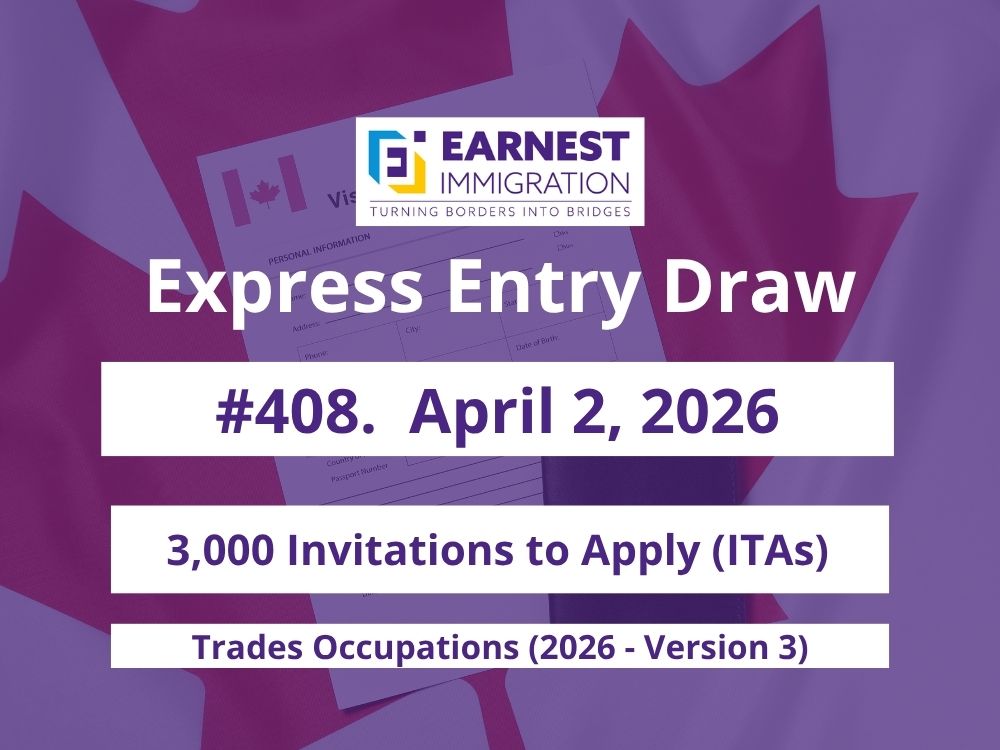
Express Entry Draw 408 issued 3,000 invitations to Trades Occupations candidates on April 2, 2026, at a CRS cut-off of 477 – the category’s largest round ever.
Originally published April 2026. Last updated July 2026 with current draw and pool data.
Immigration, Refugees and Citizenship Canada (IRCC) held Express Entry Draw 408 on April 2, 2026, issuing 3,000 Invitations to Apply (ITAs) to candidates under the Trades Occupations category (2026 – Version 3). The minimum CRS cut-off was 477 points, with a tie-breaking date of February 14, 2026, at 20:53:54 UTC.
Draw 408 was the first Trades Occupations draw of 2026 and the first in 196 days – the previous Trades round was Draw 368 on September 18, 2025, which issued 1,250 ITAs at CRS 505. At 3,000 ITAs, Draw 408 is the largest Trades draw in the category’s history by a wide margin. It was the twentieth Express Entry draw of 2026, bringing the year-to-date total at that point to 58,830 ITAs.
For electricians, plumbers, carpenters, welders, pipefitters, machinists and the other 19 eligible trade occupations worldwide, Draw 408 was a defining signal: Canada has a purpose-built, high-volume immigration pathway designed specifically for skilled tradespeople, clearing well below the Canadian Experience Class threshold. Tradespeople who had watched Q1 2026’s CEC and French draws from the sidelines finally got a dedicated round.
Table of Contents
ToggleKey Details of Express Entry Draw 408
| Field | Value |
| Draw Number | 408 |
| Date | April 2, 2026 |
| Category | Trades Occupations (2026 – Version 3) |
| Invitations Issued | 3,000 |
| CRS Cut-off Score | 477 |
| Tie-breaking Rule | February 14, 2026, at 20:53:54 UTC |
Context: First Trades Draw in 196 Days
Draw 408 arrived 196 days after the previous Trades draw. All 19 draws between September 2025 and March 2026 were CEC, French, PNP, healthcare, physicians or senior managers rounds – none targeted Trades. Trades workers in the pool had been waiting since Q3 2025 for a dedicated round.
- Draw 368 (September 18, 2025): 1,250 ITAs | CRS 505 | Trades Occupations Version 2
- Draw 408 (April 2, 2026): 3,000 ITAs | CRS 477 | Trades Occupations Version 3
The 1,750 additional ITAs represent a 140% increase in volume. The 28-point CRS reduction made Draw 408 the most accessible Trades round since October 2024. Both changes are connected to the same structural shift: the removal of Cooks and Chefs from the eligible list in Version 3, which reshaped the competitive sub-pool.
Where the Trades Category Stands Now
As at late July 2026, Draw 408 remains the only Trades round of the year. No Trades draw has been held in the 118 days since April 2, and the category has not appeared in any of the July draw clusters.
For context, over the same 2026 period IRCC has run the French-language category eight times (40,500 ITAs), healthcare twice (8,000 ITAs) and physicians twice (662 ITAs). Trades has run once.
The 2026 draw pattern to date:
- Total Express Entry draws in 2026 (to July 23): 42
- Total ITAs issued in 2026 (to July 23): 104,616
- Trades Occupations: 1 draw, 3,000 ITAs – roughly 2.9% of the year’s total
- Most recent rounds: PNP July 20 (511 ITAs at CRS 744), CEC July 21 (2,000 at 516), French July 22 (5,000 at 399), Skilled Military Recruits July 23 (4 ITAs at 368)
- Still no general all-program draw in 2026
Two practical implications for trades candidates:
- The gap between rounds is the binding constraint, not the cut-off. Trades has averaged one round roughly every six months across its history. Planning around a near-term Trades draw is not a strategy; building CRS and pursuing parallel routes is.
- The CEC gap has widened. In April, 477 sat 30–32 points below the CEC threshold of 507–509. CEC rounds have since settled at 516–518, so the same 477 would now sit roughly 40 points below. The relative advantage of the Trades category has grown, but only for candidates who are in the pool when a round is called.
Track current rounds on our Express Entry draw page, and see the most recent CEC round and PNP round for current thresholds.
Why Removing Cooks Changed the Cut-off
The most counterintuitive aspect of Draw 408 is that removing eligible occupations – Cooks and Chefs – from the category coincided with a lower CRS cut-off than the previous round. Understanding why requires looking at who was in the Trades pool before 2026.
Prior to Version 3, Cooks (NOC 63200) were one of the most numerous occupation groups in the Trades-eligible pool. Modelling of a hypothetical 2,000-ITA Trades draw from the January 2025 pool indicated that roughly 1,121 of those ITAs – nearly 56% – would have gone to cooks. Cooks in that pool carried a median CRS of approximately 419, against approximately 399 for other construction and industrial trades workers.
| Scenario | ITA Distribution | Median CRS | Implication |
| With cooks eligible (pre-2026 pool) | ~56% of 2,000 ITAs (approx. 1,121) to cooks | ~419 (cooks) / ~399 (other trades) | Cooks dominated the eligible pool |
| Without cooks (2026 Version 3) | All ITAs to construction and industrial trades | 477 | Smaller, more targeted pool |
By removing cooks and chefs, IRCC created a smaller but more homogeneous Trades-eligible sub-pool composed of construction and industrial trades workers who, on average, scored lower than cooks did. Filling 3,000 ITAs from that pool required reaching further down the ranked list than the September 2025 round did.
An Honest Caveat on the 477 Figure
The composition change explains the 28-point drop from September 2025. It does not make 477 a low number in absolute terms.
Four of the five Trades rounds held before 2026 cleared below 477 – at 388, 425, 433 and 436. Draw 408 is the second-highest Trades cut-off ever recorded, behind only Draw 368’s 505. The category has become more accessible relative to its most recent round, and much more accessible relative to CEC, but it has not returned to the thresholds of 2023 and 2024.
The reason is the pool itself. The Express Entry pool has stratified upward since 2024: the 501-600 band has grown substantially, and profile quality across the board has risen. A cut-off of 433 in October 2024 and 477 in April 2026 can both reflect a healthy Trades draw in the pool conditions of their day.
Butchers Replaced Cooks
IRCC made one addition alongside the removals: Butchers and Meat Cutters -Retail and Wholesale (NOC 63201), which moved from the retired Agriculture and Agri-Food category into Trades. For butchers, this preserved an immigration route when Agriculture was retired.
Trades Draw History: Draw 408 in Context
| Draw # | Date | CRS | ITAs | Version |
| 408 | Apr 2, 2026 | 477 | 3,000 | Version 3 |
| 368 | Sep 18, 2025 | 505 | 1,250 | Version 2 |
| 321 | Oct 23, 2024 | 433 | 1,800 | Version 1 |
| 300 | Jul 4, 2024 | 436 | 1,800 | Version 1 |
| 276 | Dec 19, 2023 | 425 | 1,000 | Version 1 |
| 261 | Aug 3, 2023 | 388 | 1,500 | Version 1 |
Six Trades rounds in three years, totalling 10,350 ITAs. Draw 408 alone accounts for 29% of every Trades invitation ever issued.
Read across the table and two things stand out. Volume has risen sharply – 3,000 ITAs is nearly double the previous best. Cut-offs have risen too, from 388 in the category’s first round to 477 in its most recent. The category is bigger and it is more competitive, at the same time.
Express Entry Pool Composition
Pool as at March 29, 2026 (the IRCC update closest to Draw 408):
| CRS Score Range | Number of Candidates |
| 601-1200 | 351 |
| 501-600 | 12,506 |
| 451-500 | 73,445 |
| 401-450 | 64,104 |
| 351-400 | 52,736 |
| 301-350 | 18,855 |
| 0-300 | 8,189 |
| Total | 230,186 |
Pool as at July 19, 2026:
| CRS Score Range | Number of Candidates |
| 601-1200 | 511 |
| 501-600 | 18,133 |
| 451-500 | 72,579 |
| 401-450 | 63,877 |
| 351-400 | 51,107 |
| 301-350 | 17,490 |
| 0-300 | 7,836 |
| Total | 231,533 |
At CRS 477, Draw 408 reached into the middle of the 451-500 band – the largest band in the pool, then and now.
The comparison between the two snapshots is the useful part. The total pool has barely moved, but the 501-600 band has grown by more than 5,600 profiles and the 601-1200 band has grown by 46%, while every band below 450 has shrunk. Candidates are not leaving the pool; they are climbing within it.
For a trades candidate sitting at 460 or 470, that is the number that matters. The distance to a 477-style threshold is not fixed – the pool is moving upward underneath you.
Understanding the Trades Occupations Category
What Is the Trades Occupations Category?
The Trades Occupations category is one of ten active category-based selection streams in Express Entry for 2026. Unlike CEC (which requires Canadian work experience) or French draws (which require NCLC 7 across all four abilities), the Trades category targets candidates on occupation – specifically, experience in the skilled construction and industrial trades Canada needs for housing, infrastructure and energy.
Canada’s shortage of skilled trades workers is structural. An aging trades workforce, declining apprenticeship enrolment and sustained construction demand have created persistent vacancies across residential and commercial building, pipeline infrastructure, industrial manufacturing and public works. Domestic training cannot close the gap quickly enough.
The 25 Eligible NOC Codes for the Trades Category (2026 Version 3)
To qualify for the Trades Occupations category, candidates need at least 12 months of full-time (or equivalent part-time) work experience within the last three years in one of the following occupations. The experience may have been gained in Canada or abroad.
| NOC Code | Occupation Title |
| 72100 | Machinists and machining and tooling inspectors |
| 72101 | Tool and die makers |
| 72102 | Sheet metal workers |
| 72103 | Boilermakers |
| 72104 | Structural metal and platework fabricators and fitters |
| 72105 | Ironworkers |
| 72106 | Welders and related machine operators |
| 72200 | Electricians (except industrial and power system) |
| 72201 | Industrial electricians |
| 72203 | Power system electricians |
| 72300 | Plumbers |
| 72301 | Steamfitters, pipefitters and sprinkler system installers |
| 72302 | Gas fitters |
| 72310 | Carpenters |
| 72311 | Cabinetmakers |
| 72320 | Bricklayers |
| 72400 | Industrial instrument technicians and mechanics |
| 72401 | Heavy-duty equipment mechanics |
| 72402 | Heating, refrigeration and air conditioning mechanics |
| 72403 | Elevator constructors and mechanics |
| 72422 | Electrical mechanics |
| 82021 | Supervisors, oil and gas drilling and service |
| 83112 | Water well drillers |
| 92100 | Power engineers and power systems operators |
| 63201 | Butchers and meat cutters – retail and wholesale (added Feb 2026) |
Confirm your NOC against the current round instructions. IRCC publishes the authoritative occupation list in the Ministerial Instructions for each individual round, and the list can be revised between rounds – as Version 3 demonstrated.
Your Job Title Does Not Decide Your NOC Code
Your job title does not need to match the NOC occupation title exactly. What matters is that your actual duties align with the lead statement and main duties in the NOC description. IRCC’s standard is that you performed the actions in the lead statement and carried out a substantial number of the main duties listed – not necessarily every one. An apprentice electrician performing the same core duties as a journeyperson falls under the same NOC code.
This is where most trades eligibility problems originate, and it is a documentation problem more than a qualification problem. Your reference letters must describe duties in language that maps to the NOC, not to your employer’s internal job titles.
2026 Changes to the Trades Category
The February 18, 2026 ministerial announcement introduced these changes for Version 3:
- Cooks (NOC 63200) removed. Cooks were among the most numerous occupation groups in the Trades pool, consistently capturing more than half of all Trades ITAs. Their removal refocuses the category on construction and industrial trades.
- Chefs (NOC 62200) removed. Food service management no longer qualifies under Trades.
- Butchers and Meat Cutters – Retail and Wholesale (NOC 63201) added. Moved from the retired Agriculture and Agri-Food category.
- Minimum work experience raised from 6 months to 12 months. Effective February 18, 2026, candidates need 12 months of qualifying Trades experience within the last three years. This applies to all renewed categories in 2026, not just Trades.
Eligibility: Two Separate Requirements to Meet
Qualifying for the Trades category requires meeting two independent sets of criteria.
Requirement 1 – Express Entry Program Eligibility
Hold an active profile under FSWP, CEC or FSTP. The work experience used to qualify for the program does not need to be in trades.
Requirement 2 – Trades Category Eligibility
- At least 12 months of full-time (or equivalent) paid work experience in one of the 25 eligible Trades NOC codes within the last three years
- Work experience may be gained anywhere in the world – Canadian experience is not required. This distinguishes Trades from CEC, Physicians, Senior Managers and Researchers, which all require Canadian experience
- The experience must have been performed in a country where you were qualified to practise the trade
- Job duties must align with the NOC lead statement and main duties
- Your profile must have been created before the tie-breaking date and time specified in the round instructions
The global eligibility for Trades experience is the category’s most significant advantage. An electrician with 14 months in the UAE, a welder with two years in Germany, or a plumber with 18 months in India can all qualify – provided they also meet the requirements of at least one Express Entry program.
A Job Offer No Longer Adds CRS Points
Worth stating plainly, because trades candidates are frequently told otherwise: IRCC removed arranged employment points from the CRS on March 25, 2025. This applied to both LMIA-backed job offers and LMIA-exempt closed work permits, and the points have not been reinstated.
A job offer still matters for FSTP eligibility and for some provincial nominee streams. It no longer adds a single CRS point. If you are considering paying for an LMIA to raise your score, that arithmetic no longer works. Our work permits and LMIA page covers where a job offer does and does not help.
The Federal Skilled Trades Program (FSTP)
The FSTP is designed specifically for skilled trades workers and is often the most appropriate Express Entry program for Trades category candidates:
- Work experience: At least 2 years of full-time skilled trades experience within the 5 years before applying, in an FSTP-eligible occupation (NOC Major Groups 72, 73, 82, 83, 92 or 93, excluding Sub-Major Group 726 and 932)
- Language: Minimum CLB 5 in speaking and listening, CLB 4 in reading and writing – lower than FSWP requirements
- Job offer OR certification: Either a valid job offer of at least one year from a Canadian employer in a qualifying trade, or a certificate of qualification in the trade issued by a Canadian province or territory (including Red Seal certification)
- No education requirement: Unlike FSWP, the FSTP requires no minimum level of education and no ECA for foreign credentials
The FSTP’s lower language thresholds make it accessible to trades workers whose proficiency reflects practical workplace fluency rather than academic test performance. Candidates who qualify under FSTP can combine this with Trades category eligibility to access rounds like Draw 408 regardless of whether their CRS reaches the CEC threshold.
After Receiving a Trades ITA: Key Documents
Candidates who receive a Trades ITA have 60 days to submit a complete permanent residence application. Critical documents:
- Proof of qualifying Trades work experience: Reference letters on company letterhead for each qualifying employer, confirming job title, NOC code, hours per week, salary, dates of employment, and main duties aligned with the NOC description
- Trade certification (if applying under FSTP): Provincial or territorial certificate of qualification (Red Seal or equivalent), or proof of a valid Canadian job offer of at least one year
- Language test results: Valid IELTS General Training, CELPIP-General (English), or TEF Canada / TCF Canada (French), within two-year validity
- ECA: If claiming foreign education under FSWP
- Police clearance certificates: From Canada and all countries of residence for six months or more since age 18
- Medical examination: From an IRCC-designated physician
- Proof of settlement funds: Required for FSWP and FSTP applicants, unless you are currently authorised to work in Canada and hold a valid job offer. Not required under CEC
- Valid passport
For tradespeople with overseas experience, reference letters from foreign employers may need certified translation into English or French. Allow extra time — the 60-day window is firm and does not extend for document delays.
Frequently Asked Questions
I am a cook with 3 years of experience. Am I still eligible for Express Entry?
Not through the Trades category after February 18, 2026 – Cooks (NOC 63200) were removed in Version 3. Cooks are not excluded from Express Entry altogether. If you have Canadian work experience in a qualifying NOC TEER 0-3 occupation, CEC remains available. If your overseas experience meets FSWP requirements (67-point minimum under the six-factor grid), FSWP is another option. Several provincial nominee programs have streams that include food service occupations, though a number of provinces have tightened these in 2026. The removal is category-specific, not program-specific.
Has there been another Trades draw since Draw 408?
No. As at late July 2026, Draw 408 remains the only Trades round of the year – a gap of 118 days and counting. Across the category’s history, Trades rounds have averaged roughly one every six months, with the longest gap being the 196 days between September 2025 and April 2026. IRCC does not announce category draws in advance.
My CRS is 460. How realistic is it that a future Trades draw will reach me?
Draw 408 cleared at 477, placing 460 seventeen points short. Whether a future round reaches 460 depends on volume and pool composition. Trades cut-offs have historically ranged from 388 to 505, so 460 is well within the plausible range – four of the six rounds held to date cleared below it. The complication is that the pool has stratified upward since those lower rounds. The most effective actions while waiting are retaking your language test, verifying your NOC code is correct, and pursuing a provincial nomination, which adds 600 CRS points. See our guide on boosting your Express Entry profile.
What is a Red Seal and how does it affect my Express Entry application?
The Red Seal Program (Interprovincial Standards Program) is Canada’s national certification standard for skilled trades. A Red Seal certificate is issued by a provincial or territorial authority and confirms you have met the national standard for your trade. For FSTP eligibility, a Red Seal certificate counts as a certificate of qualification – one of the two alternatives alongside a Canadian job offer. Red Seal certified tradespeople can therefore qualify for FSTP without a job offer. Red Seal certification does not directly add CRS points, but it strengthens your documentation and may improve your standing in provinces with trades nomination streams.
Can apprenticeship experience count toward the Trades category requirement?
Yes. Paid apprenticeship work experience qualifies, provided you were paid wages and performed the duties listed in the relevant NOC code. Unpaid training periods and classroom instruction do not count, but paid apprenticeship work – the standard in Canadian and most international apprenticeship systems – does. A four-year apprenticeship graduate now working as a journeyperson has comfortably more than the required 12 months.
I am a carpenter in Canada on a work permit. Should I apply under CEC or wait for a Trades draw?
Both may be available, and the answer depends on your CRS. CEC rounds have been clearing at 516–518 through mid-2026. If you are above that, a CEC ITA may arrive before the next Trades round – particularly given that Trades has run only once this year. If you are between 477 and 515, the Trades category is your realistic federal route, but you need to be in the pool and correctly coded when a round is called. Below 477, improving language scores or pursuing a provincial nomination are the faster parallel strategies. In all cases, ensure your profile accurately reflects both your CEC-eligible Canadian experience and your Trades-eligible occupation under the correct NOC. A well-maintained profile participates in both draw types simultaneously.
Does Draw 408’s CRS of 477 mean trades draws are getting harder?
Relative to the previous round, no – 477 was 28 points below Draw 368’s 505. Relative to the category’s history, yes: four of the five earlier Trades rounds cleared lower, at 388, 425, 433 and 436. The upward drift tracks the Express Entry pool as a whole, which has been stratifying toward higher scores since 2024. Cut-offs are set by pool depth and invitation volume in each round, not by a target IRCC announces in advance.
The Bottom Line
Express Entry Draw 408 issued 3,000 ITAs to Trades Occupations candidates at CRS 477 on April 2, 2026 – the first Trades draw of the year and the largest in the category’s history by volume. The removal of Cooks and Chefs from the eligible list in Version 3 reshaped the competitive pool, producing a round that went directly and exclusively to the construction and industrial trades workers Canada’s housing and infrastructure agenda most urgently needs.
The honest reading four months on is more measured than it looked in April. Draw 408 has not been followed by a second Trades round, and 477 sits at the higher end of the category’s historical range rather than the lower end. The Trades category remains a genuine advantage – roughly 40 points below the current CEC threshold, with overseas experience fully accepted and no job offer required – but it is an infrequent one. Candidates who treat it as their only route are exposed to a draw calendar they cannot predict.
The variables you control are your NOC accuracy, your language scores, your FSTP or FSWP program eligibility, and whether you have a parallel provincial route in motion. Candidates below the recent threshold should also review alternatives for lower CRS scores and provincial nominee options for skilled workers, where a nomination adds 600 CRS points.
At Earnest Immigration, our RCIC-licensed consultants help trades candidates verify NOC code eligibility, assess Express Entry program qualification under FSWP, CEC or FSTP, navigate overseas employer reference letter requirements, and prepare complete permanent residence applications within the 60-day ITA window. Contact us for a comprehensive profile assessment.