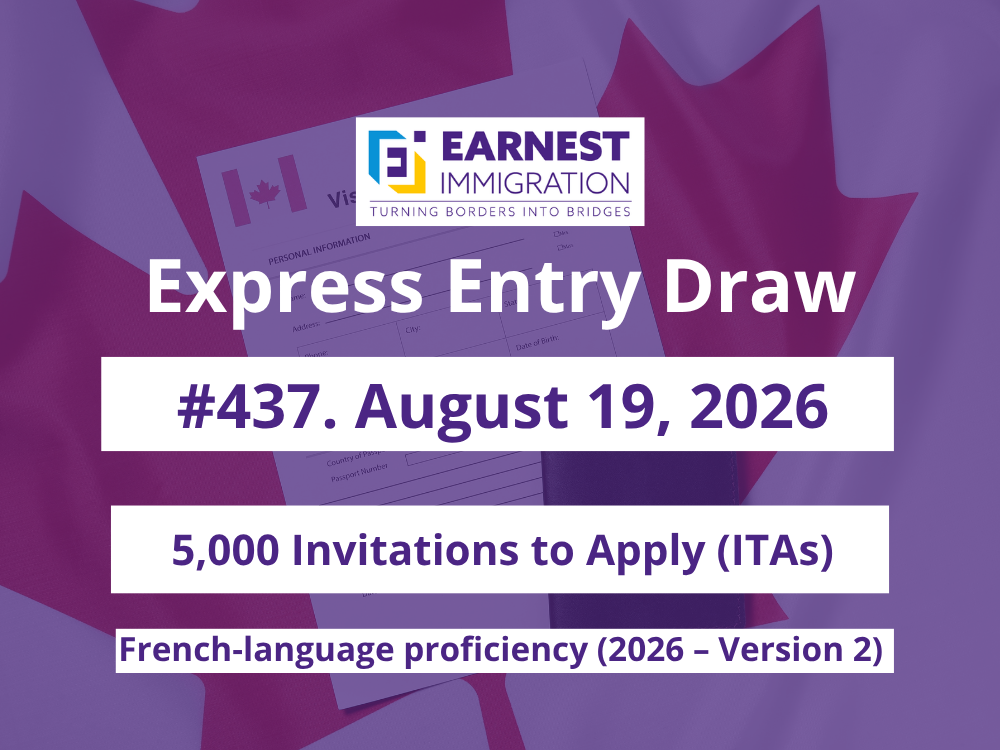
On August 19, 2026, Immigration, Refugees and Citizenship Canada (IRCC) held Express Entry Draw #437, issuing 5,000 Invitations to Apply (ITAs) to candidates in the French-language proficiency category. The minimum Comprehensive Ranking System (CRS) score was 382.
This draw marks a turning point in how Express Entry works in 2026. With these 5,000 invitations, French-language proficiency has issued 50,500 ITAs this year – passing the Canadian Experience Class, at 49,250, to become the single largest Express Entry category of 2026. The most reliable high-volume route into Canadian permanent residence this year is no longer the traditional CEC. It is French. Below, the Earnest Immigration team explains what changed, and what it means for you.
Table of Contents
ToggleExpress Entry Draw #437 at a Glance
| Detail | Information |
| Draw number | #437 |
| Date | August 19, 2026 |
| Category | French-language proficiency (2026 – Version 2) |
| Invitations issued | 5,000 |
| CRS cut-off score | 382 |
| Tie-breaking rule | March 1, 2026 at 18:34:05 UTC |
| Draw position in 2026 | 49th Express Entry round; 10th French-language round |
| Previous French draw | Draw #433 – August 6, 2026 – 5,000 ITAs at CRS 391 |
| Milestone | French becomes the largest 2026 category (50,500 ITAs, ahead of CEC’s 49,250) |
| Application deadline | 60 days from the date of the invitation |
The Crossover: What French Overtaking CEC Actually Means
For most of Express Entry’s history, the Canadian Experience Class has been the workhorse – the category that issued the most invitations and defined what a “typical” successful candidate looked like: someone already in Canada, with Canadian work experience and a CRS score in the low-to-mid 500s.
As of this draw, that is no longer the largest route. French-language proficiency has issued 42% of all 2026 Express Entry invitations, against CEC’s 41%. Every other pathway combined – the Provincial Nominee Program and the eight other active categories together – accounts for just 17%.
The significance is not the one-point margin. It is what the margin represents. IRCC has spent 2026 running large, frequent French rounds while holding CEC roughly flat, and the cumulative effect has now tipped French into first place. This is a deliberate, sustained policy priority reaching its logical result: Canada is selecting more permanent residents on the basis of French-language ability than on the basis of Canadian work experience.
382 Is the Lowest of the Year – and the Trend Is Clean
The cut-off of 382 is the lowest French-language threshold of 2026, continuing a decline that is now unmistakable across the last four French rounds.
| French draw | Date | ITAs | CRS |
| #425 | July 9, 2026 | 5,000 | 420 |
| #429 | July 22, 2026 | 5,000 | 399 |
| #433 | August 6, 2026 | 5,000 | 391 |
| #437 | August 19, 2026 | 5,000 | 382 |
Four consecutive rounds of exactly 5,000 ITAs, and a cut-off that has fallen 38 points – from 420 to 382 – in six weeks. This is the clearest, most sustained downward trend in any category this year, and unlike the erratic tie-break movements we tracked on earlier French rounds, this one is simple: consistent high volume steadily drawing the cut-off down through a deep French-eligible pool.
The mechanism is the same one we explained on Draw #433, now compounded over four rounds. Each 5,000-seat draw reaches a little further down the ranked list than the pool refills at the top between rounds, so the cut-off steps down each time. As Moving2Canada notes, if IRCC continues French draws at this biweekly pace and size, further declines are plausible.
The Tie-Break: Reaching Back to March
This round’s tie-breaking timestamp was March 1, 2026. That is worth reading alongside the cut-off.
At a cut-off of 382, candidates who scored exactly 382 were invited only if their profile was submitted before 18:34:05 UTC on March 1, 2026. In other words, at the very bottom of this draw, IRCC is now reaching profiles that have been sitting in the pool since the start of March. Candidates comfortably above 382 with qualifying French were invited regardless of their submission date.
For a candidate sitting at exactly the cut-off, this is the practical read: a March 2026 profile date at 382 got you in; a later profile date at the same score did not. As the cut-off keeps falling, the score matters more than the date for anyone even slightly above the line – which is the position you want to be in.
Will French Draws Continue at This Pace?
There is a fair question lurking here. IRCC has now issued 50,500 French ITAs in 2026, against a 2026 Immigration Levels Plan target of 30,267 French-speaking permanent resident admissions outside Quebec. On the surface, that looks like the department has already overshot its target – which might suggest French draws should stop.
That reading confuses two different things, and getting the distinction right matters for planning. An ITA is an invitation to apply. An admission is a landed permanent resident. They are not the same number, and they do not occur in the same year. Because permanent residence applications take months to process, a large share of the candidates invited in the second half of 2026 will not actually land as permanent residents until 2027. The 50,500 ITAs issued this year feed admissions across both 2026 and 2027 – they are not all counted against the 2026 target.
So the gap between “50,500 ITAs issued” and “30,267 admissions targeted” is not oversupply. It is the normal lag between invitation and landing, plus the fact that not every ITA becomes a PR. And Canada’s Francophone commitment does not stop at year-end: the 2027 target rises to 31,825 French-speaking admissions outside Quebec, with commitments running through 2029. French draws are very likely to continue as a core feature of Express Entry – though individual rounds could get smaller as IRCC paces itself toward next year’s target with a full year to work with.
Who Qualifies for a French-Language Draw
Eligibility rests on your French ability, not your occupation. To be considered you need:
- French-language results from TEF Canada or TCF Canada showing NCLC 7 or higher in all four abilities – reading, writing, listening, and speaking
- Eligibility for one of the three core Express Entry programs: the Federal Skilled Worker Program, the Canadian Experience Class, or the Federal Skilled Trades Program
- An active Express Entry profile in the pool
- A CRS score at or above the cut-off on the day of the draw
French does not need to be your first language – it only has to be tested at NCLC 7 or above. And because the Federal Skilled Worker Program is a qualifying route, you do not need Canadian work experience. That combination is exactly why this category has now become the largest in the system: it is reachable by candidates who have no other competitive path.
If You Received an ITA in Draw #437
You have 60 days from the date of your invitation to submit a complete permanent residence application. One item on this list is specific to French draws and is the most common avoidable failure in this category.
- Accept the invitation in your IRCC secure account and record your exact 60-day deadline.
- Check your French test expiry date now. TEF Canada and TCF Canada results are valid for two years and must still be valid on the day you submit – not merely on the date you were invited. If your results expire inside your 60-day window, arrange an expedited retest immediately. This is the single most common reason French-draw applications fail.
- Verify that the test report number in your Express Entry profile matches the results you are submitting, exactly. Discrepancies between profile and certificate are a recurring cause of refusals in language-based rounds.
- Confirm any English test results you claimed points for are also still valid and consistent with your profile.
- Request police certificates from every country where you have lived six months or more since age 18. Start the same day; some jurisdictions take six to eight weeks.
- Book your medical exam with an IRCC-approved panel physician.
- Assemble work-experience reference letters on company letterhead stating job title, NOC code, duties, hours per week, salary, and employment dates for all qualifying experience.
- Obtain an Educational Credential Assessment if you are claiming foreign education points under the Federal Skilled Worker Program, and prepare proof of settlement funds if applying under FSWP without a Canadian job offer.
- Arrange certified translations for any document not in English or French.
- Budget the fees. As of April 30, 2026, an economic-class principal applicant pays $990 in processing fees plus a $600 Right of Permanent Residence Fee – $1,590 in total. Biometrics and accompanying family members are additional.
If You Were Not Invited
Your next move depends on where you sit relative to 382 – and, increasingly, on whether you can reach this category at all, given it is now the largest route in the system.
At exactly 382 with a post-March 2026 profile:
You met the cut-off but were not reached, because of the March 1, 2026 tie-break date. You are closer than your score suggests – a single additional CRS point lifts you out of the tie-break entirely. And with the cut-off falling round over round, the next French draw may well clear at or below your score regardless. This is among the strongest positions in the pool right now.
Below 382 with qualifying French:
A French retest is usually the fastest lever, since a gain in a single ability can move your score, and the cut-off is trending toward you. Beyond that, the standard CRS levers apply. Given the sustained decline, a modest improvement now may be enough to clear an upcoming round.
Not yet French-eligible:
This is now the most consequential group. With French the largest category in the system and clearing more than 130 points below the concurrent CEC cut-off, the case for investing in French is stronger than at any point this year. Reaching NCLC 7 across all four abilities is worth up to 50 CRS points on its own, and separately it unlocks the highest-volume category in Express Entry. It takes most learners a year or more of serious study – start with a diagnostic assessment and structured instruction, and book test slots early, as they fill weeks ahead.
If French is not realistic:
A provincial nomination adds 600 CRS points and effectively guarantees an invitation in a subsequent PNP round – and several provinces have just gained additional nomination allocations for 2026. If your occupation falls within an active category, that is worth assessing. And for French speakers wanting to build Canadian experience while their score improves, the Francophone Mobility work permit is a practical parallel track.
How Earnest Immigration Can Help
With French now the largest Express Entry category, getting your French-language documentation and profile timing right is more valuable than ever. The test-validity trap in particular catches candidates who did everything else correctly.
As a CICC-regulated, RCIC-licensed firm, Earnest Immigration supports French-speaking candidates with:
- Confirming category eligibility and the NCLC levels your test results translate to
- Building and optimising an Express Entry profile that maximises your CRS, including the bilingualism bonus
- Timing your profile updates and test results to line up with the biweekly French rounds
- Checking test validity against your submission window before it becomes a problem
- Preparing a complete, deadline-proof permanent residence application after an ITA
If you speak French – or are considering learning it as an immigration strategy – and want to know where you stand after Draw #437, book a consultation with our team.
Frequently Asked Questions
What was the CRS cut-off for Express Entry Draw #437?
The minimum CRS score for Draw #437 on August 19, 2026 was 382 – the lowest French-language cut-off of 2026, continuing a decline from 420 in early July.
Is French now the largest Express Entry category in 2026?
Yes. With this draw, French-language proficiency has issued 50,500 ITAs in 2026 – 42% of all Express Entry invitations – passing the Canadian Experience Class at 49,250 (41%) to become the single largest category of the year.
How many invitations were issued in Draw #437?
IRCC issued 5,000 Invitations to Apply – the fourth consecutive French round to issue exactly 5,000, bringing the July–August French total to 20,000.
I have a CRS of exactly 382. Why was I not invited?
The tie-breaking rule. IRCC invited candidates at exactly 382 only if their Express Entry profile was submitted before 18:34:05 UTC on March 1, 2026. Candidates at 382 who joined the pool after that date were not reached in this round.
Why does French have such a low cut-off compared to CEC?
French-language proficiency is a category-based stream selecting for a policy priority – growing Francophone communities outside Quebec. It draws from its own sub-pool at a threshold far below CEC rounds. As of this draw, the French cut-off (382) sits more than 130 points below the concurrent CEC cut-off (523).
Do I need Canadian work experience for a French draw?
No. Because the Federal Skilled Worker Program is a qualifying route, candidates whose entire qualifying experience was gained outside Canada can be invited in a French-language round. This is a major reason the category has become the largest in the system.
Will French draws slow down now that IRCC has passed its admissions target?
The 50,500 ITAs issued are invitations, not landings – many will become permanent residents in 2027, not 2026, so they are not all counted against the 2026 admissions target. Canada’s Francophone commitment runs through 2029, with the 2027 target rising to 31,825. French draws are expected to continue, though individual rounds could get smaller.
How can I qualify for a future French draw?
Take the TEF Canada or TCF Canada, aim for NCLC 7 or higher in all four abilities, then update your Express Entry profile immediately once results arrive so your CRS is recalculated.
How long do I have to apply after receiving an ITA?
You have 60 days from the date of your invitation. Confirm your French test results will still be valid on your submission date, not just on the invitation date.
How many Express Entry ITAs has Canada issued in 2026?
As of this draw, 119,865 across 49 rounds – already the most in any year in Express Entry history, with more than four months of 2026 still remaining.