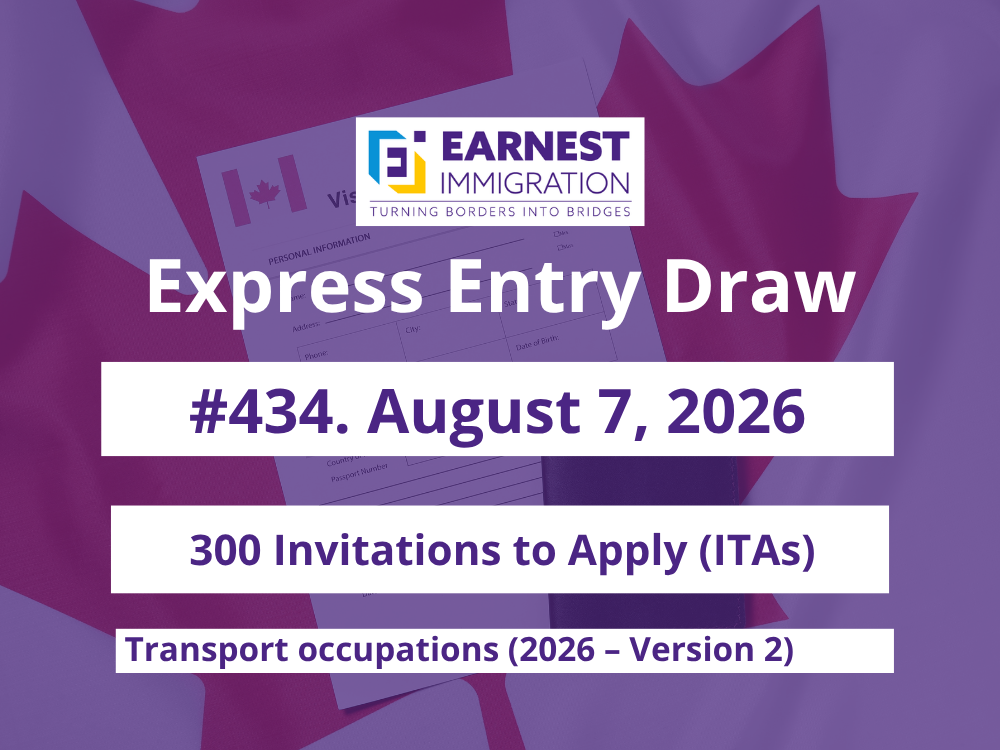
On August 7, 2026, Immigration, Refugees and Citizenship Canada (IRCC) held Express Entry Draw #434, issuing 300 Invitations to Apply (ITAs) to candidates in the Transport occupations category. The minimum Comprehensive Ranking System (CRS) score was 470.
This was the first Transport draw in more than two years, and only the fourth ever. The headline number – a cut-off of 470, the highest this category has ever required – is not the important part. The important part is that the Transport category IRCC just drew from is not the one that existed in 2023 and 2024. It was scrapped, rebuilt, and narrowed, and if you qualified under the old version, you may not qualify now. Below, the Earnest Immigration team explains what actually changed.
Table of Contents
ToggleExpress Entry Draw #434 at a Glance
| Detail | Information |
| Draw number | #434 |
| Date | August 7, 2026 |
| Category | Transport occupations (2026 – Version 2) |
| Invitations issued | 300 |
| CRS cut-off score | 470 |
| Tie-breaking rule | October 11, 2025 at 14:55:49 UTC |
| Draw position in 2026 | 46th Express Entry round; 1st Transport round of 2026 |
| Significance | First Transport draw in over two years; highest Transport cut-off ever |
| Application deadline | 60 days from the date of the invitation |
The Eligibility Reset: Truck Drivers Are No Longer Eligible
The Transport category has a more complicated history than any other Express Entry category, and understanding it is the difference between a valid application and a costly mistake.
It was one of the original occupation-based categories launched in 2023. IRCC drew from it three times – twice in 2023, once in March 2024 – then removed it entirely for 2025. On February 18, 2026, it came back. But the version that came back is a different category wearing the same name.
The old Transport category covered a broad range of transportation roles: transport truck drivers, managers in transportation, railway workers, air traffic controllers, water transport officers, and more. The 2026 version covers just four occupations – and truck drivers, the single largest group under the old category, are not among them.
Which Occupations Qualify Under the 2026 Transport Category
Exactly four occupations are eligible under the rebuilt category, all of them TEER 2 technical or aviation roles:
| NOC code | Occupation |
| 72404 | Aircraft mechanics and aircraft inspectors |
| 72600 | Air pilots, flight engineers and flying instructors |
| 22313 | Aircraft instrument, electrical and avionics mechanics, technicians and inspectors |
| 72410 | Automotive service technicians, truck and bus mechanics, and mechanical repairers |
The pattern is clear: the rebuilt category targets people who maintain, repair, and fly aircraft, plus vehicle and truck mechanics. It is an aviation-and-mechanics category, not a drivers-and-operators category. Note that NOC 72410 covers the mechanics who repair trucks and buses – but not the people who drive them.
Who Is Eligible for a Transport Occupations Draw
Being employed in one of the four occupations is necessary but not sufficient. To be considered in a Transport round, a candidate must also:
- Be eligible for at least one of the three core Express Entry programs – the Canadian Experience Class, the Federal Skilled Worker Program, or the Federal Skilled Trades Program
- Have at least 12 months of experience within the last three years in one of the four eligible Transport occupations
- Hold an active Express Entry profile
- Meet the CRS cut-off and tie-breaking rule for the specific round
The 12-month experience requirement is worth emphasising, because it is a change. IRCC raised the experience threshold for its renewed 2026 categories from six months to a full year. If your plan was built around the old six-month rule, it is out of date – you now need twice as much qualifying experience.
Why the Cut-Off Was So High – and Why It Tells You Little
At 470, this is comfortably the highest cut-off any Transport draw has ever produced. The three previous rounds cleared at 430 or 435.
The jump is not a sign that Transport candidates suddenly became more competitive. It is a function of draw size meeting a narrow pool. IRCC issued only 300 invitations – the smallest Transport round ever – into a category whose eligible population was just shrunk by the occupation-list rewrite. A small number of invitations reaching into a small, redefined pool stops higher up the ranked list than the large 2023–24 rounds did. That lifts the cut-off.
This is the same lesson the Skilled Military Recruits and Physicians rounds taught earlier in 2026: in a narrow category, the published cut-off is a artefact of how many invitations were issued against how many people qualified, not a stable competitive bar. A future Transport round of a different size, into a pool of different composition, could clear well above or below 470. Do not treat 470 as a target to plan around.
Where This Fits in the 2026 Category Landscape
Draw #434 is part of a deliberate IRCC pattern in 2026: smaller, more frequent draws spread across a wider range of categories, rather than a few very large rounds concentrated in one or two.
IRCC lists ten active categories for 2026. With this draw, Transport joins the group that has actually been used. The updated picture:
| Category | Drawn in 2026? | Notes |
| French-language proficiency | Yes | Largest category – 45,500 ITAs across 9 rounds |
| Canadian Experience Class | Yes | Program-specific – ~48,250 ITAs |
| Healthcare & social services | Yes | Two rounds |
| Trades occupations | Yes | One round |
| Senior managers | Yes | Two small rounds |
| Physicians | Yes | Two small rounds |
| Skilled military recruits | Yes | One round – 4 ITAs, smallest ever |
| Transport occupations | Yes – NEW (Aug 7) | First 2026 round; rebuilt occupation list |
| Education occupations | No | Renewed for 2026, not yet drawn |
| STEM occupations | No | Dormant more than two years |
| Researchers | No | New for 2026, not yet drawn |
Transport was the fourth of the “never drawn in 2026” categories to activate. Three still remain dormant – Education, STEM, and Researchers – which means more first-of-2026 rounds in more categories are still plausible before year-end. If your occupation sits in one of those three, a dedicated round is possible but entirely unscheduled, and should not be the whole of your plan.
If You Received an ITA in Draw #434
You have 60 days from the date of your invitation to submit a complete permanent residence application. The documentation priority for this category is proving your Transport occupation precisely.
- Accept the invitation in your IRCC secure account and record your exact 60-day deadline.
- Confirm your NOC is one of the four eligible codes (22313, 72404, 72410, 72600) and that your actual duties match it. This is the highest-risk item in a Transport application – the category eligibility rests on it.
- Assemble work-experience evidence for at least 12 months in the last three years: reference letters on company letterhead stating the NOC-relevant duties, hours, dates, and salary, plus pay records.
- Gather any professional licences or technical certifications relevant to your role – for pilots, flight engineers, and aircraft mechanics in particular, these substantiate the occupation.
- Request police certificates from every country where you have lived six months or more since age 18. Start the same day; some jurisdictions take six to eight weeks.
- Book your medical exam with an IRCC-approved panel physician.
- Arrange certified translations for any document not in English or French.
- Budget the fees. As of April 30, 2026, an economic-class principal applicant pays $990 in processing fees plus a $600 Right of Permanent Residence Fee – $1,590 in total. Biometrics and accompanying family members are additional.
If You Were Not Invited – or No Longer Qualify
There are two distinct situations here, and they call for different responses.
You are in an eligible occupation, below 470:
This category is realistically within reach. With only four eligible NOCs and a narrow pool, a modest CRS improvement can move you into range for a future round. A language retest is usually the fastest lever, and confirming every year of experience and every credential is correctly entered often recovers overlooked points. Keep your profile active and your experience documented against the correct NOC.
You qualified under the old Transport category but not the new one:
This is the harder case, and honesty serves you better than false hope. If your occupation – truck driver, transport manager, railway worker, and others – was dropped from the 2026 list, no amount of CRS improvement makes you eligible for a Transport round. Your realistic routes are elsewhere: the Canadian Experience Class if you have Canadian work experience and a competitive score, a provincial nomination for the 600-point boost, or the French-language category if you can reach NCLC 7. Build around one of those rather than waiting for a Transport round you can no longer qualify for.
How Earnest Immigration Can Help
The Transport category is a case where getting the NOC right is the entire game. Category eligibility depends on it, and a misclaimed code carries real consequences.
As a CICC-regulated, RCIC-licensed firm, Earnest Immigration helps candidates:
- Confirm whether your occupation falls within the current 2026 Transport list – and, if it does not, identify which pathway actually fits
- Verify the correct NOC and TEER classification for your work history before you claim it
- Document 12 months of qualifying experience to IRCC’s evidentiary standard
- Build and optimise an Express Entry profile that claims every legitimate point
- Prepare a complete, deadline-proof permanent residence application after an ITA
If you work in a transport occupation and are unsure whether the 2026 category applies to you, book a consultation with our team.
Frequently Asked Questions
What was the CRS cut-off for Express Entry Draw #434?
The minimum CRS score for Draw #434 on August 7, 2026 was 470 – the highest cut-off any Transport occupations draw has ever produced. Because only 300 invitations were issued into a narrow pool, this figure reflects draw size and category composition more than candidate competitiveness.
How many invitations were issued in Draw #434?
IRCC issued 300 Invitations to Apply – the smallest Transport occupations round to date.
Which occupations qualify for the 2026 Transport category?
Just four: aircraft mechanics and inspectors (NOC 72404); air pilots, flight engineers and flying instructors (72600); aircraft instrument, electrical and avionics mechanics and technicians (22313); and automotive service technicians, truck and bus mechanics and mechanical repairers (72410). All are TEER 2.
I qualified under the old Transport category. Am I still eligible?
Possibly not. IRCC removed the Transport category in 2025 and rebuilt it for 2026 with a completely different occupation list. Truck drivers, transport managers, railway workers and several other previously eligible roles are no longer included. Confirm your NOC against the current four-occupation list before assuming eligibility.
Are truck drivers eligible under the 2026 Transport category?
No. Transport truck drivers were eligible under the 2023–24 category but are not on the 2026 list. Note that NOC 72410 covers mechanics who repair trucks and buses – but not the drivers.
How much work experience do I need?
At least 12 months in the last three years in one of the four eligible occupations. This is up from the six-month requirement that applied to the older category – IRCC raised the threshold to a full year for its renewed 2026 categories.
Why was the cut-off so much higher than previous Transport draws?
Earlier Transport rounds cleared at 430–435. Draw #434 issued only 300 invitations into a pool narrowed by the occupation-list rewrite, so the electronic system stopped higher up the ranked list. The high cut-off reflects a small draw into a small, redefined pool – not a rise in candidate competitiveness.
Will there be more Transport draws in 2026?
Possibly. IRCC identified Transport as a 2026 priority, but has not committed to the timing, size, or cut-off of any future round. One draw is not enough to establish a pattern.
How long do I have to apply after receiving an ITA?
You have 60 days from the date of your invitation to submit a complete permanent residence application.
What does a PR application cost in 2026?
As of April 30, 2026, an economic-class principal applicant pays $990 in processing fees plus a $600 Right of Permanent Residence Fee – $1,590 in total. Biometrics and accompanying family members cost extra.