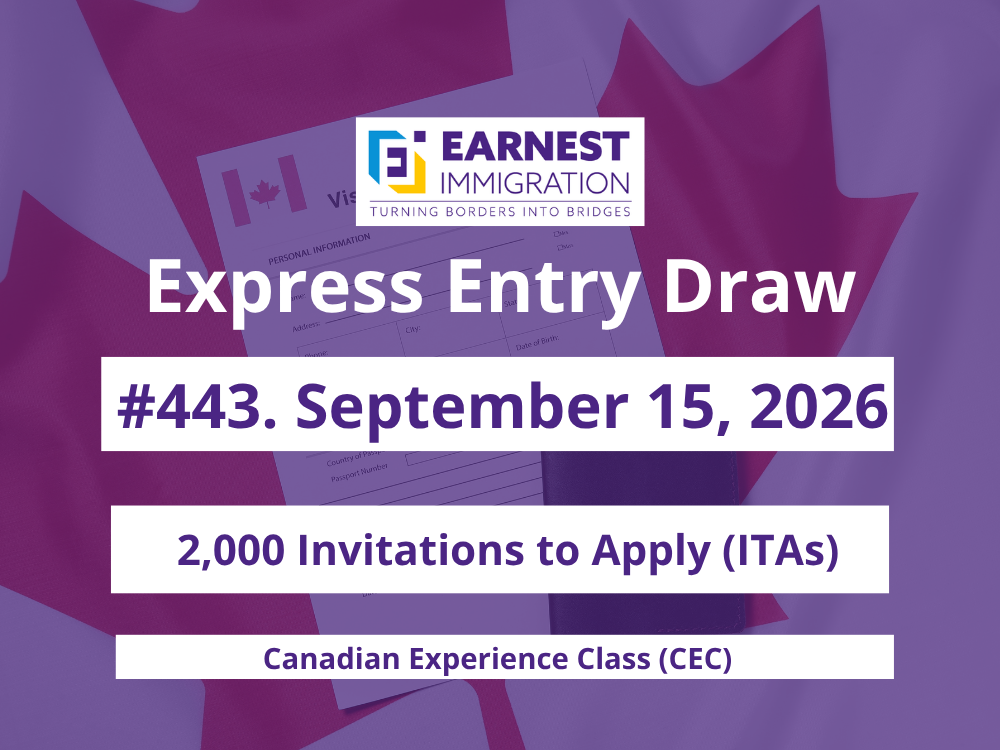
On September 15, 2026, Immigration, Refugees and Citizenship Canada (IRCC) held Express Entry Draw #443, issuing 2,000 Invitations to Apply (ITAs) to candidates in the Canadian Experience Class (CEC). The minimum Comprehensive Ranking System (CRS) score was 519.
That is two points below the last CEC round, and the third CEC decline in a row: 523, then 521, now 519. It is tempting – and much of this week’s coverage is doing it – to read that gentle slide as the cut-off drifting back toward the levels it held earlier in the year. It is not. 519 is still above the 507–518 band that governed every CEC round in the first half of 2026, and the pool data shows why it is unlikely to fall back into that band at all. 519 is not a way station on the road back to normal. It is the new normal. Below, the Earnest Immigration team explains why.
Table of Contents
ToggleExpress Entry Draw #443 at a Glance
| Detail | Information |
| Draw number | #443 |
| Date | September 15, 2026 |
| Program | Canadian Experience Class (CEC) |
| Invitations issued | 2,000 |
| CRS cut-off score | 519 |
| Tie-breaking rule | March 26, 2026 at 00:16:39 UTC |
| Draw position in 2026 | 55th Express Entry round; 16th CEC round |
| Previous CEC draw | Draw #439 – September 1, 2026 – 2,000 ITAs at CRS 521 |
| Application deadline | 60 days from the date of the invitation |
Three Rounds, Three Points Down – but Not Back to the Old Band
The recent CEC cut-offs read like a slow, steady descent: 523 on August 18, 521 on September 1, 519 on September 15. Two points per round, straight down. On its own, that looks like the beginning of a return to the 507–518 range that held all through the first half of the year.
But look at what is driving the descent. The August 18 round was the smallest CEC draw of the year – just 1,000 invitations – which pushed its cut-off up to a 2026 high of 523. The two rounds since have returned to 2,000 invitations. A larger draw reaches further down the ranked list, so the cut-off eased. The three-point drop from 523 to 519 is almost entirely the mechanical effect of draw size normalising after that unusually small August round – not a softening of the pool.
And here is the tell: at 519, the descent has nearly stopped, and it has stopped well above the old band. If the pool were genuinely softening, a 2,000-ITA draw would have pulled the cut-off back toward 515 or lower, where 2,000-ITA draws landed in spring. Instead it is holding at 519. Something is propping it up.
What Is Propping It Up: the Pool Keeps Deepening
The something is the pool. The number of candidates sitting in the competitive 501–600 CRS band – the tier CEC draws invite from – has risen relentlessly all year:
| Pool snapshot | Candidates at CRS 501–600 |
| July 19, 2026 | 18,133 |
| August 30, 2026 | 19,542 |
| September 13, 2026 | 20,784 |
That is roughly 2,650 additional competitive candidates since mid-July, and about 1,240 in the last two weeks alone. High-scoring candidates are entering the CEC pool faster than IRCC is drawing them out. That upward pressure is exactly what is offsetting the downward pull of the return to 2,000-ITA draws – and it is why the cut-off has flattened at 519 instead of sliding back into the old band.
This confirms, for the third time, the read we first set out after Draw #432 and refined after Draw #439: the CEC pool is not just deep, it is deepening, and the cut-off has settled onto a higher plateau than the one that held earlier in the year. Each new data point has narrowed the range of that plateau, and it is now clear: the floor is around 519, not 516 and below.
The CEC Plateau, in One Table
| Draw | Date | ITAs | CRS |
| #404 | March 17, 2026 | 4,000 | 507 |
| #417 | May 27, 2026 | 3,000 | 518 |
| #428 | July 21, 2026 | 2,000 | 516 |
| #432 | August 5, 2026 | 3,000 | 516 |
| #436 | August 18, 2026 | 1,000 | 523 |
| #439 | September 1, 2026 | 2,000 | 521 |
| #443 | September 15, 2026 | 2,000 | 519 |
The spring rounds, even at 3,000 and 4,000 invitations, cleared at 507 to 518. Every round since August 18 has cleared at 519 or higher – at the same or smaller draw sizes. That is the plateau shift in a single column: same-sized draws, higher cut-offs, because the pool underneath is deeper than it was.
CEC Remains the Largest Route of 2026
With this draw, CEC has issued 53,250 ITAs in 2026 – about 42 percent of all invitations this year, and comfortably the largest single route. French-language proficiency, which briefly overtook CEC in mid-August, sits at 50,500, having not held a round since August 19; CEC has pulled clearly ahead again in the interval.
That lead is not fixed, and it is worth being straight about that. IRCC has signalled French rounds will resume at two or more per draw cycle, each issuing around 4,000 invitations, which could close the gap again quickly. The honest picture is that CEC and French are the two dominant routes of 2026 by a wide margin over everything else, and which one is nominally largest depends on the recent draw calendar. For planning, the useful fact is not which leads this week, but that both are running at high volume – and that they serve very different candidates.
If You Received an ITA in Draw #443
You have 60 days from the date of your invitation to submit a complete permanent residence application. Work in this order – and one caution specific to CEC bears repeating.
- Accept the invitation in your IRCC secure account and record your exact 60-day deadline.
- Do not make profile changes that could drop your CRS below the cut-off after the ITA. Losing a job or letting a language result lapse can prompt IRCC to withdraw the invitation. Leave your profile stable until you have submitted.
- Request police certificates from every country where you have lived six months or more since age 18. Start the same day; some jurisdictions take six to eight weeks.
- Book your medical exam with an IRCC-approved panel physician. If you hold a valid exam from a prior application, confirm it is still within its validity period before rebooking.
- Assemble Canadian work-experience evidence. This is where CEC applications most often fail: reference letters must be on company letterhead and state your job title, the NOC-relevant duties you actually performed, hours per week, dates, and salary. Duties that do not map to the NOC you claimed will trigger scrutiny.
- Gather pay records, T4 slips, and Notices of Assessment covering the qualifying period, and arrange certified translations for any document not in English or French.
- Budget the fees. As of April 30, 2026, an economic-class principal applicant pays $990 in processing fees plus a $600 Right of Permanent Residence Fee – $1,590 in total. Biometrics and accompanying family members are additional.
If You Were Not Invited
Two situations are worth separating, because the plateau changes the advice.
At or just above 519, but not invited:
The tie-breaking rule is the likely explanation. This draw reached back to March 26, 2026 – so a candidate who hit exactly 519 after that date was ranked behind those who reached it earlier and could fall just outside a 2,000-ITA draw. Check also that your profile was showing as complete and valid at the moment of the draw, and that your CEC eligibility was correctly declared. If all of that is in order, you are extremely close, and a single additional point removes the tie-break risk entirely.
Below about 515:
The plateau means waiting is not a strategy – the cut-off is not coming down to you. Build points or change lanes. A language retest is the fastest CRS gain; from CLB 8 to CLB 9 across all four abilities is a meaningful jump. Structurally, a provincial nomination adds 600 points and effectively guarantees an invitation. Strong French opens the French-language category, clearing more than 100 points below CEC. An eligible occupation may fit the healthcare category, which offers a stable, plannable cut-off in the mid-470s.
How Earnest Immigration Can Help
CEC applications are decided on how precisely your Canadian work history is documented. The score gets you the invitation; the reference letters get you the approval.
As a CICC-regulated, RCIC-licensed firm, Earnest Immigration supports CEC candidates with:
- Confirming eligibility and the correct NOC/TEER classification for your role
- Building and optimising an Express Entry profile so your CRS reflects every point you can legitimately claim
- Identifying the fastest realistic routes to add points before the next round
- Assessing whether a provincial nomination, a French test, or a category-based pathway is the better play for your profile
- Preparing a complete, deadline-proof permanent residence application after an ITA
If you have Canadian work experience and want to know where you stand after Draw #443, book a consultation with our team.
Frequently Asked Questions
What was the CRS cut-off for Express Entry Draw #443?
The minimum CRS score for Draw #443 on September 15, 2026 was 519 – two points below the previous CEC round and the third consecutive small decline (523, 521, 519).
How many invitations were issued in Draw #443?
IRCC issued 2,000 Invitations to Apply to Canadian Experience Class candidates – the same size as the previous CEC round, and on the lower end for CEC draws in 2026.
Why did the cut-off drop to 519?
Mostly a draw-size effect. The August 18 CEC round was the smallest of the year (1,000 ITAs), which pushed its cut-off up to 523. The return to 2,000-ITA draws since has eased it to 519. It is a mechanical adjustment, not a softening of the pool.
Is the CEC cut-off going back down toward the low 510s in 2026?
Unlikely. 519 is still above the 507–518 band that held earlier in the year, and the competitive pool keeps deepening (20,784 candidates in the 501–600 band as of September 13, up from 18,133 in July). With CEC draws expected to stay around 2,000 ITAs, the realistic expectation is a cut-off holding in roughly the 517–521 range, not falling back to the old band.
What does the tie-breaking date of March 26, 2026 mean?
Candidates at exactly 519 were invited only if they submitted their Express Entry profile before 00:16:39 UTC on March 26, 2026. A candidate who reached 519 after that date could be left just outside the draw despite meeting the score.
Is CEC or French the largest Express Entry category in 2026?
As of this draw, CEC leads at 53,250 ITAs versus French’s 50,500. French briefly overtook CEC in mid-August but has not drawn since August 19. With French rounds expected to resume, the gap may narrow again – the two are the dominant routes of the year by a wide margin.
How long do I have to apply after receiving an ITA?
You have 60 days from the date of your invitation. Avoid profile changes that could lower your CRS in the meantime, as they can prompt IRCC to withdraw the invitation.
What does a PR application cost in 2026?
As of April 30, 2026, an economic-class principal applicant pays $990 in processing fees plus a $600 Right of Permanent Residence Fee – $1,590 in total. Biometrics and accompanying family members cost extra.
Related Reading
Canada Invites 2,000 CEC Candidates at CRS 521 – the Draw Doubled, and the Cut-Off Barely Moved (Draw #439) – [CONFIRM SLUG once published: /express-entry-draw-439-cec-september-2026/]
Canada Invites 576 Provincial Nominees at CRS 734 – the 37-Point Jump That Means Nothing (Draw #442) – [CONFIRM SLUG once published: /express-entry-draw-442-pnp-september-2026/]
Permanent Residency in Canada – how Express Entry, PNP, and other PR pathways compare
Provincial Nomination Program – the 600-point route for candidates below the CEC threshold
Francophone Immigration Services – the category clearing 100+ points below CEC
Express Entry draw history hub – [CONFIRM SLUG]
Talk to a Licensed Consultant
Earnest Immigration and Citizenship Services Inc. is a CICC-regulated, RCIC-licensed Canadian immigration consultancy with offices in Windsor, Ontario and Regina, Saskatchewan, serving clients across North America and North India.
Book a consultation to have your Express Entry profile, CRS breakdown, and alternative pathway options assessed by a licensed consultant.