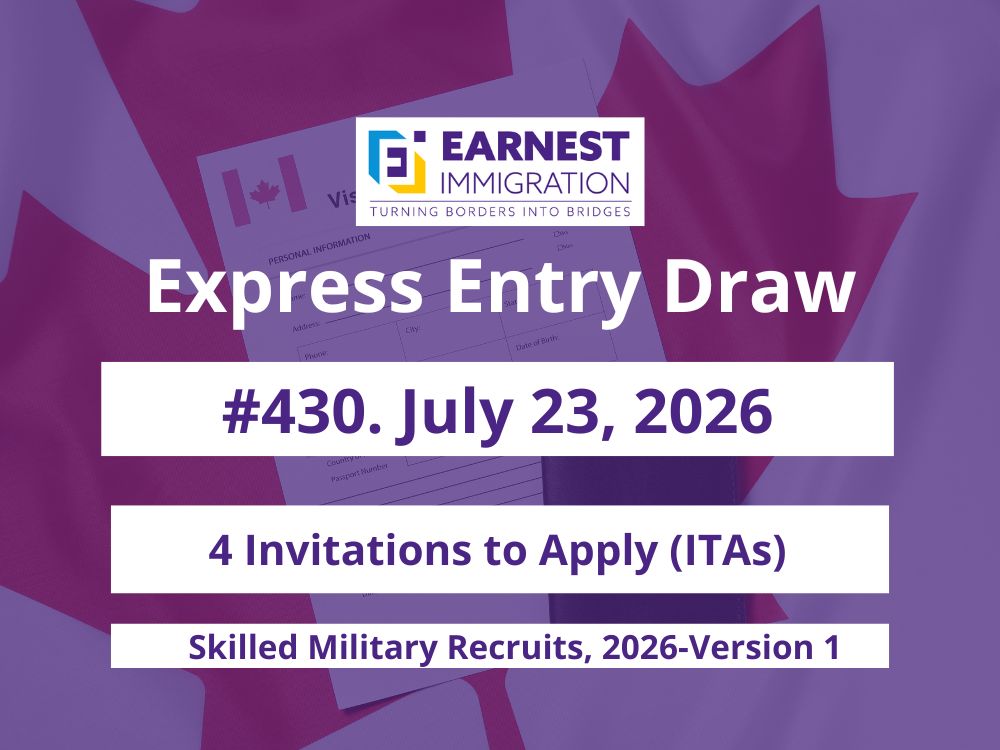
On July 23, 2026, Immigration, Refugees and Citizenship Canada (IRCC) held Express Entry Draw #430, issuing 4 Invitations to Apply (ITAs) to candidates in the Skilled Military Recruits category. The minimum Comprehensive Ranking System (CRS) score was 368.
Four invitations. It is the smallest round of invitations in the history of Express Entry, and the first ever held under this category since IRCC created it in February 2026.
The number that will get misread is 368. Below, the Earnest Immigration team explains why that figure is not what it looks like – and what this draw actually tells you about how category-based selection works in 2026.
Table of Contents
ToggleExpress Entry Draw #430 at a Glance
| Detail | Information |
| Draw number | #430 |
| Date | July 23, 2026 |
| Category | Skilled Military Recruits (2026 – Version 1) |
| Invitations issued | 4 |
| CRS cut-off score | 368 |
| Tie-breaking rule | June 2, 2026 at 20:11:26 UTC |
| Draw position in 2026 | 42nd Express Entry round; 1st Skilled Military Recruits round |
| Significance | Smallest Express Entry draw ever held |
| Application deadline | 60 days from the date of the invitation |
Why CRS 368 Is Not a Target
Competitor pages are already describing this as the most accessible category in Express Entry. That is a misreading of what a cut-off means in a draw this small.
In a 5,000-invitation round, the cut-off is a genuine threshold. IRCC ranks everyone eligible, works down the list, and stops when the seats are full. The score at the stopping point tells you how competitive the category is.
In a four-invitation round, none of that applies. IRCC did not rank a large field and select the top four. On the available evidence, it invited essentially everyone who qualified. The 368 is simply the lowest score among the four people who happened to be sitting in that sub-pool – a sample of four. It is not a bar that was cleared, it is a floor that was observed.
The same caution applies, in weaker form, to the Physicians category, which cleared at 169 in February and 223 in June. Very low cut-offs in very small categories reflect how few people qualify, not how easy the category is to enter. The difficulty sits entirely in the eligibility gate.
What This Draw Actually Reveals
IRCC created this category in February 2026 and waited five months to use it. When it finally ran a round, it found four people.
That is the real story, and it is a useful one. Eligibility here requires a foreign national currently serving in a recognised military outside Canada, with at least ten years of continuous service, holding a job offer from the Canadian Forces Recruiting Group. Each of those conditions is narrow. Stacked together, they produce a qualifying population of a handful of people worldwide with an active Express Entry profile.
The wider lesson for anyone building an Express Entry strategy in 2026: in category-based selection, the eligibility gate does almost all of the work. Your CRS score matters enormously in CEC and PNP rounds, where you are competing against tens of thousands of ranked candidates. In a narrow category, once you are through the gate you are close to guaranteed. The strategic question is therefore not “how do I raise my score” but “which gate can I actually get through.”
The 2026 Category Landscape, in One Table
IRCC lists ten active categories for 2026. Only six have actually had a draw. The spread in volume between them is extraordinary – and it is the clearest picture available of where category-based selection is really operating.
| Category | Draws in 2026 | ITAs issued | CRS range |
| French-language proficiency | 8 | 40,500 | 393 – 420 |
| Healthcare & social services | 2 | 8,000 | 467 – 475 |
| Trades occupations | 1 | 3,000 | 477 |
| Senior managers | 2 | 750 | 392 – 429 |
| Physicians | 2 | 662 | 169 – 223 |
| Skilled military recruits | 1 | 4 | 368 |
| Education occupations | 0 | – | – |
| STEM occupations | 0 | – | – |
| Researchers | 0 | – | – |
| Transport occupations | 0 | – | – |
Six active categories, 52,916 ITAs, and a range running from 40,500 invitations down to four. Four categories created or renewed for 2026 have not been used at all – STEM has now been dormant for more than two years. If your strategy depends on a category that has never drawn, it is not a strategy.
Who Qualifies for the Skilled Military Recruits Category
If you are among the small group this category is built for, the criteria are specific. You must be a Foreign Skilled Military Applicant, meaning a foreign national currently serving in a recognised military outside Canada with at least ten years of continuous service, and you must have:
• Work experience and training matching NOC 40042 (commissioned officers of the Canadian Armed Forces), NOC 42102 (specialised members), or NOC 43204 (operations members)
• A job offer from the Canadian Forces Recruiting Group for full-time work in Canada lasting at least three years, under one of those three NOC codes
• At least a two-year post-secondary credential – with an Educational Credential Assessment if it was earned outside Canada
• An active Express Entry profile and eligibility for one of the three core programs
• All other requirements set out in the ministerial instructions for the specific round
The job offer is the binding constraint, and it comes from a Canadian Armed Forces recruitment process, not an immigration one. Securing it sits outside what any immigration consultant can do for you. What a licensed consultant can do is confirm whether your service record and credentials satisfy the category, make sure your Express Entry profile is correctly structured and active, and prepare the permanent residence application if an invitation follows.
One honest caveat if you are in this position: IRCC has given no indication of how often it intends to run this category. There may not be another Skilled Military Recruits round in 2026. Entering the pool costs nothing and is clearly worth doing if you qualify, but it should sit alongside other pathways rather than replace them.
If You Are Not a Military Applicant
This draw is not a route for you, and no amount of profile optimisation will make it one. It is, however, a useful prompt to check whether a different category applies.
The categories that are actually issuing invitations at volume in 2026 are French-language proficiency, healthcare and social services, and trades. Of those, French is the only one you can qualify for through effort rather than existing occupation – reaching NCLC 7 across all four abilities opens a sub-pool that has cleared between 393 and 420 all year, roughly 120 points below the concurrent Canadian Experience Class threshold, and adds up to 50 CRS points to every other draw type through the bilingualism bonus.
If no category fits, a provincial nomination remains the highest-leverage move available: 600 CRS points, and effectively a guaranteed invitation in a subsequent Provincial Nominee Program round.
How Earnest Immigration Can Help
The practical takeaway from Draw #430 is that category eligibility, not CRS score, is what determines most outcomes in Express Entry this year. Working out which gate you can pass is worth more than another five points.
As a CICC-regulated, RCIC-licensed firm, Earnest Immigration helps candidates:
• Assess which of the ten 2026 categories your occupation, credentials, and language profile actually qualify you for
• Confirm the correct NOC and TEER classification for your work history
• Build and optimise an Express Entry profile that claims every point you are entitled to
• Weigh category-based, provincial, and program-specific routes against each other realistically
• Prepare a complete, deadline-proof permanent residence application after an ITA
If you are unsure which pathway fits your profile, book a consultation with our team.
Frequently Asked Questions
What was the CRS cut-off for Express Entry Draw #430?
The minimum CRS score for Draw #430 on July 23, 2026 was 368. Because only four invitations were issued, this figure reflects the lowest score among a very small group of eligible candidates rather than a competitive threshold.
What is the smallest Express Entry draw ever held?
Draw #430 on July 23, 2026, with just 4 invitations issued to Skilled Military Recruits. It is the smallest round of invitations since Express Entry launched in January 2015.
Why were only 4 invitations issued?
Eligibility for this category requires ten years of continuous service in a recognised foreign military plus a job offer from the Canadian Forces Recruiting Group. Very few people worldwide meet those conditions and hold an active Express Entry profile, so the qualifying pool was tiny.
Does a CRS of 368 mean this category is easy to enter?
No. The difficulty is in the eligibility criteria, not the score. A low cut-off in a four-person draw tells you how few people qualified, not how accessible the category is. The same applies to the Physicians category, which cleared at 169 in February.
Will there be another Skilled Military Recruits draw in 2026?
IRCC has not indicated how often it intends to run this category. One round is not enough to establish a pattern, and there may not be another before the end of the year.
Can an immigration consultant get me a Canadian Armed Forces job offer?
No. The job offer comes from the Canadian Forces Recruiting Group through a Department of National Defence recruitment process, which is entirely separate from immigration consulting. A licensed consultant can assess your eligibility, position your Express Entry profile, and prepare your permanent residence application after an invitation.
Which Express Entry categories are actually issuing invitations in 2026?
Six of the ten active categories have held draws: French-language proficiency, healthcare and social services, trades, senior managers, physicians, and skilled military recruits. Education, STEM, researchers, and transport have not drawn at all this year.
How long do I have to apply after receiving an ITA?
You have 60 days from the date of your invitation to submit a complete permanent residence application.