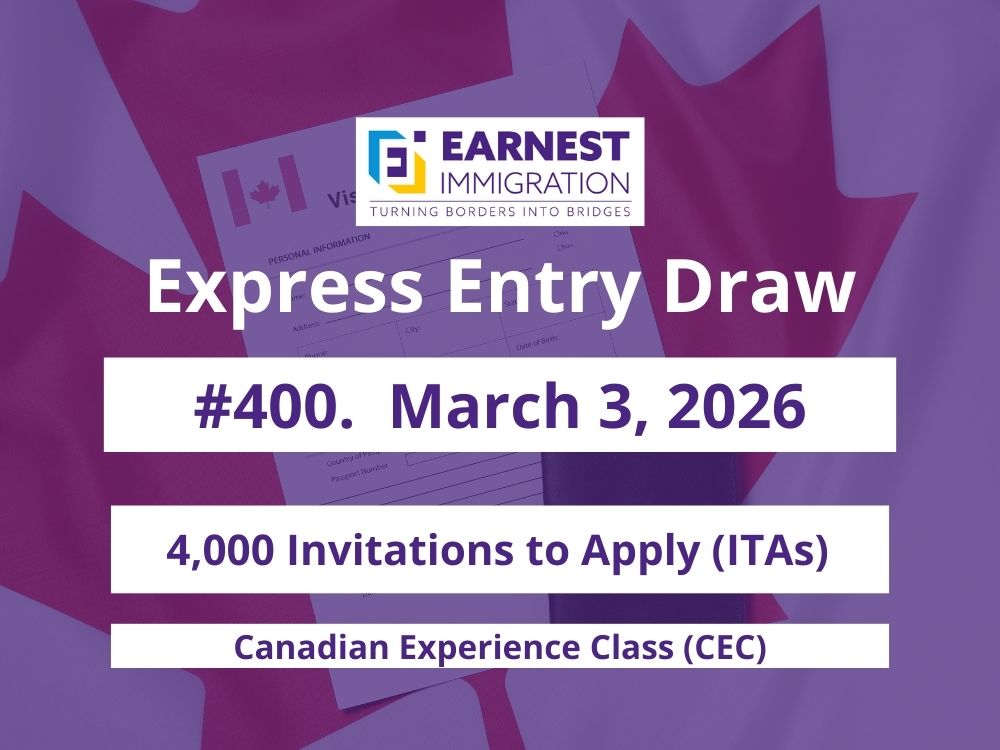
Immigration, Refugees and Citizenship Canada (IRCC) held Express Entry Draw 400 on March 3, 2026 – a milestone round that marks the 400th draw in the history of the Express Entry system. The draw issued 4,000 Invitations to Apply (ITAs) to candidates under the Canadian Experience Class (CEC), with a minimum CRS cut-off of 508 and a tie-breaking date of June 24, 2025.
This is the fourth CEC-specific draw of 2026 and the second draw of the week, following the PNP draw (Draw 399) on March 2 and preceding the French-language proficiency draw (Draw 401) on March 4. Draw 400 continues the large-volume CEC pattern established in January and February 2026, when IRCC issued 8,000 and 6,000 CEC ITAs in single rounds respectively. The CRS of 508 is stable – identical to the previous CEC draw (Draw 396) held on February 17 – confirming that the competitive threshold for CEC candidates in 2026 has settled firmly around 508.
For temporary residents in Canada who have been building their skills, language scores, and work experience with permanent residence as their goal, Draw 400 is a strong signal: the CEC pathway is active, high-volume, and consistent. If you are close to 508, now is the time to understand exactly how to close the gap.
Table of Contents
ToggleKey Details of Express Entry Draw 400
| Draw Number | 400 |
| Date | March 3, 2026 |
| Program | Canadian Experience Class (CEC) |
| Invitations Issued | 4,000 |
| CRS Cut-off Score | 508 |
| Tie-breaking Rule | June 24, 2025, at 22:35:48 UTC |
Draw 400: A Milestone in Express Entry History
Draw 400 is not just another CEC round – it marks the 400th invitation round since Express Entry launched in January 2015. In the decade since, the system has evolved considerably: general all-program draws dominated the early years, category-based selection was introduced in 2023, and the 2026 framework now features ten occupation-specific categories alongside the traditional CEC, PNP, and French-language streams.
The fact that Draw 400 is a CEC round is fitting. The Canadian Experience Class has been the backbone of Express Entry throughout its history, transitioning hundreds of thousands of temporary residents – students, post-graduation work permit holders, and skilled workers – into permanent residents. In 2026 alone, the four CEC draws to date have collectively issued 24,000 ITAs, accounting for the single largest share of 2026 Express Entry invitations.
Comparison with the Previous CEC Draw (Draw 396)
Draw 400 and Draw 396 (February 17, 2026) share the same CRS cut-off of 508, but differ in one important way:
- Draw 396: 6,000 ITAs | CRS 508 | Tie-breaking: March 16, 2025, at 09:35:59 UT
- Draw 400: 4,000 ITAs | CRS 508 | Tie-breaking: June 24, 2025, at 22:35:48 UTC
Although Draw 400 issued fewer ITAs (4,000 vs 6,000), the tie-breaking date advanced by more than three months – from March 16 to June 24, 2025. This means IRCC is reaching candidates who entered the pool later in 2025, indicating that earlier-entry candidates at exactly 508 have now been cleared. For candidates who created their profiles after June 2025 and sit at exactly 508, the next CEC draw may finally be their round.
The stable CRS of 508 across two consecutive large CEC draws – covering a combined 10,000 ITAs – confirms that 508 is the sustainable competitive threshold for CEC in 2026. Candidates targeting this program should use 508 as their planning benchmark.
Complete Summary of Express Entry Draws in 2026
| Draw # | Date | Category | CRS | ITAs |
| 401 | Mar 4 | French-Language Proficiency (Version 2) | 397 | 5,500 |
| 400 | Mar 3 | Canadian Experience Class | 508 | 4,000 |
| 399 | Mar 2 | Provincial Nominee Program | 710 | 264 |
| 398 | Feb 20 | Healthcare & Social Services (Version 3) | 467 | 4,000 |
| 397 | Feb 19 | Physicians with Canadian Work Experience | 169 | 391 |
| 396 | Feb 17 | Canadian Experience Class | 508 | 6,000 |
| 395 | Feb 16 | Provincial Nominee Program | 789 | 279 |
| 394 | Feb 6 | French-Language Proficiency (Version 2) | 400 | 8,500 |
| 393 | Feb 3 | Provincial Nominee Program | 749 | 423 |
| 392 | Jan 21 | Canadian Experience Class | 509 | 6,000 |
| 391 | Jan 20 | Provincial Nominee Program | 746 | 681 |
| 390 | Jan 7 | Canadian Experience Class | 511 | 8,000 |
| 389 | Jan 5 | Provincial Nominee Program | 711 | 574 |
CEC Draw History: Trend Analysis
| Draw # | Date | CRS | ITAs | Tie-breaking Rule Date |
| 400 | Mar 3, 2026 | 508 | 4,000 | Jun 24, 2025 |
| 396 | Feb 17, 2026 | 508 | 6,000 | Mar 16, 2025 |
| 392 | Jan 21, 2026 | 509 | 6,000 | Oct 29, 2025 |
| 390 | Jan 7, 2026 | 511 | 8,000 | Jun 10, 2025 |
| 387 | Dec 16, 2025 | 515 | 5,000 | Sep 9, 2025 |
| 384 | Dec 10, 2025 | 520 | 6,000 | Jul 15, 2025 |
| 381 | Nov 26, 2025 | 531 | 1,000 | Oct 8, 2025 |
| 378 | Nov 12, 2025 | 533 | 1,000 | Oct 17, 2025 |
| 375 | Oct 28, 2025 | 533 | 1,000 | Mar 21, 2025 |
| 370 | Oct 1, 2025 | 534 | 1,000 | Feb 21, 2025 |
| 364 | Sep 3, 2025 | 534 | 1,000 | Aug 14, 2025 |
| 359 | Aug 7, 2025 | 534 | 1,000 | Aug 3, 2025 |
| 355 | Jul 8, 2025 | 518 | 3,000 | Oct 2, 2024 |
| 353 | Jun 26, 2025 | 521 | 3,000 | Nov 21, 2024 |
| 335 | Feb 5, 2025 | 521 | 4,000 | Nov 14, 2025 |
The CEC CRS trend over the past year tells a clear story. From mid-2025 through late 2025, draws were small (1,000 ITAs each) and the CRS hovered at 533-534. Then, starting with Draw 387 in December 2025, IRCC dramatically scaled up CEC draw sizes – 5,000, then 6,000, then 8,000 – causing the CRS to fall to 508-511. Draw 400 continues this high-volume pattern at 4,000 ITAs and CRS 508, consolidating the lower threshold rather than pushing it further down. For candidates just below 508, the question is whether future large draws will pull the cut-off to 507 or 506 – and that depends entirely on how many eligible candidates are clustered just below the current threshold.
Key Statistics: 2026 Express Entry Draws to Date (as of March 3)
- Total ITAs issued in 2026: 43,112 across 14 draws
- CEC ITAs: 24,000 across 4 draws (draws 390, 392, 396, 400)
- French-Language Proficiency ITAs: 14,000 across 2 draws (draws 394, 401)
- PNP ITAs: 2,241 across 4 draws
- Healthcare and Social Services ITAs: 4,000 (Draw 398)
- Physicians with Canadian Work Experience ITAs: 391 (Draw 397)
- No general all-program draw has been held in 2026
- CEC draws account for 55.6% of all 2026 ITAs to date
Current Express Entry Pool Composition (March 5, 2026)
With a CRS cut-off of 508, Draw 400 invited candidates from the top of the 501-600 band. The pool composition as of March 5, 2026 shows exactly how competitive this range is:
| CRS Score Range | Number of Candidates |
| 601–1200 | 258 |
| 501–600 | 14,031 |
| 491–500 | 13,321 |
| 481–490 | 12,678 |
| 471–480 | 15,415 |
| 461–470 | 15,099 |
| 451–460 | 15,167 |
| 401–450 | 65,868 |
| 351–400 | 53,727 |
| 301–350 | 18,694 |
| 0–300 | 8,276 |
| Total | 232,534 |
The 501-600 band contains 14,031 candidates. After Draw 400’s 4,000 ITAs from this band (plus candidates at 508 from Draw 396 two weeks earlier), the pool of eligible CEC candidates at 508+ has thinned. This is consistent with the advancing tie-breaking date – as the pool clears at 508+, the CRS is unlikely to rise because new candidates continue to enter at various score levels. The stabilisation at 508 reflects a dynamic equilibrium between new profiles entering and invitations being issued.
Understanding the Canadian Experience Class
What Is the Canadian Experience Class?
The Canadian Experience Class (CEC) is one of three programs managed through the Express Entry system. It is designed specifically for individuals who are already in Canada as temporary residents and have accumulated skilled work experience here. Unlike the Federal Skilled Worker Program (FSWP), which accepts applications from skilled workers anywhere in the world, the CEC is exclusively for people who have lived and worked in Canada.
The core premise of the CEC is straightforward: Canada invests in people who arrive as international students or temporary workers, and the CEC is the mechanism that converts that temporary investment into permanent settlement. Candidates who came as students, completed their degrees, obtained Post-Graduate Work Permits (PGWPs), and worked in skilled roles are the archetypal CEC applicants.
CEC Eligibility Requirements
To be eligible for the CEC, you must meet all of the following at the time you apply:
- At least 12 months of full-time (or equivalent part-time) skilled work experience in Canada within the three years before applying – TEER 0, 1, 2, or 3 occupations only
- Work experience must have been gained while authorised to work in Canada (open work permit, employer-specific work permit, or PGWP)
- Minimum language proficiency: CLB 7 for NOC TEER 0/1 occupations; CLB 5 for TEER 2/3 occupations
- You must intend to reside outside Quebec (Quebec has its own immigration system and CEC candidates intending to settle in Quebec must use the Quebec Experience Program instead)
- No education requirement – unlike the FSWP, there is no minimum education threshold for the CEC
- No minimum funds requirement – unlike the FSWP, you do not need to demonstrate settlement funds if you have a valid job offer or are already working in Canada
What CRS Score Do You Need for CEC in 2026?
Based on 2026 draw data, the competitive CRS threshold for CEC is firmly at 508. Here is what that score requires in terms of human capital factors:
| CRS Factor | Maximum Points |
| Age (20–29, single applicant) | Up to 110 |
| Education (Master’s degree or higher, Canadian) | Up to 150 |
| First official language – IELTS CLB 9 all bands | Up to 136 |
| Second official language – CLB 5 | Up to 24 |
| Canadian work experience (3+ years) | Up to 80 |
| Sibling in Canada (citizen or PR) | 15 |
| Post-secondary in Canada (2+ year diploma) | 30 |
| French proficiency (NCLC 7+, English CLB 4+) | 50 |
| Arranged employment – NOC TEER 0/1/2/3 | Up to 200 |
| Provincial nomination (PNP) | 600 |
A score of 508 without a job offer or PNP nomination requires a strong combination of: young age (ideally 20-29), maximum or near-maximum language scores in English and/or French, a graduate-level education, and multiple years of Canadian skilled work experience. Candidates who fall short on one factor typically compensate on others. For example, an older candidate with a lower age score might compensate with a provincial nomination or a qualifying job offer. Understanding exactly where your points come from – and where you can realistically gain more – is the foundation of a sound CEC strategy.
How to Improve Your CRS Score for CEC
For candidates sitting below 508, the most impactful actions available are:
- Improve language scores: Language is the highest-leverage CRS factor for most candidates. Moving from CLB 9 to CLB 10 in a single band can add several points; maximising all four IELTS or CELPIP bands to CLB 10+ produces the largest single gain available without changing jobs or education. Retaking language tests is often the fastest and most cost-effective improvement
- Add French as a second language: Candidates who achieve NCLC 7 or higher in French while maintaining English at CLB 4+ receive a 25-50 point bilingualism bonus, depending on French proficiency level. With French-language proficiency also unlocking French category-based draws at much lower CRS thresholds, French remains one of the most strategic investments for any Express Entry candidate
- Accumulate additional Canadian work experience: Moving from 1 year to 2 or 3 years of Canadian experience adds CRS points under the work experience factor and may also qualify you for a provincial nomination in streams that require longer tenure
- Pursue a provincial nomination: A provincial nomination adds 600 CRS points and effectively guarantees an ITA in the next PNP draw. For candidates at 450-500 who cannot quickly reach 508, a provincial nomination is often the most reliable path to permanent residence
- Complete Canadian education: If you studied in Canada at the post-secondary level for 2 or more years, you receive 30 additional CRS points. If you have a 3-year or longer Canadian credential, the points increase further
- Secure a qualifying job offer: A valid LMIA-supported or LMIA-exempt job offer at NOC TEER 0/1 adds 200 points; at TEER 2/3, it adds 50 points. While a job offer is not required for CEC eligibility, it can push candidates well above the 508 threshold
The PGWP Pipeline: Why CEC Volumes Are So High in 2026
The consistently large CEC draw sizes in 2026 – 8,000 in January, 6,000 twice, and 4,000 in March – reflect the maturation of a very large cohort of international students who graduated between 2021 and 2023, obtained Post-Graduate Work Permits, accumulated the required 12 months of Canadian work experience, and entered the Express Entry pool from late 2022 onwards.
This PGWP cohort is unusually large because Canadian institutions saw record international enrolment in 2019-2022. As those students transitioned to work permits and then built their CEC eligibility, the pool filled with hundreds of thousands of qualified candidates. IRCC’s response has been to issue larger CEC draws – the high volumes in 2026 are a deliberate effort to process this backlog while meeting annual immigration targets.
For new PGWP holders entering the pool now, the implication is that competition at the 508 level is real and sustained. Building the strongest possible profile before entering the pool – particularly through language score improvement and additional work experience – remains the best preparation strategy.
What to Do After Receiving a CEC ITA
Candidates who received an ITA in Draw 400 have 60 days from the invitation date to submit a complete permanent residence application. Required documents include:
- Proof of 12 months of Canadian skilled work experience: employment letters on company letterhead confirming job title, NOC code, hours worked, salary, and dates of employment, signed by your employer or HR
- Valid language test results: IELTS General Training, CELPIP-General, TEF Canada, or TCF Canada – results must be within their validity period (generally 2 years from test date) at the time of application
- Educational Credential Assessment (ECA) if claiming points for foreign education under FSWP or if foreign credentials are listed in your profile – not required for CEC-only applicants claiming only Canadian education
- Police clearance certificates from Canada and all countries where you have lived for 6 months or more since the age of 183
- Medical examination results from an IRCC-designated physician – arrange as early as possible as results are typically valid for 12 months
- Valid passport or travel document covering the entire application processing period
- Proof of status documents: work permit, study permit, and any prior status documents showing authorisation to work in Canada during the qualifying employment period
IRCC targets a six-month processing timeline for complete Express Entry CEC applications. The most common cause of delay is incomplete documentation – particularly missing employer letters that don’t include all required details. Preparing reference letters carefully and reviewing them against IRCC’s requirements before submission will significantly reduce the risk of a processing request or refusal.
Frequently Asked Questions
Why is the CRS for CEC so much higher than for category-based draws like healthcare or French?
CEC draws select from a pool of hundreds of thousands of eligible candidates across all occupations – anyone with Canadian work experience and eligible language scores competes in the same round. Category-based draws carve out a much smaller sub-pool of eligible candidates in specific sectors, which means there is far less competition for the available ITAs. A healthcare worker in the sub-pool of a healthcare draw might be competing against 30,000 eligible candidates instead of 200,000. This structural difference is why a healthcare draw can clear at CRS 467 while a CEC draw requires 508 in the same week. Occupation and language category alignment, not just raw CRS score, is the most important strategic consideration in 2026.
I received my CEC ITA but my employer letter is from a previous employer who has since closed. What should I do?
A closed or dissolved employer is a common documentation challenge. IRCC still requires evidence of the work performed. You should gather alternative documentation: final pay stubs, T4 slips or tax assessments from the period, any termination or reference letter issued before closure, contracts of employment, and any correspondence with the employer that establishes the dates and terms of work. If possible, obtain a letter from a former supervisor, colleague, or HR contact who can attest to your employment. If the business registry shows the company as dissolved, include documentation of this fact as supporting context. If you are uncertain about what will satisfy IRCC’s requirements in your specific situation, consulting a licensed immigration consultant or lawyer before submitting is strongly advisable.
Does my self-employed work in Canada count toward CEC eligibility?
No. Self-employment does not qualify as work experience for the Canadian Experience Class. The CEC specifically requires work performed as an employee – meaning you were employed by an organisation, received a salary or wages, and had taxes deducted at source. Freelance, contract, and self-employed income does not satisfy the CEC work experience requirement, even if the work was performed in Canada on a valid work permit. Some provincial nominee program streams do consider self-employed experience, and the Federal Self-Employed Persons Program exists for certain categories of self-employed individuals – but neither of these is the CEC. If your Canadian work history is primarily self-employed, your pathway to permanent residence will need to be assessed under a different stream.
I have 11 months of Canadian work experience. Can I submit my Express Entry profile now and receive an ITA before reaching 12 months?
Yes – you can create your Express Entry profile before completing 12 months of experience, but you cannot receive an ITA until the date on which you will have completed 12 months. Your profile will be ranked in the pool, but IRCC will not issue you an ITA before your qualifying experience is complete. Once you are 60 days or fewer away from completing 12 months – and you have an otherwise strong profile – it can be strategic to enter the pool early so your profile submission date is as early as possible, which helps in the event of a tie-breaking rule applying. Just ensure all other elements of your profile are accurate and your language test is within its validity period.
What happens if the CRS drops below 508 in future CEC draws?
A drop below 508 would happen if IRCC issues a very large draw (larger than the current number of candidates at 508+) or if the pool composition shifts significantly. Based on current pool data – with 14,031 candidates at 501-600 – a draw of more than approximately 10,000-12,000 ITAs would be needed to push the cut-off below 500, assuming all candidates in that band are CEC-eligible. More likely, the CRS will remain at 508 or fluctuate within a narrow range (506-511) as draw sizes vary. A significant structural drop would require either IRCC dramatically increasing CEC draw volumes or a large number of candidates leaving the pool through expiry. Monitoring each draw closely and having your application ready is the most practical approach for candidates near 508.
Can I use CEC experience from a PGWP along with experience from an employer-specific work permit?
Yes. CEC work experience does not need to come from a single work permit or employer. What matters is that at the time the work was performed, you held valid authorisation to work in Canada. Experience accumulated on an employer-specific work permit, an open work permit (including a PGWP), a spousal open work permit, or a Bridging Open Work Permit all count toward the 12-month CEC requirement, provided the work was in an eligible NOC TEER 0, 1, 2, or 3 occupation. The experience can span multiple employers and multiple permit types as long as the total reaches 12 full-time months within the three-year window before you apply.
The Bottom Line
Express Entry Draw 400 is a milestone – the 400th invitation round in a system that has transformed Canadian immigration since 2015. Issuing 4,000 ITAs to CEC candidates at a stable CRS of 508, it confirms that the Canadian Experience Class remains the highest-volume, most active pathway in the 2026 Express Entry landscape. The four CEC draws of 2026 have collectively produced 24,000 ITAs, more than any other category by a wide margin.
For temporary residents in Canada who have built skilled work experience here, the message is clear: the CEC is working, the volumes are large, and the threshold is stable at 508. If you are not yet at 508, the most effective actions remain language score improvement, accumulating additional Canadian experience, and – for those who cannot quickly close the gap – pursuing a provincial nomination that delivers a reliable pathway at a lower base CRS.
At Earnest Immigration, our licensed consultants help CEC candidates assess their current CRS, identify the fastest and most impactful score improvements, and prepare complete, accurate applications within the 60-day ITA window. Whether you are a few points short of 508 or have just received your ITA, the Earnest Immigration team is here to guide you to permanent residence. Contact us today for a comprehensive profile assessment.