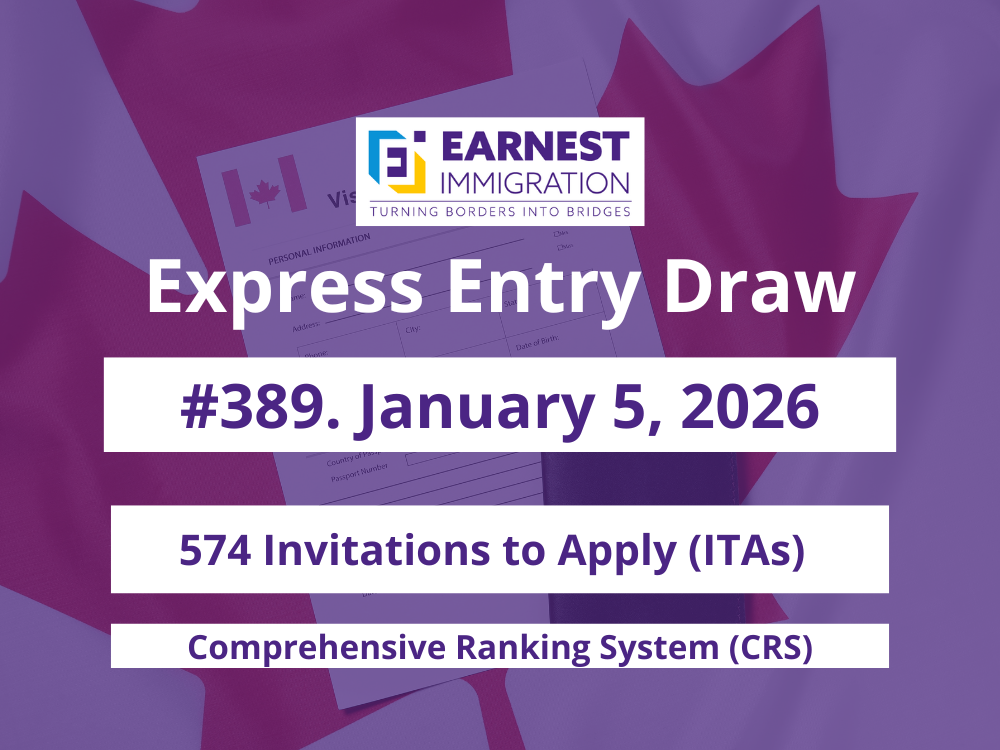
Canada has officially launched the 2026 immigration year with its first Express Entry draw, signaling continued momentum in economic immigration. On January 5, 2026, Immigration, Refugees and Citizenship Canada (IRCC) issued 574 Invitations to Apply (ITAs) to candidates nominated under the Provincial Nominee Program (PNP).
The minimum Comprehensive Ranking System (CRS) score required for this draw was 711, consistent with historically high cut-offs seen in PNP-specific rounds.
This draw marks the 389th Express Entry draw overall and sets the tone for what applicants can expect in the early months of 2026.
Table of Contents
ToggleExpress Entry Draw #389 – Key Details
- Program targeted: Provincial Nominee Program (PNP)
- Date of draw: January 5, 2026
- Number of ITAs issued: 574
- Minimum CRS score: 711
- Tie-breaking rule: October 6, 2025 at 01:54:31 UTC
As with all Express Entry rounds, candidates who received an invitation now have 60 days to submit a complete permanent residence application. Processing typically follows IRCC’s six-month service standard.
How This Draw Fits Into Recent Express Entry Trends
The January 5 draw follows a French language proficiency draw on December 17, 2025, where 6,000 ITAs were issued with a CRS cut-off of just 399. Together, these two rounds highlight IRCC’s continued reliance on category-based selection, particularly:
- Provincial nominees
- Francophone candidates
- Canadian Experience Class applicants
So far in 2026, IRCC has conducted:
- 1 Express Entry draw, targeting PNP candidates
By comparison, 2025 was one of the busiest years in Express Entry history, with Canada issuing 113,998 ITAs, narrowly missing the all-time annual record.
Breakdown of Express Entry Draws in 2025
- 24 PNP draws
- 15 Canadian Experience Class (CEC) draws
- 9 French-language proficiency draws
- 7 healthcare and social services draws
- 2 education-focused draws
- 1 trades draw
This trend confirms that general draws remain limited, while targeted pathways dominate selection decisions.
Express Entry ITA Trends: A Look Back
Canada’s recent Express Entry invitation history shows a clear focus on candidates already connected to the labour market:
- 2025: 113,998 ITAs
- 2024: 110,266 ITAs
- 2023: 110,266 ITAs
- 2022: 45,115 ITAs
- 2021: 114,431 ITAs (record year)
The 2021 record was driven almost entirely by CEC and PNP candidates, a strategy that IRCC continues to follow today.
What the First 2026 Draw Means for Candidates
A CRS cut-off of 711 reinforces an important reality:
PNP nominations remain one of the strongest guarantees of receiving an ITA.
For candidates without a provincial nomination, this draw serves as a reminder to:
- Explore PNP pathways actively
- Strengthen CRS scores through language ability, Canadian experience, or education
- Consider French-language proficiency, which continues to produce some of the lowest CRS cut-offs
Staying inside the Express Entry pool is critical. Candidates who delay profile creation often miss opportunities when sudden draws occur.
What Employers Should Know
For Canadian employers facing labour shortages, provincial nominations and LMIA-backed pathways remain key tools for recruiting and retaining foreign talent.
Employers can benefit from:
- Provincial Nominee Programs tailored to regional labour needs
- Strategic use of LMIA-supported job offers
- Long-term workforce stability through permanent residence pathways
With immigration policy increasingly focused on economic integration, employers play a growing role in Canada’s immigration system.
What Comes Next in 2026?
Based on recent patterns, IRCC is expected to continue with:
- Additional PNP draws
- CEC-specific rounds
- More French-language category draws
- Select occupation-targeted draws tied to labour shortages
While CRS scores may fluctuate, candidates who prepare early and diversify their strategies will be best positioned to succeed.
Final Thoughts
Canada’s first Express Entry draw of 2026 confirms that targeted immigration remains the priority. Provincial nominees continue to enjoy a significant advantage, while category-based draws offer strong opportunities for candidates with in-demand skills or French-language proficiency.
As the year unfolds, staying informed, proactive, and adaptable will be key to turning eligibility into an invitation.