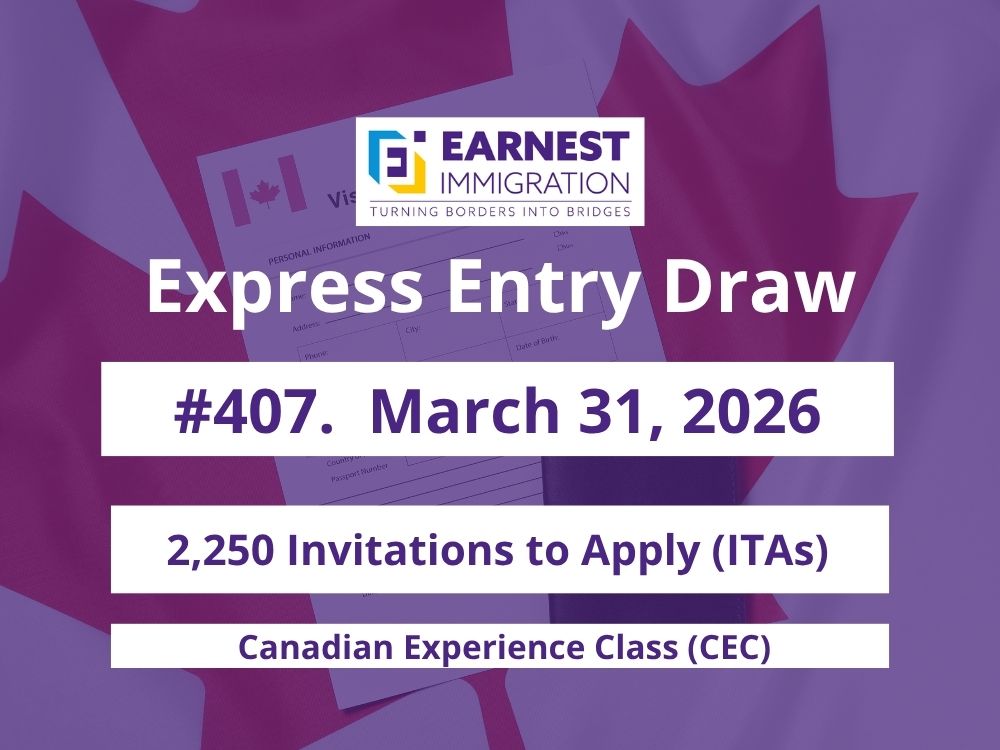
Immigration, Refugees and Citizenship Canada (IRCC) closed the first quarter of 2026 with Express Entry Draw 407 on March 31, 2026 – a Canadian Experience Class (CEC) draw issuing 2,250 Invitations to Apply (ITAs) with a minimum CRS cut-off of 509. The tie-breaking date was March 18, 2026, at 08:27:11 UTC – just 13 days before the draw itself, making it the most recent tie-breaking date of any 2026 CEC draw by a significant margin.
Draw 407 is the sixth CEC draw and the nineteenth Express Entry draw of 2026. It is also the smallest CEC draw of the year – issuing 2,250 ITAs compared to the 4,000 of Draw 404 (March 17), the 4,000 of Draw 400 (March 3), and the 6,000 and 8,000 of January’s draws. The smaller invitation volume directly explains the 2-point CRS increase from 507 (Draw 404) to 509: fewer spots available means only higher-ranked candidates are reached. This inverse relationship between draw size and CRS cut-off is one of the most consistent and predictable dynamics in the entire Express Entry system.
Despite its smaller size, Draw 407 caps a remarkable Q1: 19 draws, 55,830 ITAs, six distinct draw categories, and records broken in every major category type. The 2,250 CEC invitations bring the CEC Q1 total to 30,250 – more than half of all Express Entry ITAs issued in the first three months of 2026.
Table of Contents
ToggleKey Details of Express Entry Draw 407
| Draw Number | 407 |
| Date | March 31, 2026 |
| Program | Canadian Experience Class (CEC) |
| Invitations Issued | 2,250 |
| CRS Cut-off Score | 509 |
| Tie-breaking Rule | March 18, 2026, at 08:27:11 UTC |
Draw 407 Is the Smallest CEC Round of 2026: Why Size Matters
With 2,250 ITAs, Draw 407 is the smallest CEC draw of 2026 by a wide margin. Understanding why draw size affects the CRS cut-off is essential for any Express Entry candidate tracking their chances:
| Draw | Date | ITAs | CRS | Interpretation |
| Draw 390 | Jan 7 | 8,000 | 511 | Large draw – reaches further down pool |
| Draw 392 | Jan 21 | 6,000 | 509 | Large draw – lower CRS |
| Draw 396 | Feb 17 | 6,000 | 508 | Large draw – lower CRS |
| Draw 400 | Mar 3 | 4,000 | 508 | Medium draw – stable CRS |
| Draw 404 | Mar 17 | 4,000 | 507 | Medium draw – new 2026 CEC low |
| Draw 407 | Mar 31 | 2,250 | 509 | Small draw – CRS rises 2 points |
The pattern is clear and consistent: larger draws reach further down the pool, reducing the CRS cut-off; smaller draws reach only the top-ranked candidates, raising (or stabilising) the cut-off. Draw 407’s 2,250 ITAs at CRS 509 is entirely predictable given this dynamic. The cut-off is 2 points higher than Draw 404’s record low of 507 simply because 1,750 fewer candidates were invited. If Draw 407 had issued 4,000 ITAs, the cut-off would almost certainly have been 507 – or possibly 506.
For candidates who narrowly missed an ITA in Draw 407 at CRS 508 or 509, this insight is important: a future larger CEC draw will be more likely to reach your score than a small one. Monitoring IRCC’s draw pattern – and recognising when a larger-volume CEC round is likely – can inform when to enter the pool or update profile details to maximise tie-breaking position.
The Remarkably Recent Tie-breaking Date: March 18, 2026
Draw 407’s tie-breaking date of March 18, 2026, at 08:27:11 UTC is the most striking technical detail of this round. The draw was held on March 31 – just 13 days after the tie-breaking cutoff. This is dramatically more recent than any previous 2026 CEC draw:
• Draw 404 (March 17): Tie-break May 11, 2025 – approximately 10 months prior
• Draw 400 (March 3): Tie-break June 24, 2025 – approximately 9 months prior
• Draw 396 (February 17): Tie-break March 16, 2025 – approximately 11 months prior
• Draw 407 (March 31): Tie-break March 18, 2026 – just 13 days prior
What does this mean? A tie-breaking date of March 18 means that candidates who entered the pool on March 17 or earlier – at CRS 509 – were potentially eligible. The fact that IRCC had to use such a recent date to fill 2,250 spots at CRS 509 tells us two important things: first, the pool at CRS 509 was relatively thin, having been partially cleared by Draw 404’s 4,000-ITA round at CRS 507 two weeks earlier; second, new profiles with scores at or near 509 have been entering the pool rapidly in recent weeks. Candidates who have just completed language tests or updated their profiles in mid-March are being reached almost immediately at this score level.
For candidates considering when to enter the Express Entry pool, this is a significant signal. The tie-breaking advantage of early entry is diminished when draws clear profiles at a given CRS level so quickly. In a pool where March 18 profiles were already reached by March 31, candidates at CRS 509+ who entered the pool in early-to-mid March are likely already in possession of ITAs. Those who entered after March 18 at this score level are the next in queue for the following CEC draw.
Q1 2026 Express Entry: A Quarter of Milestones
Draw 407 closes Q1 2026. The quarter produced records across every major draw category:
| Month | Draws | ITAs | Notable Records |
| January 2026 | 4 draws | 21,255 | 511 CEC low, 746 PNP low |
| February 2026 | 7 draws | 22,072 | 508 CEC, 169 Physicians record, 789 PNP |
| March 2026 | 8 draws | 18,732 | 507 CEC low, 393 French record, 802 PNP high |
| Q1 2026 Total | 19 draws | 55,830 | Multiple category records set |
Q1 2026 produced 55,830 ITAs across 19 draws in 91 days – an average of more than 600 ITAs per calendar day. No previous quarter in Express Entry history has matched this pace in terms of both draw frequency and category diversity. Four categories produced new historic records: the first-ever sub-400 French draw (393, Draw 405), the lowest CEC cut-off in 18 months (507, Draw 404), the highest 2026 PNP cut-off (802, Draw 406), and the first-ever Senior Managers draw (429, Draw 402). The introduction of Senior Managers alongside the sustained high volumes of CEC and French draws marks Q1 2026 as structurally significant in the evolution of Canada’s immigration system.
2026 Express Entry ITAs by Category: Q1 Complete
| Category | Draws | ITAs Issued | % of Total |
| Canadian Experience Class | 6 | 30,250 | 54.2% |
| French-Language Proficiency | 3 | 18,000 | 32.2% |
| Healthcare and Social Services | 1 | 4,000 | 7.2% |
| Provincial Nominee Program | 7 | 2,939 | 5.3% |
| Physicians with Canadian Work Exp. | 1 | 391 | 0.7% |
| Senior Managers with Canadian Work Exp. | 1 | 250 | 0.4% |
| Total | 19 | 55,830 | 100% |
CEC draws account for 30,250 of the 55,830 Q1 ITAs – 54.2% of the total. French-language draws (18,000 ITAs, 32.2%) are the second-largest category by a considerable margin. Together, CEC and French account for 86.4% of all Q1 ITAs – confirming these two pathways as the dominant channels of Canada’s 2026 Express Entry strategy. For Q2, the addition of a Trades Occupations draw (issued April 2, 2026, with 3,000 ITAs at CRS 477) signals that IRCC is beginning to diversify the category mix while maintaining high overall volumes.
Express Entry Pool Composition (March 29, 2026)
| CRS Score Range | Number of Candidates |
| 601–1200 | 351 |
| 501–600 | 12,506 |
| 451–500 | 73,445 |
| 401–450 | 64,104 |
| 351–400 | 52,736 |
| 301–350 | 18,855 |
| 0–300 | 8,189 |
| Total | 230,186 |
At CRS 509, Draw 407 invited candidates from the top of the 501-600 band, which shows 12,506 candidates as of March 29. With 2,250 ITAs issued at CRS 509, the top slice of this band has been trimmed – but 10,000+ candidates remain in the 501-600 range who have not yet received a CEC ITA. Many of these candidates, particularly those whose profiles pre-date March 18, 2026, are at or near the front of the tie-breaking queue for the next CEC round. The 451-500 band (73,445 candidates) remains the largest cohort in the pool and is most directly served by downward CRS movement or category draw expansion.
Understanding the Canadian Experience Class: What Draw 407 Tells Us About Q2 2026
Why Draw 407 Is Smaller – and What That Signals for Q2
The 2,250-ITA volume of Draw 407 – significantly smaller than all five prior 2026 CEC draws – reflects a deliberate modulation in IRCC’s invitation strategy heading into Q2. Several factors explain the reduction:
• Processing capacity management: With approximately 55,000+ applications already submitted from Q1 draws, IRCC is likely smoothing the flow of new applications to avoid processing bottlenecks at the start of Q2. A smaller CEC draw reduces new applications in the immediate pipeline
• Resource allocation for category draws: A Trades Occupations draw was held on April 2, 2026, issuing 3,000 ITAs at CRS 477. Trimming the CEC volume on March 31 likely freed officer capacity for this occupation-specific round
• Annual target management: Canada’s 2026 target of 380,000 permanent residents requires distributing invitations across four quarters. Having issued 55,830 ITAs in Q1 – nearly 15% of the annual target in just 91 days – IRCC may be moderating Q2 volumes to remain on target pacing
• Selective pool clearing at the 509 threshold: With Draw 404 having recently cleared profiles at CRS 507 with 4,000 ITAs, the pool at 509 was relatively thin. A 2,250-ITA draw was sufficient to clear the available 509+ profiles without wasting invitation capacity on a threshold already partially cleared
CEC Eligibility: Key Requirements
For candidates building toward the CEC pathway in Q2, the core eligibility requirements are unchanged from earlier in 2026:
• At least 12 months of full-time (or equivalent part-time) skilled work experience in Canada within the three years before applying – in a NOC TEER 0, 1, 2, or 3 occupation
• Work must have been performed while authorised to work in Canada – open work permits (PGWP, SOWP, BOWP), employer-specific work permits, or work performed as a permanent resident or Canadian citizen all qualify
• Minimum language proficiency: CLB 7 in all four abilities for TEER 0/1 occupations; CLB 5 for TEER 2/3 – tested through IELTS General Training, CELPIP-General (English), or TEF Canada / TCF Canada (French)
• No minimum education requirement – unlike the FSWP, the CEC does not require a minimum level of education and does not require an ECA for CEC-only applicants
• No settlement funds requirement for candidates with current Canadian work authorisation
• Must intend to reside outside Quebec
The CEC pathway has no occupation restriction – any TEER 0-3 occupation qualifies. This universality is a key difference from the healthcare, physicians, senior managers, and trades occupation category draws, which are limited to specific NOC codes. The CEC remains the most broadly accessible pathway for candidates already in Canada with skilled work experience.
Strategies for CEC Candidates Below 509 in Q2 2026
For candidates currently in the pool below CRS 509, the key insight from Draw 407 is that the CRS threshold is directly tied to draw volume. The most effective strategies for Q2 are:
• Improve language scores: Each CLB-level improvement in a single language band can add 5-15 CRS points. Moving from CLB 8 to CLB 9 across multiple bands can add 20-30+ points. Retaking IELTS or CELPIP is typically the fastest and highest-return CRS improvement available
• Develop French proficiency: Adding NCLC 7+ French proficiency unlocks the French-language draw category (which cleared at 393 in Q1 2026) and adds a 25-50 point bilingualism bonus. For candidates at 460-500, this single investment may be more impactful than any other available action
• Enter the pool immediately if not yet active: The tie-breaking date of March 18 for a March 31 draw confirms that pool entry timing matters. Entering the pool 13 days before a draw can be the difference between receiving an ITA and missing it. Candidates who are eligible and ready should enter the pool without delay
• Verify your NOC code: Ensure your NOC code accurately reflects your actual duties. An incorrect NOC code affects both CRS calculation and eligibility for category-based draws. If you are unsure, have your NOC confirmed by a licensed immigration consultant before entering the pool
• Pursue a provincial nomination in parallel: Candidates who cannot quickly improve their CRS to 509+ should pursue PNP nominations alongside their CEC strategy. A nomination adds 600 points and guarantees an ITA in the next PNP draw regardless of base CRS
What to Do After Receiving a CEC ITA in Draw 407
Candidates who received an ITA in Draw 407 have 60 days to submit a complete permanent residence application. With a draw date of March 31, the deadline falls around May 30, 2026. Recommended actions by timeline:
• Days 1-3: Request all employer reference letters immediately. Allow 2-3 weeks for preparation, review, and signing – this is the longest lead-time document in most CEC applications. Letters must confirm job title, NOC code, hours per week, annual salary, employment dates, and a detailed duties description
• Days 1-7: Initiate police clearance certificates from Canada (RCMP fingerprint-based) and all other countries of residence for 6 months or more since age 18. International certificates can take 4-12 weeks
• Days 1-7: Book your medical examination with an IRCC-designated physician. Results are valid for 12 months; schedule as early as possible
• Days 1-14: Verify language test validity – IELTS, CELPIP, TEF Canada, and TCF Canada results must remain valid (within 2 years) at time of application submission
• Days 7-14: Review your Express Entry profile for accuracy against all supporting documents. Every field must match exactly – NOC code, employment dates, education, language scores
• Days 14-45: Assemble all documents, complete the e-APR forms, and prepare to submit
• Days 45-60: Submit with buffer time. Avoid waiting until the final days – unexpected documentation issues can arise
IRCC targets a six-month processing timeline for complete CEC applications. Incomplete or inconsistent applications take longer and risk procedural fairness letters or refusal. The investment of careful preparation in the first two weeks of the ITA window pays dividends throughout the six-month processing period.
Frequently Asked Questions
Draw 407 had 2,250 ITAs at CRS 509. Draw 404 had 4,000 ITAs at CRS 507. Does the higher CRS mean it is becoming harder to get an ITA?
No – the 2-point increase is entirely explained by the smaller draw size, not by increased competition or a policy change. When IRCC issues 4,000 ITAs, it reaches further down the ranked pool, touching the 507 threshold. When it issues 2,250, only the top 2,250 candidates are invited – which in this pool corresponds to CRS 509. The underlying pool dynamics have not changed: thousands of candidates remain in the 505-515 range. A future large-volume CEC draw (4,000+ ITAs) is expected to return the cut-off to 507-508 or lower. Monitoring both the draw size and the CRS together – not just the CRS in isolation – is the correct way to interpret Express Entry draw results.
The tie-breaking date was March 18 – only 13 days before the draw. I submitted my profile on March 20. Was I close to getting an ITA?
Very close. Candidates with CRS 509+ who submitted their profiles on March 19 or 20 were literally days behind the tie-breaking cutoff. You are now at or near the front of the queue at CRS 509+ for the next CEC draw. Assuming the next draw uses a tie-breaking date after March 18, you will be in the first cohort reached at your score level. The practical implication is: maintain your profile in active status, ensure it is accurate and complete, and do not delete and resubmit your profile (which would reset your submission date). Your March 20 entry date is now a valuable asset for tie-breaking purposes.
My CRS is 505. What is the fastest path to receiving an ITA – improving CRS or pursuing a PNP?
Both pathways are worth pursuing simultaneously, and the fastest one depends on your individual circumstances. For CRS improvement: if your language scores have room to grow (e.g., CLB 7-8 with potential for CLB 9-10), a language retest could add 10-25 points and push you above 509 within 6-8 weeks. If you have any French ability, developing it to NCLC 7 adds the bilingualism bonus (25-50 points) and simultaneously opens French draws at CRS 393. For PNP: provincial nominations can take 2-6 months or longer depending on the stream, employer involvement, and province. If you have a genuine connection to a province and the right occupation, the PNP may be more reliable than waiting for CEC draws to reach CRS 505. In most cases, the optimal strategy is: enter the pool now at your current score, book a language retest for the soonest available date, and initiate a PNP strategy in parallel. Which pathway delivers first depends on your language test results and provincial nomination timelines.
I am an international graduate who just started working on my PGWP. When can I apply for Express Entry CEC?
You can create your Express Entry profile as soon as you have a valid job offer and your PGWP – even before completing 12 months of Canadian work experience. However, you cannot receive a CEC ITA until you have completed 12 months of full-time (or equivalent) Canadian skilled work experience in a qualifying NOC TEER 0-3 occupation. IRCC will not issue an ITA before your qualifying experience is complete. Creating your profile early is still valuable because it establishes your profile submission date, which determines your tie-breaking position. If your CRS is strong enough to attract an ITA once you have completed 12 months of experience, entering the pool early – even while still accumulating months – gives you a more advantageous tie-breaking date than entering later. Ensure your NOC code is accurate for your work experience and that your language test scores are within their two-year validity period when you reach the 12-month eligibility threshold.
I received an ITA in Draw 407 but my employer is reluctant to provide a reference letter before I tender my notice. What should I do?
This is one of the most common practical challenges in CEC applications. The employer reference letter requirement is strict – IRCC needs a signed letter on company letterhead confirming employment details and duties. A few approaches can help: First, many candidates find that framing the request as a routine employment verification (rather than an immigration-specific reference) can reduce employer discomfort. Second, you do not need to disclose to your employer that you plan to leave – a reference letter confirming employment dates and duties is a standard HR function and does not require disclosure of your immigration plans. Third, if your employer has an HR department, requesting the letter through HR rather than your direct manager often produces a less contentious process. Fourth, some candidates engage an immigration consultant to draft the exact letter content so the employer only needs to review and sign a pre-prepared document, reducing the burden on them. If your employer refuses despite these approaches, alternative supporting documentation (T4 slips, pay stubs, employment contract, LinkedIn profile, and a statutory declaration from a colleague familiar with your duties) may be submitted alongside whatever documentation is available, with an explanation of the circumstances. Consulting a licensed consultant before submitting is advisable if your reference letter situation is complex.
Q1 2026 had 55,830 ITAs in 19 draws. Is this pace sustainable for the full year? Could IRCC slow down in Q2?
Q1’s pace of 55,830 ITAs in 91 days translates to an annualised rate of approximately 224,000+ ITAs per year – well above any prior year in Express Entry history. Canada’s 2026 target is 380,000 permanent residents total across all immigration streams, of which Express Entry feeds roughly 110,000-130,000 in a typical year. At Q1’s pace, Express Entry alone would exceed that sub-target by mid-year. This strongly suggests that IRCC will moderate the pace in Q2 and beyond to avoid over-issuing ITAs that convert into applications faster than processing capacity can handle, or that exceed the annual allocation. The March 31 small CEC draw (2,250 ITAs versus earlier rounds of 4,000-8,000) may already be an early signal of this moderation. In Q2, candidates should expect a mix of large and small draws across categories, with the overall pace likely lower than Q1’s extraordinary throughput. Planning for a Q2 that is active but somewhat less frenetic than Q1 is a reasonable expectation.
The Bottom Line
Express Entry Draw 407 issued 2,250 ITAs to CEC candidates at a CRS of 509 on March 31, 2026 – the final draw of Q1 and the smallest CEC round of the year. The 2-point CRS rise from Draw 404’s record low of 507 is a direct consequence of the smaller invitation volume and carries no broader signal about deteriorating conditions for CEC candidates. The tie-breaking date of March 18 – just 13 days before the draw – confirms that the pool at CRS 509 is being refreshed by new profiles rapidly, and candidates who entered the pool in mid-to-late March at this score level are already near the front of the queue.
Draw 407 closes a Q1 that set records across every major Express Entry category: the first sub-400 French draw, the lowest CEC cut-off in 18 months, the highest 2026 PNP cut-off, and the inaugural Senior Managers draw – all while issuing 55,830 ITAs across 19 draws in 91 days. The CEC pathway, accounting for 54.2% of all Q1 ITAs at 30,250 invitations, remains the backbone of Express Entry and the most broadly accessible federal immigration pathway for skilled workers currently in Canada.
At Earnest Immigration, our licensed consultants help CEC candidates calculate their precise CRS, identify the fastest available score improvements, assess parallel pathways (French language, PNP, or occupation categories), and prepare complete permanent residence applications within the 60-day ITA window. Whether you received an ITA in Draw 407 or are building toward your first invitation in Q2 2026, the Earnest Immigration team is here to guide you. Contact us today for a comprehensive profile assessment.