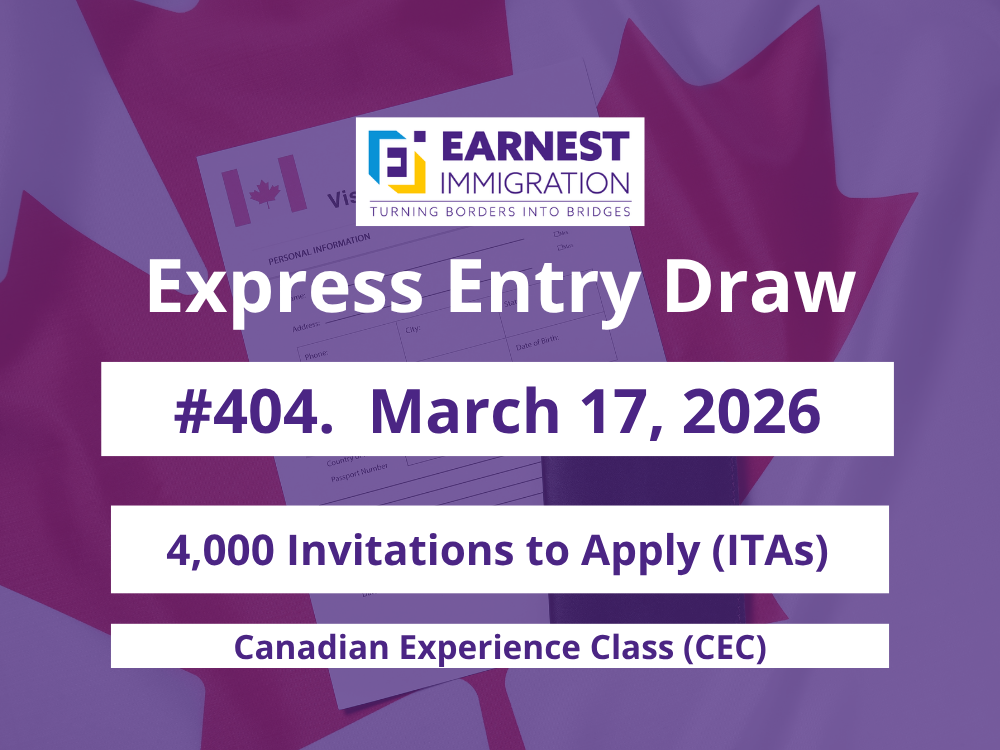
Immigration, Refugees and Citizenship Canada (IRCC) held Express Entry Draw 404 on March 17, 2026, issuing 4,000 Invitations to Apply (ITAs) to candidates under the Canadian Experience Class (CEC). The minimum CRS cut-off was 507 points, with a tie-breaking date of May 11, 2025, at 18:57:31 UTC.
Draw 404 is a landmark CEC round for one significant reason: the CRS of 507 is the lowest CEC-specific cut-off since August 2024 – an 18-month low. Every prior CEC draw in 2026 cleared at 508 or above. This one-point drop may appear small, but it signals something meaningful: the large-volume CEC draws of 2026 are steadily working through the pool at the 508 threshold, and the competitive floor is beginning to ease. For candidates who have been sitting at exactly 507, watching draw after draw pass them at 508, Draw 404 represents the moment they have been waiting for.
The draw also arrives the day after Draw 403 (a PNP round on March 16), making this the second consecutive daily draw. Together, Draws 403 and 404 issued 4,362 ITAs in 24 hours to two entirely different candidate populations – PNP nominees and CEC-eligible skilled workers – demonstrating the multi-stream efficiency of Canada’s category-based Express Entry system in full operation.
Table of Contents
ToggleKey Details of Express Entry Draw 404
| Draw Number | 404 |
| Date | March 17, 2026 |
| Program | Canadian Experience Class (CEC) |
| Invitations Issued | 4,000 |
| CRS Cut-off Score | 507 |
| Tie-breaking Rule | May 11, 2025, at 18:57:31 UTC |
Draw 404 Is a New 2026 CEC Low: What CRS 507 Means
Every CEC draw in 2026 prior to Draw 404 had cleared at CRS 508 or higher. The progression has been: 511 (January 7), 509 (January 21), 508 (February 17), 508 (March 3). Draw 404 breaks below that floor for the first time this year at 507 – the lowest CEC cut-off since Draw 312 in August 2024, which also cleared at 507 on 3,300 ITAs.
This downward movement is consistent with what large-volume CEC draws do over time: they clear the pool at the prevailing threshold, thinning the concentration of candidates at that score level and forcing the next draw’s cut-off marginally lower to fill the same invitation quota. With five CEC draws in 2026 now collectively issuing 28,000 ITAs, the pool of candidates at 508 and above has been steadily depleted, and the next reachable tier – the 507 band – is now entering scope.
For candidates currently sitting at 506 or 505, this trajectory is encouraging. The question is not whether the CEC cut-off will eventually reach their score, but how quickly – and that depends on IRCC’s draw frequency and volume, the pace of new profile entries, and the distribution of candidates clustering in the 505–510 range.
Comparison with Previous CEC Draws in 2026
Draw 404 can be most usefully compared with its immediate predecessor, Draw 400 (March 3, 2026), which was also a 4,000-ITA CEC round:
• Draw 400: 4,000 ITAs | CRS 508 | Tie-break: June 24, 2025 at 22:35:48 UTC
• Draw 404: 4,000 ITAs | CRS 507 | Tie-break: May 11, 2025 at 18:57:31 UTC
Both draws issued identical invitation volumes of 4,000 ITAs, yet the CRS dropped one point and the tie-breaking date moved backward by more than six weeks – from June 24, 2025 to May 11, 2025. This means IRCC is now inviting candidates whose profiles were submitted approximately 10 months before the draw date, compared to the 9-month gap seen in Draw 400.
| Draw | Date | CRS | Tie-break Date | Approx. Profile Age |
| Draw 400 | Mar 3, 2026 | 508 | Jun 24, 2025 | ~9 months prior |
| Draw 404 | Mar 17, 2026 | 507 | May 11, 2025 | ~10 months prior |
The receding tie-breaking date is a key signal. It means the pool at exactly CRS 507–508 is deep enough that after 4,000 ITAs, IRCC is still working through profiles submitted as far back as May 2025. Candidates who entered the pool at 507+ in June, July, or August 2025 are likely still waiting – but they are now closer to the front of the queue than at any point in 2026 so far.
Current Express Entry Pool Composition (March 15, 2026)
| CRS Score Range | Number of Candidates |
| 601–1200 | 360 |
| 501–600 | 13,039 |
| 451–500 | 72,558 |
| 491–500 | – |
| 481–490 | – |
| 471–480 | – |
| 461–470 | – |
| 451–460 | – |
| 401–450 | 64,638 |
| 351–400 | 53,565 |
| 301–350 | 18,903 |
| 0–300 | 8,299 |
| Total | 231,362 |
The pool as of March 15 shows 13,039 candidates in the 501–600 band. With Draw 404 issuing 4,000 ITAs primarily from the 507+ end of this band, the effective size of the CEC-eligible pool at 507 and above has been meaningfully reduced. The 451–500 band (72,558 candidates) is the largest in the pool and represents the cohort most directly served by downward CRS movement – every additional point the CEC cut-off drops brings thousands more candidates within reach. The broad question for the coming months is whether IRCC sustains high-volume CEC draws that continue to erode the 508–510 floor, or reduces volumes and allows the cut-off to stabilise or rise slightly.
Key Statistics: 2026 Express Entry Draws to Date (as of March 17, 2026)
• Total ITAs issued in 2026: 49,224 across 16 draws (Draws 389–404)
• CEC ITAs: 28,000 across 5 draws – 56.9% of all 2026 ITAs
• French-Language Proficiency ITAs: 14,000 across 2 draws – 28.4%
• Healthcare and Social Services ITAs: 4,000 (Draw 398) – 8.1%
• Provincial Nominee Program ITAs: 2,583 across 6 draws – 5.3%
• Physicians with Canadian Work Experience: 391 (Draw 397)
• Senior Managers with Canadian Work Experience: 250 (Draw 402)
• CEC draws in 2026: 5 rounds averaging 5,600 ITAs each
• New 2026 CEC low: CRS 507 – first time below 508 this year
• CRS 507 is the lowest CEC cut-off since August 2024 (18-month low)
What Does a CRS Score of 507 Look Like?
For candidates aiming at the 507–510 CEC threshold, understanding what profile characteristics typically generate scores in this range is essential for identifying where improvements can be made. The table below shows one illustrative combination – real profiles vary widely depending on age, education, language, and Canadian experience:
| CRS Factor | Points | Notes |
| Age 26, single | 110 | Maximum age points for candidates aged 20–29 |
| Master’s degree or doctorate | 150 | Highest available education points (single applicant) |
| IELTS CLB 9 all four bands | 124 | Strong but not perfect language score |
| 3+ years Canadian work experience | 80 | Maximum Canadian work experience points (CEC) |
| Canadian credential – 2-year diploma | 30 | Additional adaptability: Canadian education |
| Sibling in Canada (PR or citizen) | 15 | Family ties bonus |
| Approximate total | 509 | Illustrative only – actual profiles vary |
There is no single profile that defines a CRS of 507. A candidate with a lower education score might compensate with higher language scores, or vice versa. The critical point is that candidates near this threshold should review each CRS factor individually and identify which ones are currently below their potential maximum. The most commonly improvable factors are language scores (where a retake can add 10–30 points) and the profile submission date (which can be optimised by entering the pool as early as possible to maximise tie-breaking priority at any given score).
Understanding the Canadian Experience Class in 2026
What Is the Canadian Experience Class?
The Canadian Experience Class (CEC) is one of three federal immigration programs managed through Canada’s Express Entry system. It is specifically designed for temporary foreign workers and international graduates who have already gained skilled work experience in Canada. Unlike the Federal Skilled Worker Program (FSWP), which is open to candidates worldwide, the CEC is exclusively for people who are already in Canada or have recently been working here.
The CEC was designed on a simple and well-evidenced premise: immigrants who have already lived and worked in Canada integrate faster, succeed economically sooner, and require less settlement support than those arriving from abroad with no prior Canadian exposure. By channelling these candidates into permanent residence, Canada retains talent that it has already invested in through temporary permit pathways – primarily Post-Graduate Work Permits (PGWPs) for international graduates and employer-specific or open work permits for skilled workers.
CEC Eligibility Requirements in 2026
To qualify for the CEC, candidates must meet all of the following requirements at the time of application:
• At least 12 months of full-time (or equivalent part-time) skilled work experience in Canada within the three years immediately before applying – work must be in a NOC TEER 0, 1, 2, or 3 occupation. Note: the minimum was raised from 6 months to 12 months effective February 18, 2026 for new category-based draws; for straight CEC draws, always verify current requirements on the IRCC website
• Work experience must have been gained while authorised to work in Canada – this includes work performed on an employer-specific work permit, open work permit (including Post-Graduate Work Permit), Bridging Open Work Permit, or while holding Permanent Resident or Canadian Citizen status
• Minimum language proficiency: CLB 7 in all four abilities (reading, writing, speaking, listening) for NOC TEER 0 and 1 occupations; CLB 5 for TEER 2 and 3 occupations. Language must be tested with an IRCC-approved test: IELTS General Training or CELPIP-General for English; TEF Canada or TCF Canada for French
• Must intend to reside and work outside Quebec – candidates planning to settle in Quebec must use Quebec’s own immigration pathways
• No minimum education requirement – unlike the FSWP, the CEC does not require a minimum level of education. Candidates do not need an ECA for CEC-only applications
• No settlement funds requirement – unlike the FSWP, the CEC does not require proof of funds if the candidate is legally authorised to work in Canada and has an offer of employment, or is already working in Canada
The PGWP-to-CEC Pipeline: Why CEC Draws Are Larger in 2026
The consistently high CEC draw volumes in 2026 – 8,000, 6,000, 6,000, 4,000, and now 4,000 ITAs – reflect the maturation of an exceptionally large cohort of international students who graduated from Canadian post-secondary institutions between 2021 and 2023. This cohort obtained Post-Graduate Work Permits, spent 12 to 24 months accumulating Canadian skilled work experience, and began entering the Express Entry pool from 2023 onwards.
The scale of this cohort is the direct result of record international student enrolment in Canadian universities, colleges, and polytechnics in the 2019–2022 period. As those graduates transitioned to the workforce and then to Express Entry, the CEC sub-pool grew to hundreds of thousands of eligible candidates. IRCC’s response has been to issue large, frequent CEC draws throughout late 2025 and 2026 – the five 2026 CEC draws together issued 28,000 ITAs in under 11 weeks, compared to far smaller totals in prior equivalent periods.
For new PGWP holders who are now building their 12 months of qualifying Canadian experience, the implication is that they will be entering a pool that has been partially cleared by these large draws – which is broadly positive for their competitive prospects. The key variables are their language scores, the NOC classification of their work, and the date they enter the pool, all of which together determine their CRS and tie-breaking position.
Strategies for Candidates Below 507
For candidates currently in the pool below CRS 507, the 2026 CEC trend offers cautious optimism – but waiting passively for the cut-off to drop to your score is not a strategy. The most reliable actions are:
• Retake language tests: Language is the highest-leverage CRS factor for most candidates. A single additional IELTS or CELPIP band improvement can add 10–15 CRS points; achieving CLB 10 across all four bands on both tests can add 30+ points compared to a CLB 8 baseline. The cost of a retest is trivial compared to the months of additional pool time a higher score eliminates
• Add French proficiency: Achieving NCLC 7 or above in all four French abilities through TEF Canada or TCF Canada adds CRS points directly and unlocks the French-language proficiency draw category, which cleared at CRS 393–400 in 2026. It also adds the 25–50 point bilingualism bonus. For candidates at 460–500, developing French proficiency to NCLC 7 with English CLB 5+ may be the fastest available route to an ITA
• Enter the pool immediately if not yet active: The tie-breaking rule means that two candidates with identical CRS scores are ranked by their profile submission date. Every day you delay entering the pool pushes you further back in the tie-break queue for any future draw at your score. If your profile is eligible and accurate, enter the pool now – even if your score is below the current threshold
• Verify your NOC code accuracy: CEC eligibility is determined partly by NOC code. Ensure your NOC accurately reflects your actual job duties – not just your job title. An incorrect NOC code can affect eligibility, CRS calculation, and the strength of supporting documentation
• Pursue a provincial nomination: For candidates who cannot quickly improve their CRS to 507+, a provincial nomination adds 600 points and guarantees an ITA in the next PNP-specific draw. Provincial streams exist for most skilled occupations and income levels across Canada’s provinces and territories
What to Do After Receiving a CEC ITA
Candidates who received an ITA in Draw 404 have 60 days from the invitation date to submit a complete electronic Application for Permanent Residence (e-APR). The 60-day deadline is firm and cannot be extended. The most important actions after receiving an ITA are:
• Begin documentation immediately: Do not wait for day 30 or 40 to start gathering documents. Reference letters, police clearance certificates (especially from countries other than Canada), and educational credential assessments can take weeks to obtain. Request all documents on the day you receive your ITA
• Prepare employer reference letters: Each period of qualifying CEC work experience requires a reference letter on company letterhead, signed by a supervisor or HR representative, confirming your job title, NOC code, hours worked per week, annual salary, and dates of employment, along with a description of main duties. Letters must explicitly address each of these elements – missing elements are the most common documentation deficiency in CEC applications
• Arrange language tests if needed: Ensure your language test results are current – IELTS, CELPIP, TEF Canada, and TCF Canada results are typically valid for two years. If your results expire within the application period, you may need to retest. Do not submit an application with expired language results
• Book your medical examination: Medical exams with IRCC-designated physicians are valid for 12 months. Book as early as possible after receiving your ITA – in some cities and countries, appointment availability is limited
• Obtain police clearance certificates: Required from Canada (RCMP fingerprint-based clearance) and from every country where you have lived for 6 months or more since the age of 18. International certificates can take 4–12 weeks depending on the country – initiate these requests immediately
• Review your Express Entry profile for accuracy: The profile information you entered when creating your Express Entry account forms the basis of your permanent residence application. Discrepancies between the profile and supporting documents – different job titles, different dates, different NOC codes – are a common cause of procedural fairness letters. Review every field carefully before submitting
IRCC targets a six-month processing timeline for complete, accurate CEC applications submitted through Express Entry. Applications that are incomplete, inconsistent, or missing supporting documentation take longer and are at higher risk of a procedural fairness letter (which extends processing) or refusal. Investing time in document preparation in the first two to three weeks after receiving your ITA is the most important thing you can do to ensure a smooth process.
Frequently Asked Questions
I have exactly 507 CRS but my profile submission date is after May 11, 2025. Did I miss Draw 404?
Yes, if your CRS is exactly 507 and you submitted your profile after May 11, 2025 at 18:57:31 UTC, you were not selected in Draw 404. The tie-breaking rule means that when more candidates have the minimum score than there are invitations available, IRCC prioritises those who entered the pool earliest. However, this does not mean you will miss future draws indefinitely. As IRCC holds more CEC draws and continues to clear profiles at the 507+ threshold, your tie-breaking position improves with each draw that removes candidates who submitted before you. Maintaining an active profile at the highest CRS score you can achieve – and entering the pool as early as possible – maximises your tie-breaking priority for upcoming rounds.
My CRS score is 506. How realistic is it that a future CEC draw will reach me?
Based on the 2026 trend, it is plausible but not certain that CEC draws will reach CRS 506 in the coming weeks or months. The downward movement from 511 in January to 507 in March – a 4-point drop across five draws – suggests the CRS is eroding gradually rather than falling sharply. The pace of further drops depends on IRCC’s draw volumes and the density of candidates clustered at 506–508. A large draw (8,000+ ITAs, as seen in January 2026) would have a more pronounced downward effect than a 4,000-ITA round like Draw 404. While waiting, candidates at 506 should also evaluate alternative pathways: French proficiency, healthcare or other occupation categories, and provincial nominations are all worth assessing in parallel. Relying solely on a CEC draw at 506 is not a strategy – exploring parallel options is.
I work on a PGWP and my permit expires in eight months. Should I apply for CEC now or wait for a higher-scoring draw?
Apply now. Work permit expiry is a critical constraint in Express Entry planning and the consequences of running out of status while your application is pending can be severe. If your CRS is competitive and you have sufficient qualifying work experience, you should enter the pool immediately and pursue an ITA actively, rather than waiting for a marginally better CRS position. IRCC does allow candidates to apply for a Bridging Open Work Permit (BOWP) once they have submitted an Express Entry permanent residence application – this allows you to continue working in Canada on an open work permit while your PR application is processed, even if your original PGWP expires during that period. However, you must have submitted your PR application before your PGWP expires to be eligible for a BOWP. Timing is everything: the earlier you receive an ITA and submit your application, the more runway you have before permit expiry becomes a concern.
My employer reference letter describes my duties in general terms. Is that sufficient for a CEC application?
It depends on whether those general terms clearly establish that you performed skilled work duties corresponding to your claimed NOC code. IRCC’s standard for CEC reference letters is that they must confirm your job title, NOC code, hours worked per week, annual salary, and dates of employment – and provide a description of your main duties. For the duties description, the level of specificity that meets the standard depends on the occupation. For straightforward occupations with well-established NOC descriptions (such as registered nurse, software developer, or financial analyst), a duties description that clearly maps to the NOC occupation description is usually sufficient. For more complex or hybrid roles, a more detailed letter that specifically describes tasks and responsibilities is preferable. If your letter is vague – describing you as having performed ‘general management duties’ without specifics – an IRCC officer may find it insufficient and issue a procedural fairness letter requesting clarification. Reviewing your letter against the NOC occupation description for your code before submitting is a useful self-check.
I had 12 months of work experience on a work permit, but I had a 3-week gap between two permits during which I was technically not authorised to work. Does that break my continuity?
A gap between work permits does not automatically disqualify your work experience, but the experience must be assessed on the basis of what was accumulated while you were authorised to work. If you have a 3-week gap, the months of qualifying experience earned before and after the gap are still counted – the gap itself is simply not included in the calculation. What matters is whether your total authorised Canadian work experience in a qualifying NOC occupation, within the 3-year window before applying, adds up to at least 12 full-time months. In your case, if you have 12 months of authorised work experience before and after the gap combined, you meet the threshold. However, if the gap creates any ambiguity about whether you were working without authorisation during that period, you should be prepared to provide documentation (permit history, payroll records, absence records) that clearly shows the gap was a period of non-work, not unauthorised work. Working without authorisation – even briefly – is a serious admissibility issue and must be distinguished clearly from an authorised gap.
If I receive an ITA and my application is approved, will I automatically get to keep my CRS score benefits (like Canadian education points) after landing?
Your CRS score is relevant only for the purpose of receiving an ITA – it is the ranking mechanism for selection, not a permanent benefit. Once you land as a permanent resident, your CRS score has no ongoing significance. Your rights, benefits, and obligations as a permanent resident are defined by the Immigration and Refugee Protection Act, not by your Express Entry CRS profile. In practical terms: Canadian education credentials you earned remain your credentials; work experience in Canada remains on your resume; language proficiency you demonstrated remains your demonstrated proficiency. These are real-world assets, not CRS constructs – and they continue to benefit you in the Canadian labour market regardless of your immigration status.
The Bottom Line
Express Entry Draw 404 issued 4,000 ITAs to CEC candidates at a CRS of 507 on March 17, 2026 – a new 2026 low and the lowest CEC cut-off in 18 months. One point below the 508 threshold that defined every prior 2026 CEC draw, it signals that the large-volume CEC rounds of this year are beginning to clear the pool at that level and the competitive floor is edging downward. For candidates who have been positioned just below 508, this draw is both a near-miss and a clear indication of where momentum is heading.
The broader 2026 CEC picture – five draws, 28,000 ITAs, five consecutive draws in three months – shows a system operating at high throughput in this category. The tie-breaking date of May 2025, now nearly 10 months in the past, tells candidates with profiles submitted since mid-2025 that they are progressively moving to the front of the queue as each draw clears those before them.
At Earnest Immigration, our licensed consultants help CEC candidates calculate their current CRS precisely, identify the fastest available score improvements, assess whether alternative pathways (French language, occupation categories, or PNP) are available in parallel, and prepare complete, well-documented permanent residence applications within the 60-day ITA window. Whether you received an ITA in Draw 404, or are still in the pool working toward your first invitation, Earnest Immigration is here to guide you. Contact us today for a comprehensive profile assessment.