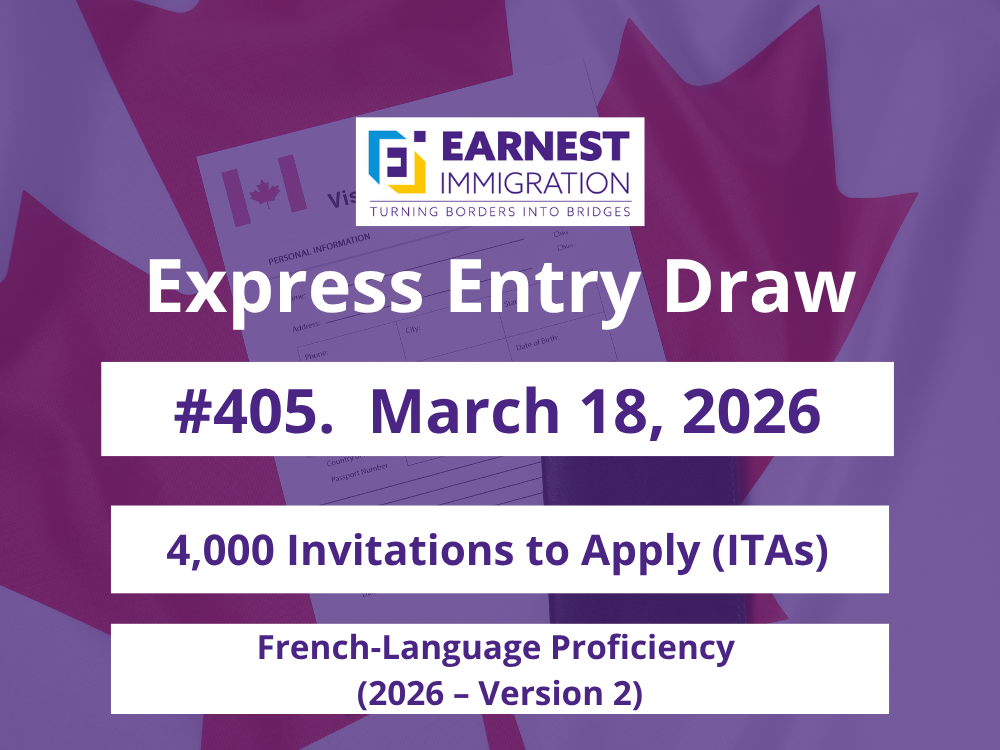
Immigration, Refugees and Citizenship Canada (IRCC) held Express Entry Draw 405 on March 18, 2026, issuing 4,000 Invitations to Apply (ITAs) to candidates under the French-Language Proficiency category (2026 – Version 2). The minimum CRS cut-off was 393 points, with a tie-breaking date of December 29, 2025, at 12:47:31 UTC.
Draw 405 is a landmark round for French-language candidates: a CRS of 393 is the lowest French draw cut-off of 2026, and the first time a French-language proficiency draw has ever cleared below the 400-point threshold in the history of Express Entry. The previous low was 397 (Draw 401, March 4) – itself a record at the time. With each successive 2026 French draw producing a new historic low, the downward trajectory is now unmistakable. At 393, IRCC invited French-speaking candidates at a CRS level that is 114 points below the concurrent CEC threshold of 507, and 74 points below healthcare draw cut-offs. No other pathway in the system offers this combination of accessibility and invitation volume.
Draw 405 is also the third draw in four consecutive days: a PNP draw on March 16 (Draw 403), a CEC draw on March 17 (Draw 404), and now this French round on March 18. Together, Draws 403, 404, and 405 issued 8,362 ITAs across three separate candidate populations in 72 hours – a sustained operational pace that confirms IRCC is running Express Entry at maximum throughput in the first quarter of 2026.
Table of Contents
ToggleKey Details of Express Entry Draw 405
| Draw Number | 405 |
| Date | March 18, 2026 |
| Category | French-Language Proficiency (2026 – Version 2) |
| Invitations Issued | 4,000 |
| CRS Cut-off Score | 393 |
| Tie-breaking Rule | December 29, 2025, at 12:47:31 UTC |
Breaking Below 400: What CRS 393 Means for French-Language Candidates
The 400-point threshold has long been an informal psychological benchmark in the French-language draw series – a floor below which no draw had ever reached. Draw 405 has broken that floor for the first time. At CRS 393, IRCC is now inviting French-speaking candidates whose total Express Entry scores are below what most people would consider even moderately competitive in any other stream. To put 393 in context:
• CEC draws in 2026 require CRS 507–511 – a gap of 114–118 points above Draw 405
• Healthcare draws require CRS 467 – a gap of 74 points above Draw 405
• Senior Managers draws require CRS 429 – a gap of 36 points above Draw 405
• PNP draws require CRS 710–789 – but this reflects the 600-point nomination bonus; the effective base score requirement is actually lower
A CRS of 393 is achievable by a wide range of candidates: younger workers with moderate (not exceptional) English skills, candidates with foreign education who have not completed an ECA, older candidates whose age penalties have reduced their overall score, and candidates outside Canada who lack Canadian work experience points entirely. The single common factor is French proficiency at NCLC 7 or above in all four abilities. For anyone who meets that language threshold, the 2026 French-language draw series is the most accessible federal immigration pathway in Canada’s history.
The 2026 French Draw Trend: A Consistent Downward CRS Pattern
All three French-language draws of 2026 have produced new record lows for this category. The pattern is clear and consistent:
| Draw # | Date | CRS | ITAs | Tie-breaking Date | Version |
| 394 | Feb 6, 2026 | 400 | 8,500 | Feb 3, 2026 | Version 2 |
| 401 | Mar 4, 2026 | 397 | 5,500 | Oct 10, 2025 | Version 2 |
| 405 | Mar 18, 2026 | 393 | 4,000 | Dec 29, 2025 | Version 2 |
Across the three 2026 French draws, the CRS has fallen 7 points – from 400 to 393 – while the total ITAs issued have varied from 4,000 to 8,500. The tie-breaking dates follow an unusual pattern: Draw 394’s tie-break was February 3, 2026 (just days before the draw), while Draw 401’s was October 10, 2025 (nearly 5 months prior), and Draw 405’s is December 29, 2025 (about 11 weeks prior). This non-linear movement of the tie-breaking date reflects the dynamics of the French-language sub-pool: Draw 394 nearly cleared it entirely at 8,500 ITAs (requiring a very recent tie-break date), while the smaller 4,000-5,500 ITA draws do not clear the pool as thoroughly, leaving more candidates with mid-2025 to late-2025 profile dates still waiting. Candidates who entered the pool with qualifying French scores in January and February 2026 are likely next in the queue for future French draws.
Three Draws in Three Days: March 16–18, 2026
The sequence of Draws 403, 404, and 405 demonstrates IRCC’s capacity to run distinct draw types on consecutive days without any overlap in candidate pools:
• March 16 – Draw 403 (PNP): 362 ITAs at CRS 742 – provincial nominees with the 600-point bonus
• March 17 – Draw 404 (CEC): 4,000 ITAs at CRS 507 – candidates with Canadian skilled work experience
• March 18 – Draw 405 (French): 4,000 ITAs at CRS 393 – candidates with NCLC 7+ French proficiency
The three draws collectively issued 8,362 ITAs in 72 hours. A candidate in the pool could in theory be eligible for all three draws simultaneously – for example, a provincially nominated CEC candidate with strong French scores. In that case, they would receive an ITA in whichever draw reached their profile first. However, for most candidates, the three draws serve distinct populations with minimal overlap, each clearing a different tier of the pool with different eligibility criteria.
2026 Express Entry ITAs by Category (as of March 18, 2026)
| Category | Draws | ITAs Issued | % of Total |
| Canadian Experience Class | 5 | 28,000 | 52.7% |
| French-Language Proficiency | 3 | 18,000 | 33.9% |
| Healthcare and Social Services | 1 | 4,000 | 7.5% |
| Provincial Nominee Program | 6 | 2,583 | 4.9% |
| Physicians with Canadian Work Exp. | 1 | 391 | 0.7% |
| Senior Managers with Canadian Work Exp. | 1 | 250 | 0.5% |
| Total | 17 | 53,224 | 100% |
Draw 405 brings the French-Language Proficiency total to 18,000 ITAs across three draws – 33.9% of all 2026 Express Entry invitations. This makes the French-language category the second most prolific by volume in 2026, trailing only CEC draws (28,000 ITAs, 52.7%) but ahead of every other category by a wide margin. The combined CEC and French total accounts for 86.6% of all 2026 ITAs, confirming that the two categories together form the overwhelming core of Canada’s Express Entry activity this year.
Express Entry Pool Composition (March 15, 2026)
| CRS Score Range | Number of Candidates |
| 601–1200 | 360 |
| 501–600 | 13,039 |
| 451–500 | 72,558 |
| 401–450 | 64,638 |
| 351–400 | 53,565 |
| 301–350 | 18,903 |
| 0–300 | 8,299 |
| Total | 231,362 |
At CRS 393, Draw 405 invited candidates from the lower end of the 351-400 band, which contains 53,565 candidates. This is the third-largest band in the pool and the one most directly served by low-CRS category draws. The key insight is that this band – 53,565 candidates – is now within the French-language draw’s reach, whereas it was previously unreachable by any Express Entry draw type except PNP. For every candidate in this range who has NCLC 7+ French proficiency, the question is no longer whether a draw will reach them – it already has. The question is whether their profile is in the pool, accurate, and eligible.
Key Statistics: 2026 Express Entry Draws to Date (as of March 18, 2026)
• Total ITAs issued in 2026: 53,224 across 17 draws (Draws 389–405)
• French-Language ITAs: 18,000 across 3 draws – 33.9% of all 2026 ITAs
• New 2026 French record low: CRS 393 – first ever French draw below 400
• 2026 French draw CRS trend: 400 (Draw 394) → 397 (Draw 401) → 393 (Draw 405) – down 7 points across three rounds
• Total French ITAs in 2026 are 33.9% of all ITAs, second only to CEC (52.7%)
• IRCC’s francophone immigration target outside Quebec: 9% of total economic admissions in 2026, rising to 12% by 2029
• No general all-program draw has been held in 2026 – all draws have been category-specific or program-specific
Understanding the French-Language Proficiency Category
Why Canada’s Francophone Immigration Target Drives Low CRS Cut-offs
The consistently low and declining CRS cut-offs in French-language draws are not accidental – they are a direct expression of deliberate federal policy. IRCC has set a target of 9% Francophone admissions outside Quebec for 2026, rising to 12% by 2029. These targets exist because French-speaking communities outside Quebec have been declining as a share of Canada’s national population for decades, and without sustained immigration, many of these communities face challenges maintaining French-language schools, services, healthcare, and cultural institutions.
To meet these targets, IRCC must invite enough French-speaking candidates through Express Entry to generate the required number of permanent residence applications. The French-language proficiency category is the primary federal mechanism for this – and the low CRS cut-offs reflect IRCC’s willingness to pull candidates with moderate overall profiles into the immigration system if they can demonstrate genuine French language proficiency. The $137.2 million allocated over five years in the 2023-2028 Official Languages Action Plan for Francophone immigration further underlines the government’s commitment to this policy direction.
In practical terms, this means French-language draws will continue to be a feature of the Express Entry calendar in 2026, and the CRS cut-offs are likely to remain accessible – possibly declining further – as IRCC works to meet its francophone immigration targets within the overall 2026 admission cap of 380,000 permanent residents.
Eligibility Requirements for the French-Language Proficiency Category
To be eligible for a French-language proficiency draw, candidates must meet all of the following:
• Hold an active Express Entry profile under at least one of the three eligible programs: Federal Skilled Worker Program (FSWP), Canadian Experience Class (CEC), or Federal Skilled Trades Program (FSTP) – and meet all eligibility requirements for that program
• Have French-language test results showing a minimum score of NCLC 7 in all four language abilities – reading, writing, speaking, and listening – from an approved test: TEF Canada or TCF Canada. Standard TEF or TCF (non-Canada versions) are not accepted
• Test results must be less than two years old at the time the ITA is received and at the time the permanent residence application is submitted
• No minimum English score is required to be eligible for this category, though English scores will still contribute to the overall CRS
• Must intend to reside outside Quebec – candidates planning to settle in Quebec are managed under Quebec’s own immigration system and are not eligible for federal Express Entry draws
How French Proficiency Affects Your Total CRS Score
French proficiency impacts a candidate’s CRS in multiple ways – as a direct language score, as a secondary language score, and through the bilingualism bonus. Understanding all three mechanisms is essential for optimising a French-language Express Entry profile:
| CRS Factor | Points Range | Notes |
| French as First Official Language – NCLC 7 (all bands) | Up to 128 | Primary language factor points for strong French |
| French as Second Official Language – NCLC 5+ | Up to 22 | Secondary language points if English is primary |
| Bilingualism bonus – NCLC 7+ French + CLB 4 English | +25 | Additional bonus on top of language factor points |
| Bilingualism bonus – NCLC 7+ French + CLB 5+ English | +50 | Maximum bilingualism bonus – most impactful scenario |
| Bilingualism bonus – NCLC 9+ French + CLB 5+ English | +50 | NCLC 9 does not increase the bonus beyond 50 points |
The 50-point bilingualism bonus – earned by having NCLC 7+ in French and CLB 5+ in English – is among the most valuable single CRS bonuses available. To put it in perspective: the difference between CLB 7 and CLB 10 in one English language ability is approximately 6 CRS points. The bilingualism bonus at 50 points is equivalent to nearly the full CRS gain from improving your English from CLB 7 to the maximum across all four abilities. For candidates who already have functional English at CLB 5 or above, developing French to NCLC 7 delivers the bilingualism bonus on top of all their other language score improvements – and simultaneously unlocks the French-language draw category with its dramatically lower CRS threshold.
The Two Pathways French Opens: Lower CRS Draws AND Higher CEC Scores
French proficiency creates a dual benefit that is frequently underappreciated by candidates. It works at two levels simultaneously:
• Direct pathway: French language draws at CRS 393-400 – accessible to candidates with moderate overall profiles who would never reach the CEC threshold. This pathway is available immediately once NCLC 7 is achieved, regardless of other profile factors
• Boosted CEC competitiveness: The bilingualism bonus of 25-50 points improves a candidate’s CRS across all draw types. A candidate currently at CRS 462 with strong English who develops French to NCLC 7 and CLB 5+ English may find their total CRS moves to 512 – above the CEC threshold – while also being eligible for French draws at 393
This dual benefit makes French proficiency the highest-leverage single investment available in 2026 Express Entry for the widest range of candidate profiles. Whether a candidate is looking for an immediate pathway via French draws, or seeking to break through the CEC threshold, French language development serves both goals simultaneously.
Preparing for a French-Language Draw: A Step-by-Step Approach
For candidates who are not yet eligible for the French-language category, the preparation process is structured and achievable for most motivated candidates:
• Step 1 – Baseline assessment: Before investing significant time in French preparation, take a diagnostic assessment (available through Alliance Francaise, many community colleges, or online platforms) to establish your current approximate NCLC level. Candidates at NCLC 4-5 typically need 6-12 months of structured preparation to reach NCLC 7; candidates at NCLC 6 may need as few as 2-4 months with intensive focus
• Step 2 – Structured instruction: Enrol in a structured French course rather than relying solely on self-study. Options include Alliance Francaise programmes (available in most major cities and online), government-funded language training (free for eligible temporary residents in some provinces), online platforms such as TV5MONDE and Kwiziq, and private tutors who specialize in TEF/TCF preparation for immigration candidates. The speaking and writing components of the test are the most commonly challenging for candidates; structured feedback from a qualified instructor is essential for these components
• Step 3 – Test-specific preparation: TEF Canada and TCF Canada have specific formats, time constraints, and assessment criteria that differ from general language tests. Use official practice materials and familiarise yourself with the exact format of each component before test day
• Step 4 – Register early: TEF Canada and TCF Canada are offered at authorised testing centres across Canada and in select international cities. Availability is limited and seats can book out weeks or months in advance, especially in major centres. Register as soon as you are ready to test – do not wait until you feel completely prepared
• Step 5 – Update your profile immediately: Once you receive qualifying results, update your Express Entry profile without delay. Your CRS will be recalculated immediately, and you will become eligible for the next French draw. Given that French draws have been held approximately every 4-6 weeks in 2026, prompt profile updates maximise the number of draws you are eligible for
What to Do After Receiving a French-Language ITA
Candidates who received an ITA in Draw 405 have 60 days to submit a complete permanent residence application. The required documents depend on the Express Entry program underpinning the profile (FSWP, CEC, or FSTP), but all French-language draw applicants must include:
• Valid French language test results (TEF Canada or TCF Canada) showing NCLC 7 or higher in all four abilities – test date must be within 2 years at time of submission
• Valid English language test results (if claiming English language CRS points) – IELTS General Training or CELPIP-General, within their 2-year validity window
• Proof of qualifying work experience: reference letters confirming job title, NOC code, duties, hours per week, salary, and employment dates – one letter per employer for each qualifying period
• Educational Credential Assessment (ECA) if claiming foreign education points under FSWP – from an IRCC-approved organisation such as WES, IQAS, or ICES
• Police clearance certificates from Canada and all countries of residence for 6 months or more since age 18 – initiate these requests on the day the ITA is received
• Medical examination from an IRCC-designated physician – valid for 12 months from examination date
• Proof of settlement funds (for FSWP applicants without a valid Canadian job offer) – current thresholds published on IRCC’s website
• Valid passport covering the full processing period
IRCC targets a six-month processing timeline for complete Express Entry applications. For French-language draw applicants who qualified under FSWP (no prior Canadian work experience), the most commonly missing or deficient documents are the ECA, foreign reference letters, and police certificates from countries with slow processing times. Initiating all of these requests on day one of the 60-day window is the single most important action after receiving an ITA.
Frequently Asked Questions
My CRS is 388 and I have NCLC 7 in all four French abilities. Did Draw 405 invite me?
Yes – if your CRS was 393 or above and your profile was active at the time of the draw, you were within the invited range. However, if your CRS is 388, you were not invited in Draw 405, which had a cut-off of 393. A score of 388 would have been below the threshold. That said, based on the downward trend in French draw cut-offs – from 400 to 397 to 393 across 2026’s three French draws – scores in the 385-392 range may become eligible in future draws if the trend continues. In the meantime, reviewing your profile for any available CRS improvements is worthwhile: even a 5-point gain from an English language retest or an additional qualification could push your score to 393 or above.
I am currently in Canada on a study permit completing my final semester. Can I apply for a French draw now?
You may be eligible for a French-language draw if you meet the requirements of at least one Express Entry program – most likely the Federal Skilled Worker Program (FSWP) if you have prior work experience, or the Canadian Experience Class (CEC) if you have already accumulated 12 months of qualifying Canadian skilled work experience. Study permit holders who are only studying (not working) typically do not have qualifying work experience for Express Entry. However, if you have worked on a co-op, internship, or part-time permit alongside your studies, that experience may count toward FSWP or CEC eligibility depending on the NOC code and hours worked. The critical step is to assess your Express Entry program eligibility before entering the pool – a profile that is not eligible for any Express Entry program will not receive an ITA regardless of CRS or French scores.
I scored NCLC 7 in reading, writing, and listening but NCLC 6 in speaking. What should I focus on to qualify?
Speaking is the most commonly challenging component of TEF Canada and TCF Canada for candidates who have learned French primarily through reading and writing rather than conversation. To improve your NCLC speaking score specifically, the most effective approaches are: regular structured conversation practice with a native or near-native French speaker (either a tutor, language partner, or conversation group); test-specific preparation for the oral production and oral interaction sections of TEF Canada or TCF Canada, which have specific task formats; and recording yourself speaking to identify and correct pronunciation, hesitation, and grammatical patterns that may be reducing your score. Candidates typically find that 2-3 months of intensive speaking-focused practice is sufficient to move from NCLC 6 to NCLC 7 in that single ability, provided the other three abilities are already strong.
Does achieving NCLC 8 or 9 help me more than NCLC 7 for French draw eligibility?
For the French-language proficiency draw category specifically, the minimum eligibility threshold is NCLC 7 in all four abilities – there is no additional advantage for being eligible for the draw at NCLC 8 or 9 versus NCLC 7. Eligibility is binary: you either meet NCLC 7 in all four abilities or you do not. However, higher French scores do increase your CRS points under the language factor – both for French as a first official language and for French as a second official language – which improves your position within the eligible sub-pool and may be relevant for tie-breaking at the minimum cut-off. Higher French scores also have secondary benefits: they may help you qualify for FSWP under its language selection factor, and they contribute to your overall CRS for CEC draws where you might also be competitive.
I applied under a previous French draw (Draw 394) and received an ITA but withdrew my application. Can I re-enter the pool for Draw 405 or future draws?
Withdrawing a permanent residence application after receiving an ITA does not permanently bar you from future Express Entry draws. You can re-enter the pool by creating a new Express Entry profile (or reactivating an existing one) with current and valid supporting information, including up-to-date language test results. However, when you re-enter, your profile submission date is reset to the new entry date – which means you lose any tie-breaking priority you had from your original earlier profile date. In a situation where you withdrew your application, it is important to ensure your French language test results are still within their 2-year validity window before re-entering. If your TEF Canada or TCF Canada results have expired or are approaching expiry, you should retest before re-entering the pool to ensure your new profile remains eligible for upcoming French draws.
I intend to settle in New Brunswick, which is Canada’s only officially bilingual province. Are there any additional advantages to choosing New Brunswick as my destination?
New Brunswick offers meaningful practical advantages for French-speaking immigrants. As Canada’s only officially bilingual province, all provincial government services, courts, education, and healthcare are available in both official languages – eliminating the language barriers that French speakers may encounter in other provinces. New Brunswick’s provincial nominee program (NBPNP) has dedicated streams for French-speaking workers in in-demand occupations, which may provide an additional pathway to nomination in parallel with your federal French Express Entry draw strategy. The province also has established Francophone communities, particularly in the north and northeast, with French-language schools, social services, and employment networks. For candidates who are genuinely committed to building a life in a fully bilingual environment and want to contribute to a Francophone community, New Brunswick is a natural destination – and the additional PNP options available there make it worth including in your strategic planning.
The Bottom Line
Express Entry Draw 405 issued 4,000 ITAs to French-language proficiency candidates at a CRS of 393 on March 18, 2026 – a new record low for this category and the first French draw in Express Entry history to clear below 400. Coming one day after the CEC round (Draw 404) and two days after the PNP round (Draw 403), it completes a remarkable three-draw sequence that issued 8,362 ITAs across three separate candidate populations in 72 hours. The message from IRCC is unambiguous: French proficiency is a premium asset in Canada’s 2026 immigration system, and the door for French-speaking skilled workers has never been wider open.
With the three 2026 French draws collectively issuing 18,000 ITAs at cut-offs of 400, 397, and now 393 – each round setting a new record – the trajectory points toward further accessible cut-offs in future rounds. For candidates who are already at NCLC 7 but have not yet received an ITA, the tie-breaking date of December 29, 2025 means those who entered the pool before that date were invited; those who entered later are progressively moving toward the front of the queue. For candidates who are not yet at NCLC 7, the case for prioritising French language development has never been stronger.
At Earnest Immigration, our licensed consultants help French-language candidates assess their NCLC scores and Express Entry program eligibility, optimise their CRS profile for both French draws and CEC draws simultaneously, and prepare complete, well-documented permanent residence applications within the 60-day ITA window. Whether you are starting your French language journey, waiting in the pool for the next French draw, or have just received an ITA in Draw 405, the Earnest Immigration team is here to guide you to permanent residence. Contact us today for a comprehensive profile assessment.