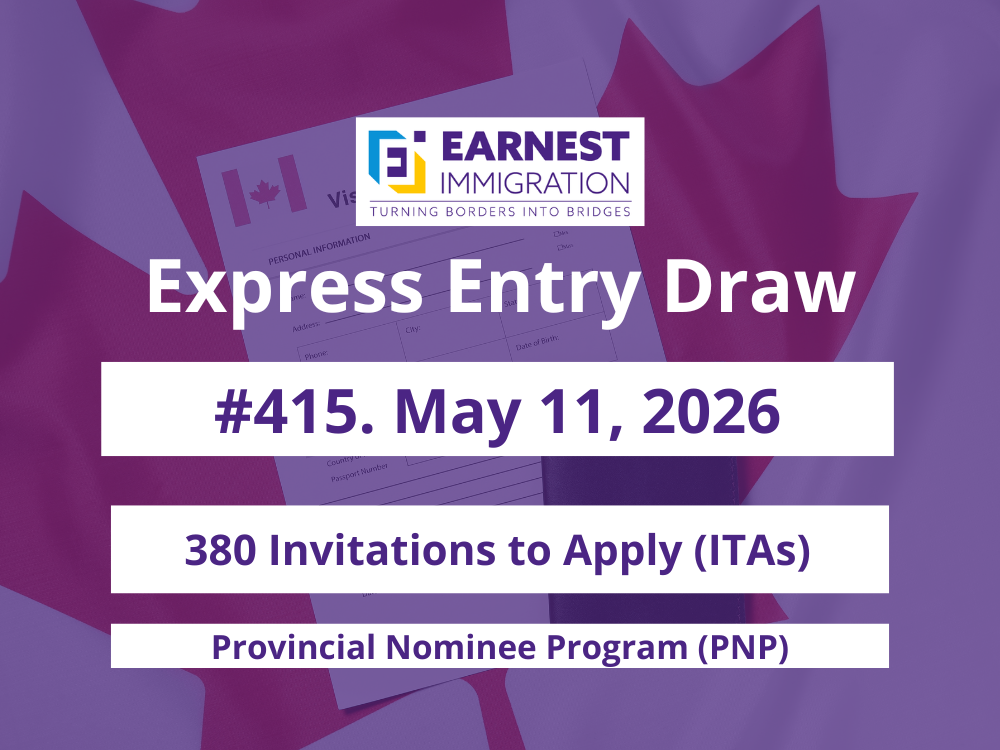
Immigration, Refugees and Citizenship Canada (IRCC) opened May 2026 with Express Entry Draw 415 on May 11, 2026, issuing 380 Invitations to Apply (ITAs) exclusively to candidates under the Provincial Nominee Program (PNP). The minimum CRS cut-off was 798 points, with a tie-breaking date of January 7, 2026, at 05:23:31 UTC.
Draw 415 is the tenth PNP-specific draw of 2026 and the twenty-seventh Express Entry draw of the year. It arrives 12 days after the April 27-28-29 three-draw burst that issued 6,473 ITAs and represents the first Express Entry draw of May. Two features stand out immediately: the ITA count has moderated from Draw 412’s rebound of 473 back to 380, and the tie-breaking date of January 7, 2026 — over four months prior — reveals that a cohort of January-vintage nominated candidates is still working through the queue at CRS 798.
Draw 415 also arrives against a significant policy backdrop: the federal government’s public consultation on proposed Express Entry reforms was underway at the time of this draw, with the consultation deadline set for May 24, 2026. The proposed reforms — including a unified pathway replacing the three existing programs and a restructured CRS scoring model — are discussed further below. No changes have taken effect yet; the current system governs this draw and all draws until any future reforms are formally implemented.
Table of Contents
ToggleKey Details of Express Entry Draw 415
| Draw Number | 415 |
| Date | May 11, 2026 |
| Program | Provincial Nominee Program (PNP) |
| Invitations Issued | 380 |
| CRS Cut-off Score | 798 |
| Tie-breaking Rule | January 7, 2026, at 05:23:31 UTC |
CRS 798: Understanding the Base Score
A CRS of 798 in a PNP draw is understood correctly only through the 600-point provincial nomination bonus. The competitive threshold is the base score — the human capital score before nomination is applied.
| Factor | Points | Profile Type | Total CRS |
| Base CRS (e.g., CLB 8, bachelor’s, 2 yrs exp, age 35) | ~185 | Moderate profile | 785 total — below 798 |
| Base CRS (e.g., CLB 9, bachelor’s, 3 yrs exp, age 29) | ~198 | Strong profile | 798 total — exactly at cut-off |
| Provincial Nomination bonus | +600 | Automatic on nomination | Applied to any base score |
At a cut-off of 798, the effective base score is approximately 198. This is a moderately strong human capital profile — a candidate in their late 20s to early 30s with a bachelor’s degree, CLB 9 English, and 2-3 years of skilled work experience can reach this level. The 3-point increase from Draw 412 (795) to Draw 415 (798) corresponds to a base score requirement rising from approximately 195 to 198 — reflecting that nominated candidates entering the pool in the 12 days since Draw 412 tend to have slightly stronger human capital profiles than the cohort cleared by that draw.
ITA Count at 380: A Moderated Replenishment
Draw 415’s 380 ITAs falls between Draw 409’s trough (324, the lowest PNP count of 2026) and Draw 412’s rebound (473). Three factors explain the modest volume:
- 12-day inter-draw gap: With only 12 days between Draw 414 (April 29) and Draw 415 (May 11), provinces had less time to issue new nominations and have nominees upload them to Express Entry profiles. Fewer new nominations accumulated in the pool compared to the 14-day gap before Draw 412
- April 27-28-29 burst cleared adjacent pools: The three-draw burst of April 27-29 did not directly clear PNP candidates — only Draw 412 (PNP) did. However, the large French and CEC draws that followed may have absorbed nominees who were also CEC-eligible, slightly reducing the overlap in the pool at CRS 795-800
- Pool composition at 798+: The 601-1200 band as of May 10 shows approximately 380 candidates — a near-perfect match to the ITAs issued, confirming IRCC cleared essentially the full nominated sub-pool available at CRS 798 in this draw
All 2026 PNP Express Entry Draws
| Draw # | Date | CRS | ITAs | Tie-breaking Date |
| 415 | May 11 | 798 | 380 | Jan 7, 2026 |
| 412 | Apr 27 | 795 | 473 | Apr 13, 2026 |
| 409 | Apr 13 | 786 | 324 | Nov 19, 2025 |
| 406 | Mar 30 | 802 | 356 | Feb 12, 2026 |
| 403 | Mar 16 | 742 | 362 | Oct 5, 2025 |
| 399 | Mar 2 | 710 | 264 | Aug 7, 2025 |
| 395 | Feb 16 | 789 | 279 | Sep 5, 2025 |
| 393 | Feb 3 | 749 | 423 | Dec 16, 2025 |
| 391 | Jan 20 | 746 | 681 | Nov 19, 2025 |
| 389 | Jan 5 | 711 | 574 | Oct 6, 2025 |
Ten PNP draws have now issued a cumulative 4,116 ITAs in 2026. The CRS range across all ten draws (710 to 802) reflects the inherent volatility of the nominated sub-pool composition. The ITA trend peaked in January (681), moderated to a low of 264 in March, partially recovered in April-May (473 and 380), and is now oscillating in the 320-480 range. This pattern is consistent with a PNP pipeline that is functioning steadily at a mature provincial nomination allocation level — not spiking dramatically nor collapsing.
2026 Express Entry ITAs by Category (as of May 11, 2026)
| Category | Draws | ITAs | % of Total |
| Canadian Experience Class | 8 | 34,250 | 47.6% |
| French-Language Proficiency | 5 | 26,000 | 36.1% |
| Healthcare and Social Services | 1 | 4,000 | 5.6% |
| Trades Occupations | 1 | 3,000 | 4.2% |
| Provincial Nominee Program | 10 | 4,116 | 5.7% |
| Physicians with Canadian Work Exp. | 1 | 391 | 0.5% |
| Senior Managers with Canadian Work Exp. | 1 | 250 | 0.3% |
| Total | 27 | 72,007 | 100% |
The PNP share remains at 5.7% of the 72,007 year-to-date total — modest in volume but consistent in frequency, with 10 of the 27 draws being PNP-specific. CEC (47.6%) and French (36.1%) together account for 83.7% of all 2026 ITAs. The pattern established across the first four months continues: Canada’s Express Entry system is running primarily as a CEC and French draw engine, with regular PNP pulses every one to two weeks to clear nominated candidates. The next expected draws — a CEC round and potentially a French or category draw — are anticipated in mid-to-late May.
Express Entry Pool Composition (May 10, 2026)
| CRS Score Range | Number of Candidates |
| 601-1200 | ~380 |
| 501-600 | ~11,200 |
| 451-500 | 74,000+ |
| 401-450 | ~64,200 |
| 351-400 | ~52,600 |
| 301-350 | ~18,900 |
| 0-300 | ~8,300 |
| Total | 233,770 |
The pool shrank to 233,770 candidates as of May 10, down from 234,452 on April 26. Despite multiple draws in April, new profile submissions were insufficient to offset the combined effect of ITAs issued and profiles expiring. The 601-1200 band at approximately 380 candidates — almost precisely matching the ITAs issued in Draw 415 — confirms near-complete clearance of the nominated sub-pool. The 451-500 band continues its stubborn hold above 74,000 candidates, remaining the largest and least-served cohort in the pool under current CEC draw volumes.
Key Statistics: 2026 Express Entry (as of May 11, 2026)
- Total ITAs issued in 2026: 72,007 across 27 draws (Draws 389-415)
- Draw 415: 10th PNP draw of 2026; 27th Express Entry draw overall
- 380 ITAs — moderated from Draw 412’s 473; pool 601+ band at ~380, confirming near-full clearance
- CRS 798 — 3-point rise from Draw 412 (795); effective base score ~198
- Tie-breaking date January 7, 2026 — over 4 months prior, indicating January-vintage nominations still clearing
- Pool at 233,770 (May 10) — slight contraction from 234,452 on April 26
- 451-500 band: 74,000+ candidates — largest pool cohort, unreachable by CEC at current volumes
- Express Entry reform consultation deadline: May 24, 2026 — no changes implemented yet
- PNP 2026 admission target: 91,500 (2026-2028 Immigration Levels Plan)
The PNP Landscape in May 2026: Context and Strategy
The Express Entry Reform Consultation: What Is Being Proposed
Immigration Minister Lena Metlege-Diab launched public consultations on proposed Express Entry reforms in late April 2026, with the consultation period running through May 24, 2026. The key proposals under discussion include:
- A single unified Express Entry pathway replacing the three existing federal programs (CEC, FSWP, FSTP) — eliminating the need for candidates to qualify under a specific program. This would make Express Entry more accessible to candidates who currently fall short of CEC or FSWP eligibility requirements
- A restructured CRS model giving greater weight to earnings potential and arranged employment, and potentially reducing the relative advantage of candidates with high educational credentials but limited work history or earnings
- Changes to how category-based draws interact with the new unified system — potentially creating new occupation or skill-based draw types that target Canada’s labour market priorities more precisely
- A review of the bilingualism bonus and French-language category draw architecture to ensure Francophone immigration targets are met efficiently
- These are consultation-stage proposals only. No changes have been implemented, and the timeline for any reform is not yet confirmed. For candidates currently in the pool: the present CRS, program eligibility rules, and category draw frameworks remain fully in effect. There is no reason to wait for reform to finalise before entering the pool — an earlier profile submission date retains value under any future system as a tie-breaking asset. Candidates should continue building toward and within the current system while monitoring consultation outcomes.
The 91,500 PNP Admission Target and What It Means
The 2026-2028 Immigration Levels Plan sets the Provincial Nominee Program admission target at 91,500 for 2026. This is the number of principal applicants and their dependants expected to land as permanent residents through PNP pathways — including both Express Entry-aligned nominations (enhanced nominations) and non-Express Entry streams (base nominations).
The 91,500 target has direct implications for the Express Entry PNP sub-system:
- More enhanced nominations: The 31% increase in provincial nomination allocations for 2026 means provinces are issuing more enhanced nominations than in 2025, feeding the Express Entry PNP pool at higher volumes
- Continued regular PNP draws: IRCC is expected to hold PNP-specific Express Entry draws throughout 2026 to clear the queue of enhanced nominees. With ten draws already held by May 11 and a further 7-8 months remaining in the year, 15-18 total PNP draws in 2026 is a reasonable expectation
- No cap on PNP draw frequency: Unlike IRCC’s management of CEC and French draws (where quarterly target management governs volumes), PNP draws are driven by the nominated sub-pool size. When nominees accumulate, a draw follows — making PNP draw timing more predictable than other categories
Why Provinces Issue Enhanced Nominations
Understanding why provincial nominations flow into the Express Entry system helps predict when the PNP pool will be replenished between draws. Provinces issue enhanced nominations through Express Entry-aligned streams for specific reasons:
- Labour market gaps: Provinces nominate candidates whose occupations address specific local labour market shortages. Ontario nominates technology and healthcare workers. Alberta nominates energy and technology workers. Saskatchewan nominates agricultural, healthcare, and trades workers. Each province’s nomination activity reflects its own economic priorities
- Post-secondary graduates: Several provinces (Ontario, BC, Nova Scotia) have graduate streams that nominate recent international graduates from provincial post-secondary institutions. These nominations tend to cluster at the end of academic terms (April-June, November-December)
- Employer-driven nominations: Provinces with employer-specific streams (New Brunswick’s Skilled Worker with Employer Support, PEI’s Labour Impact, Manitoba’s Skilled Workers in Manitoba) issue nominations when employers identify specific candidates to retain
- EOI draw cycles: Provinces using expression of interest systems (BC, Saskatchewan, Ontario) hold their own draws from their provincial pools, issuing invitation batches that then convert to nominations. Each provincial draw cycle generates a wave of nominations that flows into the federal Express Entry pool 2-6 weeks later
- This multi-source, asynchronous nomination flow is what produces the volatility in PNP draw ITA counts. When Ontario holds a large Human Capital Priority draw or BC PNP issues a major Tech stream batch, 200-500+ nominations can enter the federal pool within a fortnight, supporting a larger-than-average PNP Express Entry draw. The January tie-breaking date in Draw 415 suggests some nominations issued in the early weeks of January 2026 are still clearing — consistent with Ontario’s OINP and Saskatchewan’s SINP having held draws in late December 2025 and early January 2026.
After Receiving a PNP ITA in Draw 415
Candidates who received an ITA in Draw 415 have 60 days from May 11, 2026 (approximately until July 10, 2026) to submit a complete permanent residence application. Key steps:
- Confirm nomination validity immediately: Log into your GCKey/IRCC account to verify your ITA. Then confirm with your province that your nomination certificate remains active and has not been withdrawn. A provincial nomination that is withdrawn after an ITA is issued but before application submission requires the candidate to decline the ITA
- Gather employment reference letters: On company letterhead confirming job title, NOC code, hours per week, salary, employment dates, and duties for all qualifying positions. Allow 2-3 weeks minimum for preparation
- Intent-to-reside documentation: Under the March 30, 2026 regulatory changes, provinces now lead intent-to-reside assessments. Include a job offer from an employer in the province, signed lease agreement, or detailed settlement plan with supporting evidence
- Police clearance certificates: From Canada (RCMP fingerprint-based) and all countries of residence for 6+ months since age 18. International clearances can take 4-12 weeks — initiate on day one
- Language test validity: IELTS, CELPIP, TEF Canada, or TCF Canada results must be within their 2-year validity at time of submission
- Medical examination: From an IRCC-designated physician; valid for 12 months
- ECA if claiming foreign education under FSWP
- Proof of settlement funds (FSWP applicants without a valid Canadian job offer)
- Valid passport
One important note specific to Draw 415’s January tie-break: if your nomination was issued around January 2026 and has a defined expiry window, verify the expiry date against your July 10 submission deadline. Provincial nominations typically have a 1-year validity from issuance. A January 2026 nomination will expire in January 2027 — well after the 60-day deadline — but for nominations issued with shorter validity windows, this is worth confirming immediately.
Frequently Asked Questions
The ITA count dropped from 473 to 380. Is the PNP pipeline slowing down?
Not necessarily. The 380 ITAs in Draw 415 versus 473 in Draw 412 reflects the 12-day inter-draw gap (shorter than Draw 412’s 14-day gap) combined with fewer new nominations entering the pool in that period. The pool at 601+ was approximately 380 candidates on May 10 — IRCC cleared virtually all of them. This is not a sign of provincial nominations drying up; it is a sign that the 12 days between the April 27-28-29 burst and the May 11 draw did not generate quite as many new nominations as the period before Draw 412. Provincial nomination activity follows its own cadence — OINP, BC PNP, and SINP all hold draws on their own schedules, and the timing of those provincial draws relative to IRCC’s federal draws determines how many nominees are in the pool at each federal draw date. A faster provincial draw cycle before the next IRCC PNP draw would support a return to 400+ ITAs.
The tie-breaking date is January 7, 2026. My nomination was added to my profile on January 15, 2026. Did I get an ITA?
No — January 15 is after the January 7 tie-breaking date. Despite having an identical CRS score to invited candidates, nominees who submitted their profile after January 7, 2026, at 05:23:31 UTC were not selected in Draw 415. You are now positioned near the front of the queue for the next PNP draw. Your January 15 profile submission date is your tie-breaking asset — candidates who uploaded their nominations after you are behind you in the queue, and if the next draw’s tie-breaking date advances past January 15, you will receive an ITA. The key action is to ensure your profile remains active and accurate. Do not delete and resubmit — doing so would reset your date to today and push you significantly further back in the queue.
My provincial nomination has a condition requiring me to work for a specific employer. That employer went bankrupt 3 months ago. What do I do?
This is an urgent situation requiring immediate professional consultation. An employer going bankrupt after your provincial nomination was issued creates several concerns: the employer can no longer fulfil the job offer condition attached to your nomination, which may affect the province’s view of your nomination’s ongoing validity; IRCC may also assess whether the original employment basis for the nomination still exists when reviewing your PR application. The steps to take immediately are: First, contact your province’s PNP office to disclose the employer insolvency and ask for guidance on how it affects your nomination status. Provinces generally prefer proactive disclosure over discovering issues during their own compliance reviews. Second, assess whether you have found or can find other employment in the province — some provinces will accommodate employment changes if the new employer is in a comparable occupation and the nominee continues to demonstrate genuine provincial ties. Third, consult a licensed immigration consultant or lawyer who specialises in PNP applications before submitting your permanent residence application, to ensure the application addresses the employment change directly and transparently. Filing without disclosing the bankruptcy risk is a significant misrepresentation risk.
I received an ITA in Draw 415 but I am now living in a different province than the one that nominated me. Can I still apply?
Yes, you can apply, but this situation requires careful handling under the post-March 30, 2026 regulatory framework. Your nominating province now leads the assessment of whether you genuinely intend to reside in their province upon landing. Moving to a different province before applying does not automatically invalidate your nomination, but it creates an apparent contradiction between your current location and your stated intention to settle in the nominating province. Your application should address this directly and substantively — explaining why you are currently in another province (temporary work, family, study), and providing concrete evidence of your intention to return to or settle in the nominating province (a job offer in that province, housing arrangements, family ties, registration with provincial settlement services). The less substantiated your provincial ties appear in the application, the higher the risk of a procedural fairness letter from IRCC or provincial compliance assessment. If your genuine intention is to settle in a province different from the nominating one, consulting a licensed immigration consultant before proceeding is strongly recommended.
The Express Entry reform consultation ends May 24. If the reforms pass, will my existing ITA still be valid?
Yes — any ITA already issued (including Draw 415’s ITAs) remains valid for its 60-day window regardless of any future policy changes. Reforms would apply to new pool entries and new draws, not to already-issued ITAs. More broadly, reform consultations ending May 24 does not mean reforms will take effect immediately or even in 2026. The consultation is a mandatory step before IRCC can draft and publish formal regulatory changes, which then go through their own review and implementation process. Any structural changes to the CRS model or program eligibility rules would require regulatory amendments with significant lead time. Candidates in the current pool should continue operating under current rules; IRCC will provide advance notice of any changes before they take effect, and will provide transition rules for candidates already in the system. The reform risk to existing pool members is lower than it may appear from the consultation’s scope.
No general all-program draw has been held since late 2024. When might one return?
IRCC has not signalled any intention to return to general all-program draws in 2026. The shift to program-specific and category-based draws that began in mid-2023 has been sustained through more than two full years without a general round. The proposed Express Entry reforms under consultation include structural changes to how eligibility is determined — potentially replacing the three-program structure with a unified pathway. If those reforms pass, it is conceivable that a new type of broadly accessible draw could emerge under the reformed system, but under the current architecture, general draws are not expected. Candidates who are relying on a general draw as their primary strategy — particularly those without category eligibility or provincial nominations — are in a high-uncertainty position. The most reliable strategies remain building toward category draw eligibility (occupation, French language, trades, healthcare), pursuing provincial nominations, or improving CRS scores to reach the CEC threshold at current volumes (514-515).
The Bottom Line
Express Entry Draw 415 issued 380 ITAs to provincial nominees at CRS 798 on May 11, 2026 — opening May with a steady, predictable PNP round that cleared virtually the entire nominated sub-pool available at that threshold. The 3-point CRS rise from Draw 412 (795) and the reversion to a January 7, 2026 tie-breaking date — four months prior — reveal a multi-vintage pool where January nominations are still clearing alongside the more recently issued April cohort.
Draw 415 arrives against the backdrop of IRCC’s ongoing Express Entry reform consultation (deadline May 24) and the 91,500 PNP admission target in the 2026-2028 Levels Plan. Both signal continued government commitment to the PNP pathway as a pillar of Canada’s economic immigration system. For candidates with provincial nominations, each biweekly PNP draw is a predictable clearance event — the pipeline is functioning, and the only variable is how many nominees are in the pool when each draw is held.
At Earnest Immigration, our licensed consultants help candidates identify the provincial nomination streams best matched to their occupation and province, navigate the intent-to-reside documentation requirements under the 2026 regulatory framework, and prepare complete permanent residence applications within the 60-day ITA window. Whether you received an ITA in Draw 415, are building a PNP strategy for the first time, or are monitoring the Express Entry reform proposals to understand their implications for your profile, the Earnest Immigration team is here to guide you. Contact us today for a comprehensive profile assessment.