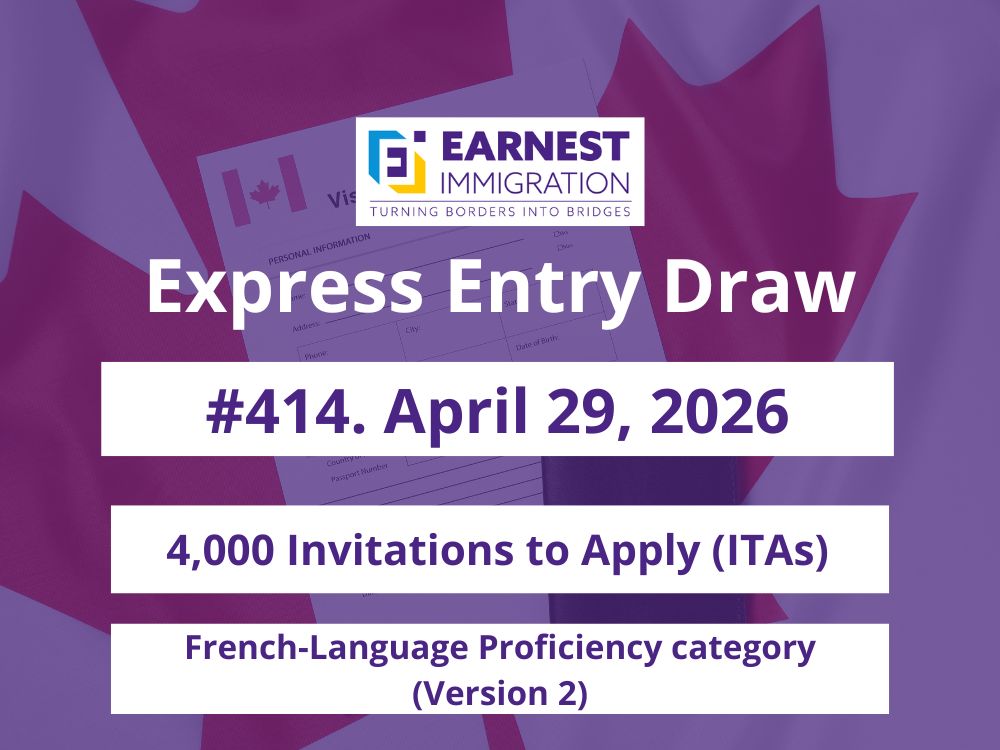
Immigration, Refugees and Citizenship Canada (IRCC) held Express Entry Draw 414 on April 29, 2026, issuing 4,000 Invitations to Apply (ITAs) to candidates under the French-Language Proficiency category (Version 2). The minimum CRS cut-off was 400 points, with a tie-breaking date of April 7, 2026, at 20:13:59 UTC.
Draw 414 is the fifth French-Language Proficiency draw of 2026 and the twenty-sixth Express Entry draw of the year. It arrives 14 days after Draw 411 (April 15, CRS 419, 4,000 ITAs) – and the 19-point CRS drop from 419 to 400 is the sharpest single-draw decline in the French category since Q1 2026. The reason is the same dynamic that drove the CRS up to 419 in Draw 411: the inter-draw gap. Draw 411 had a 28-day gap from its predecessor, allowing a wave of higher-scoring profiles to accumulate and pushing the threshold upward. Draw 414 has a 14-day gap – half as long – meaning the pool at 400-418 was refreshed by fewer high-scoring profiles, and the threshold settled back to 400.
Draw 414 closes the April 27-28-29 three-draw burst (PNP 473, CEC 2,000, French 4,000), and it brings the final tally for April to 9,221 ITAs across six draws – more than any single month has averaged in 2026. With 71,627 total ITAs across 26 draws, IRCC has now issued more invitations through the first four months of 2026 than in the entire first half of any previous year in Express Entry history. The French category has issued 26,000 of those ITAs – 36.3% of the year-to-date total.
Table of Contents
ToggleKey Details of Express Entry Draw 414
| Draw Number | 414 |
| Date | April 29, 2026 |
| Category | French-Language Proficiency (Version 2) |
| Invitations Issued | 4,000 |
| CRS Cut-off Score | 400 |
| Tie-breaking Rule | April 7, 2026, at 20:13:59 UTC |
The 19-Point CRS Drop: CRS 400 Is Back
Draw 414’s CRS of 400 matches the very first French draw of 2026 (Draw 394, February 6) exactly. The journey from 400 to 393 to 397 to 419 and back to 400 across five draws is a vivid illustration of how sensitive the French draw threshold is to a single variable: the inter-draw interval.
| Draw # | Date | CRS | ITAs | Days Since Prev. | Interpretation |
| 394 | Feb 6 | 400 | 8,500 | — | Opened 2026 French draws at 400 |
| 401 | Mar 4 | 397 | 5,500 | 26 days | Slight drop – large pool from 87-day gap |
| 405 | Mar 18 | 393 | 4,000 | 14 days | Historic low – sub-400 for first time |
| 411 | Apr 15 | 419 | 4,000 | 28 days | Large spike – 28-day gap raised bar |
| 414 | Apr 29 | 400 | 4,000 | 14 days | Reset to 400 – 14-day gap clears high-CRS backlog |
The pattern is clear. When the gap between draws is 14 days, the pool at the lower CRS range does not accumulate enough new higher-scoring profiles to push the threshold far above its previous level, and the CRS drops (or stays stable). When the gap extends to 28 days, two full weeks of new French-eligible profiles enter the pool at higher scores, and the threshold spikes upward. Draw 414’s 14-day gap explains the 19-point drop from 419 to 400 directly and completely.
The implication for future draws is significant: if IRCC continues to hold French draws every 14 days, the threshold is likely to remain in the 393-410 range. If it extends to 21-28 days, expect the threshold to rise toward 415-425. The inter-draw interval is the single most predictive variable for French draw CRS outcomes.
The Tie-breaking Date: April 7 – Only 22 Days Prior
Draw 414’s tie-breaking date of April 7, 2026, at 20:13:59 UTC is 22 days before the draw date. This is dramatically more recent than Draw 411’s tie-breaking date of November 14, 2025 (5 months prior), and reflects the different pool dynamics at CRS 400 versus 419.
At CRS 400, the pool turns over much more rapidly than at 419. More candidates reach exactly 400 CRS and enter the pool at any given time, and 4,000 ITAs at this threshold clears a larger proportion of the available pool in each draw. The fact that profiles submitted as recently as April 7 were already at the tie-breaking margin confirms that the pool at CRS 400 is continuously and rapidly being refreshed – candidates enter at 400, are cleared by a draw within weeks, and are replaced by the next cohort. For candidates currently at exactly 400 CRS who entered the pool after April 7, Draw 414 did not reach them – but they are at the very front of the queue for the next French draw.
All 2026 French Draws: The CRS Oscillation Pattern
| Draw # | Date | CRS | ITAs | Days Since Prev. | Tie-breaking Date |
| 414 | Apr 29 | 400 | 4,000 | 14 days | Apr 7, 2026 |
| 411 | Apr 15 | 419 | 4,000 | 28 days | Nov 14, 2025 |
| 405 | Mar 18 | 393 | 4,000 | 14 days | Dec 29, 2025 |
| 401 | Mar 4 | 397 | 5,500 | 26 days | Oct 10, 2025 |
| 394 | Feb 6 | 400 | 8,500 | — | Jan 30, 2026 |
Five French draws have now issued a combined 26,000 ITAs in 2026 – an average of 5,200 per draw. The CRS has oscillated between 393 and 419, with the inter-draw gap as the primary driver of each movement. The February draw (8,500 ITAs, the largest of 2026) cleared a large accumulated backlog. Subsequent draws of 4,000-5,500 ITAs have maintained a steady cadence. What is strikingly consistent is the 4,000 ITA volume for the last three draws – IRCC appears to have stabilised French draw volumes at this level, while letting the CRS oscillate based on pool dynamics.
All 2026 Express Entry Draws to Date
| Draw # | Date | Category | CRS | ITAs |
| 414 | Apr 29 | French-Language Proficiency (Version 2) | 400 | 4,000 |
| 413 | Apr 28 | Canadian Experience Class | 514 | 2,000 |
| 412 | Apr 27 | Provincial Nominee Program | 795 | 473 |
| 411 | Apr 15 | French-Language Proficiency (Version 2) | 419 | 4,000 |
| 410 | Apr 14 | Canadian Experience Class | 515 | 2,000 |
| 409 | Apr 13 | Provincial Nominee Program | 786 | 324 |
| 408 | Apr 2 | Trades Occupations (Version 3) | 477 | 3,000 |
| 407 | Mar 31 | Canadian Experience Class | 509 | 2,250 |
| 406 | Mar 30 | Provincial Nominee Program | 802 | 356 |
| 405 | Mar 18 | French-Language Proficiency (Version 2) | 393 | 4,000 |
| 404 | Mar 17 | Canadian Experience Class | 507 | 4,000 |
| 403 | Mar 16 | Provincial Nominee Program | 742 | 362 |
| 402 | Mar 5 | Senior Managers with Canadian Work Experience | 429 | 250 |
| 401 | Mar 4 | French-Language Proficiency (Version 2) | 397 | 5,500 |
| 400 | Mar 3 | Canadian Experience Class | 508 | 4,000 |
| 399 | Mar 2 | Provincial Nominee Program | 710 | 264 |
| 398 | Feb 20 | Healthcare & Social Services (Version 3) | 467 | 4,000 |
| 397 | Feb 19 | Physicians with Canadian Work Experience | 169 | 391 |
| 396 | Feb 17 | Canadian Experience Class | 508 | 6,000 |
| 395 | Feb 16 | Provincial Nominee Program | 789 | 279 |
| 394 | Feb 6 | French-Language Proficiency (Version 2) | 400 | 8,500 |
| 393 | Feb 3 | Provincial Nominee Program | 749 | 423 |
| 392 | Jan 21 | Canadian Experience Class | 509 | 6,000 |
| 391 | Jan 20 | Provincial Nominee Program | 746 | 681 |
| 390 | Jan 7 | Canadian Experience Class | 511 | 8,000 |
| 389 | Jan 5 | Provincial Nominee Program | 711 | 574 |
2026 Express Entry ITAs by Category (as of April 29, 2026)
| Category | Draws | ITAs | % of Total |
| Canadian Experience Class | 8 | 34,250 | 47.8% |
| French-Language Proficiency | 5 | 26,000 | 36.3% |
| Healthcare and Social Services | 1 | 4,000 | 5.6% |
| Trades Occupations | 1 | 3,000 | 4.2% |
| Provincial Nominee Program | 9 | 3,736 | 5.2% |
| Physicians with Canadian Work Exp. | 1 | 391 | 0.5% |
| Senior Managers with Canadian Work Exp. | 1 | 250 | 0.3% |
| Total | 26 | 71,627 | 100% |
Draw 414 brings the French category total to 26,000 ITAs across five draws – 36.3% of all 71,627 year-to-date ITAs. This is the highest share the French category has held in 2026, narrowing the gap with CEC (47.8%) to just 11.5 percentage points. The French pathway now accounts for more than one in three Express Entry ITAs issued in 2026 – a remarkable proportion that reflects Canada’s sustained commitment to its Francophone immigration targets and the accessibility of the French draw pathway relative to CEC.
Express Entry Pool Composition (Estimated Post-Draw 414)
| CRS Score Range | Estimated Candidates (post-draws) |
| 601-1200 | ~1 |
| 501-600 | ~9,600 |
| 451-500 | ~73,659 |
| 401-450 | ~64,500 |
| 391-400 | ~11,500 |
| 351-390 | ~41,000 |
| 301-350 | ~19,000 |
| 0-300 | ~8,300 |
| Total | ~227,979 |
The pool figures above are estimated post-draw based on the April 26 pool data (234,452 candidates) minus the 6,473 ITAs issued across the April 27-28-29 burst. The most significant impact of Draw 414 is on the 391-420 CRS band, where approximately 4,000 French-eligible candidates were cleared. The 401-450 band, which contained approximately 64,500 candidates before the draw, will have been partially reduced – specifically the French-eligible sub-set of that cohort at or above 400 CRS.
Key Statistics: 2026 Express Entry (as of April 29, 2026)
- Total ITAs issued in 2026: 71,627 across 26 draws (Draws 389-414)
- Draw 414: 5th French draw of 2026; 26th Express Entry draw overall
- 19-point CRS drop from Draw 411 (419) – explained by the 14-day inter-draw gap
- CRS 400 matches the February 6 draw exactly – the French CRS has come full circle
- Tie-breaking date April 7, 2026 – just 22 days prior, rapid pool turnover at CRS 400
- French draws have issued 26,000 ITAs in 2026 – 36.3% of all year-to-date ITAs
- April 2026: 6 draws, 9,221 ITAs (27-29 April burst = 6,473 ITAs in 72 hours)
- 26th draw of 2026 – one draw every 4.7 calendar days on average since January 5
- $137.2 million invested in Francophone immigration under Official Languages Action Plan 2023-2028
Understanding the French-Language Proficiency Category in Q2 2026
Canada’s Francophone Immigration Commitment: Policy and Funding
Draw 414 is not just a routine draw event – it is the fifth expression in 2026 of a deliberate, well-funded national policy commitment to grow the French-speaking population outside Quebec. Canada’s bilingual constitutional identity depends on the vitality of Francophone communities in provinces where French is a minority language. Without active immigration policy intervention, those communities face demographic decline as birth rates and internal migration trends favour English.
The Official Languages Act and its associated Action Plan 2023-2028 allocate $137.2 million over five years specifically to promote Francophone immigration. This funding supports new measures including a dedicated Francophone immigration policy framework, expanded language test access outside Quebec, settlement services in French in minority communities, and recruitment initiatives targeting French speakers in Africa, the Middle East, and Latin America – regions where growing populations have strong French language education systems and demonstrated interest in Canadian permanent residence.
The Francophone immigration target of 9.3% of all new permanent residents outside Quebec settling as French speakers has not yet been met. The gap between the target and actual Francophone settlement rates outside Quebec is precisely why IRCC has made the French-Language Proficiency category draw one of its most active and consistent draw types in 2026. Twenty-six thousand ITAs in five draws is a deliberate policy outcome, not an accident.
The CRS Gap Advantage: Why French-Speaking Candidates Win
Draw 414’s CRS of 400 is 114 points below the current CEC threshold of 514. This gap is the most direct and quantifiable advantage that French proficiency provides in the Express Entry system. Consider what it means in practice:
- A candidate with base CRS 395 and NCLC 7 French – who would need to wait potentially years for a CEC draw to reach their score – received an ITA in Draw 414
- A CEC candidate at 400 CRS has essentially no realistic near-term pathway through CEC draws (which are clearing at 514). The same candidate with French proficiency has an active pathway through French draws clearing at 400
- The 114-point differential means candidates can receive a French ITA with profiles that are weaker across every other dimension – age, education, work experience – than what would be required to succeed in a CEC draw
This is not an exploit or a loophole – it is the system working exactly as designed. IRCC established the French-Language Proficiency category precisely because it wanted to select French speakers who might not otherwise rank highly enough in the general CEC pool. The category allows IRCC to effectively subsidise Francophone immigration by lowering the CRS bar for French speakers. Candidates who develop genuine French proficiency are not gaming the system – they are taking advantage of a pathway that Parliament created and funds.
The Bilingualism Bonus: A Second Layer of French Advantage
Beyond category draw eligibility, French proficiency also adds CRS points through the bilingualism bonus – making French speakers more competitive in every draw type simultaneously:
| French Level | English Level | Bonus Pts | Key Implication |
| No French | N/A | 0 | Not eligible for French category |
| NCLC 5-6 (basic French) | CLB 5+ English | 25 | Eligible for bilingualism bonus but NOT French category draws |
| NCLC 7 (minimum threshold) | CLB 5+ English | 25 | Eligible for French category draws; +25 bonus |
| NCLC 7 (minimum threshold) | CLB 9-10 English | 25 | Same French bonus – English level does not change the bonus amount at NCLC 7 |
| NCLC 9-10 (strong French) | CLB 5+ English | 50 | Maximum bilingualism bonus; +50 pts |
| NCLC 9-10 (strong French) | CLB 9-10 English | 50 | Maximum bonus; both language skills maximised |
The key insight from this table: NCLC 7 French adds 25 CRS points regardless of English level. For a candidate at CRS 375 with no French, adding NCLC 7 French gives them 400 CRS (375 + 25) – exactly at Draw 414’s cut-off – plus French category eligibility. For a candidate at CRS 395 with NCLC 9 French, the 50-point bilingualism bonus brings them to 445 CRS. These transformations happen immediately upon adding valid French test scores to the profile and are reflected in the CRS before the next French draw is held.
The $137.2 Million Francophone Immigration Investment
The Official Languages Action Plan 2023-2028’s $137.2 million commitment to Francophone immigration is the most explicit statement of Canada’s willingness to invest structurally in growing its French-speaking population outside Quebec. The funding targets:
- New Francophone immigration policy framework: A dedicated policy that sets Francophone immigration as a permanent pillar of Canada’s immigration strategy rather than a temporary measure
- Expanded TEF Canada and TCF Canada test access internationally: More test centres, more test dates, and lower access barriers for candidates in target source countries including francophone sub-Saharan Africa, the Maghreb, and francophone Latin America
- French-language settlement services: Funding for French-language settlement organisations in minority-language provinces and territories to improve retention of Francophone immigrants outside Quebec
- Recruitment initiatives: Overseas promotion of the French-Language Proficiency Express Entry pathway, targeted at professional communities where French is already a working language
The sustained high volumes of French Express Entry draws in 2026 – 26,000 ITAs in five draws in just the first four months of the year – are the operational expression of this investment. For French-speaking candidates, the message is consistent and clear: Canada wants you, has allocated significant public funds to attract you, and has built a dedicated immigration pathway that works in your favour.
The April 27-28-29 Burst: Three Pathways, One Outcome
Draw 414 closes a 72-hour period that exemplifies Canada’s multi-stream Express Entry strategy at its most explicit. Three draws, three completely different eligible populations, three different CRS thresholds:
- Draw 412 (April 27, PNP): 473 ITAs at CRS 795 – serving provincial nominees regardless of base CRS, as long as a nomination was received
- Draw 413 (April 28, CEC): 2,000 ITAs at CRS 514 – serving candidates with Canadian work experience who rank at the very top of the general pool
- Draw 414 (April 29, French): 4,000 ITAs at CRS 400 – serving French-proficient candidates, including many who cannot access PNP nominations or the CEC threshold
A candidate at CRS 395 with NCLC 7 French who has never worked in Canada received an ITA in Draw 414. The same candidate without French would not have been reached by any of the three draws in this burst. A nominee at CRS 195 base score (795 total after nomination) received an ITA in Draw 412. A CEC worker at CRS 514 received an ITA in Draw 413. All three received ITAs in 72 hours – through pathways calibrated specifically for their profile type. This is the system working at scale.
After Receiving a French Category ITA in Draw 414
Candidates who received an ITA in Draw 414 have 60 days from April 29, 2026 (approximately until June 28, 2026) to submit a complete permanent residence application. Key documents for French category applicants:
- Valid French language test results: TEF Canada or TCF Canada results showing NCLC 7+ in all four abilities (speaking, listening, reading, writing) within their two-year validity window. Confirm your scores meet the NCLC 7 minimum for each ability individually – a strong score in three abilities does not compensate for a shortfall in the fourth
- Valid English language test results (if claiming English CRS points): IELTS General Training or CELPIP-General results within two-year validity
- Work experience reference letters: On company letterhead confirming job title, NOC code, duties, hours per week, salary, and employment dates for all qualifying periods
- Educational Credential Assessment (ECA) if claiming foreign education points under FSWP – from an IRCC-approved organisation such as WES or IQAS
- Police clearance certificates from Canada and all countries of residence for 6 months or more since age 18 – international clearances can take 4-12 weeks
- Medical examination from an IRCC-designated physician
- Proof of settlement funds (FSWP applicants without a Canadian job offer)
- Valid passport
One document specific to French category applicants worth flagging: if applying under FSWP (the most common program for offshore French category candidates), the minimum 67-point FSWP threshold must be met at the time of application submission. Candidates should recalculate their FSWP points carefully – the 67 FSWP points is a separate requirement from the 400 CRS used for draw eligibility, and these are different calculation systems. Consulting a licensed immigration consultant to verify FSWP eligibility before submitting is strongly recommended for offshore applicants.
Frequently Asked Questions
The CRS dropped 19 points from 419 to 400 in one draw. What explains such a large swing?
The inter-draw interval is the sole explanation. Draw 411 (April 15) had a 28-day gap from its predecessor and cleared at 419 because four weeks of new high-scoring profiles had accumulated in the pool. Draw 414 (April 29) had only a 14-day gap from Draw 411 – half as long. In 14 days, the pool at 400-418 did not accumulate enough new profiles at the higher end to sustain a 419 cut-off with 4,000 ITAs. Instead, the threshold settled at 400. This exact mechanism – longer gap raises CRS, shorter gap lowers it – has now been demonstrated twice in 2026: the spike to 419 after the 28-day gap, and the immediate drop back to 400 after the 14-day gap. Candidates planning around French draws should monitor the calendar between draws as closely as they monitor the CRS cut-offs themselves.
My French CRS is 400 and my profile was submitted on April 10, 2026. Was I invited in Draw 414?
At CRS 400 with a profile submitted April 10, you narrowly missed Draw 414. The tie-breaking date was April 7, 2026, at 20:13:59 UTC – three days before your profile submission. Candidates at exactly 400 CRS who submitted after April 7 were not selected in Draw 414. However, you are now at the very front of the queue at CRS 400 for the next French draw. If the next draw uses a tie-breaking date after April 7 – which is likely since the pool at 400 has been replenishing since April 8 – you will be among the first candidates reached. The key action: maintain your profile without deleting and resubmitting (doing so would reset your date to today and push you further back in the queue). Your April 10 submission date is your tie-breaking asset.
I have CRS 380 and NCLC 7 French. The draw cleared at 400. What can I do to close the 20-point gap?
At CRS 380 with NCLC 7 French, you are 20 points below Draw 414’s cut-off. The most direct paths to close this gap: First, improve your English scores. If your English is currently CLB 7-8, improving to CLB 9 in one or more abilities can add 5-15 CRS points per ability. If you have CLB 8 across all four abilities, a comprehensive IELTS or CELPIP improvement could add 20+ points. Second, improve your French scores. Moving from NCLC 7 to NCLC 8-9 in strong abilities increases the bilingualism bonus from 25 to a maximum of 50 points – a potential gain of up to 25 additional CRS points. Third, consider whether any other CRS factors can be improved: verifying that all qualifying work experience periods are correctly counted, ensuring any Canadian education bonus is applied, or adding a sibling in Canada if applicable. Finally, at CRS 380, you may already be within range of future draws if the inter-draw gap extends to 3-4 weeks and the pool at lower scores accumulates. The historic low for any 2026 French draw was 393 in Draw 405 – and at 380, you are 13 points below that. Language improvement is your clearest, fastest path.
Can I qualify for French draws without any Canadian work experience?
Yes – the French-Language Proficiency category does not require Canadian work experience. To be eligible, you need two things: French test results showing NCLC 7+ in all four abilities (TEF Canada or TCF Canada), and an active Express Entry profile under at least one of the three federal programs (FSWP, CEC, or FSTP). For candidates without Canadian experience, FSWP is the most common program. FSWP requires meeting the 67-point minimum under the six selection factors – points for age, education, work experience (which can be foreign), language (English and/or French), arranged employment (optional), and adaptability. An overseas candidate with a bachelor’s degree, strong French scores, and 2-3 years of skilled foreign work experience can often meet the FSWP 67-point threshold and enter the Express Entry pool, becoming eligible for French category draws. If you have been excluded from Express Entry because of the misconception that Canadian work experience is required, re-evaluate your FSWP eligibility – you may already qualify.
Canada has now issued 26,000 French ITAs in 2026 – more than one-third of all Express Entry ITAs. Will IRCC reduce French draw volumes in Q3?
This is a reasonable concern. Canada’s 2026 Express Entry target is approximately 110,000 Federal High Skilled candidates. With 71,627 ITAs issued by April 29 – including 26,000 French – the pace implies well over 200,000 Express Entry ITAs for the full year, far exceeding the target. Some moderation is mathematically necessary to stay within target. However, French draw volumes are structurally constrained by the Francophone immigration target (9.3% of economic class outside Quebec) and the $137.2 million Official Languages Action Plan investment. Reducing French draw volumes significantly would directly undermine both commitments. The most likely Q3 adjustment is a reduction in the frequency of French draws (returning to 3-4 week gaps) rather than a dramatic reduction in per-draw volumes. This would raise the CRS threshold per draw rather than lowering invitation counts. Candidates should expect French draws to continue throughout 2026 but potentially at higher CRS thresholds if inter-draw intervals extend.
I received a French category ITA. My Express Entry profile was submitted under FSWP because I have no Canadian experience. What documents should I prioritise?
Congratulations. For FSWP applicants in the French category, the most critical documents to gather in the first 10 days of your 60-day ITA window are: First, employer reference letters for all qualifying foreign work experience – these are often the most complex to obtain from overseas employers, particularly those in countries with less formal HR practices. Aim to have formal letters on company letterhead with duty descriptions, even if this requires repeated follow-up with former employers. Second, your Educational Credential Assessment (ECA) from a designated organisation – if you have not already obtained an ECA, the standard processing timeline is 3-7 business days for WES’s basic option, but courier delays and document verification can add time. Initiate immediately. Third, verify that your FSWP 67-point calculation is correct at the time of application – your points calculation may differ from your CRS because FSWP points and CRS points use different formulas. Fourth, prepare police clearances from all relevant countries – international processes are the longest lead-time item. Fifth, confirm language test validity – TEF Canada and TCF Canada results expire after two years from the test date, and IELTS/CELPIP similarly. Missing the validity window invalidates the application.
The Bottom Line
Express Entry Draw 414 issued 4,000 ITAs to French-Language Proficiency candidates at CRS 400 on April 29, 2026 – closing out the April 27-28-29 three-draw burst and the month of April with a decisive reset of the French CRS from 419 back to 400. The 19-point drop is explained entirely by the 14-day inter-draw interval – the same mechanism that drove the CRS up to 419 in Draw 411’s 28-day gap works in reverse when the gap shortens. At CRS 400, Draw 414 exactly matches the threshold of the very first 2026 French draw (Draw 394, February 6), completing a full oscillation cycle in the French draw CRS.
Five French draws have now issued 26,000 ITAs in 2026 – 36.3% of the year-to-date total of 71,627. Backed by $137.2 million in Official Languages Action Plan funding and a 9.3% Francophone settlement target that has not yet been met, the French-Language Proficiency pathway remains Canada’s most accessible, highest-volume category draw for candidates with NCLC 7+ French proficiency. At 114 points below the current CEC threshold, it offers the largest gap between pathways of any two draw types in the 2026 Express Entry system.
At Earnest Immigration, our licensed consultants help candidates assess their French language eligibility, identify the fastest path to NCLC 7 or above, calculate the bilingualism bonus impact on their CRS, verify FSWP eligibility for offshore candidates, and prepare complete permanent residence applications within the 60-day ITA window. Whether you received an ITA in Draw 414, are preparing for your TEF Canada or TCF Canada sitting, or want to understand how French proficiency fits into your overall immigration strategy, the Earnest Immigration team is here to guide you. Contact us today for a comprehensive profile assessment.