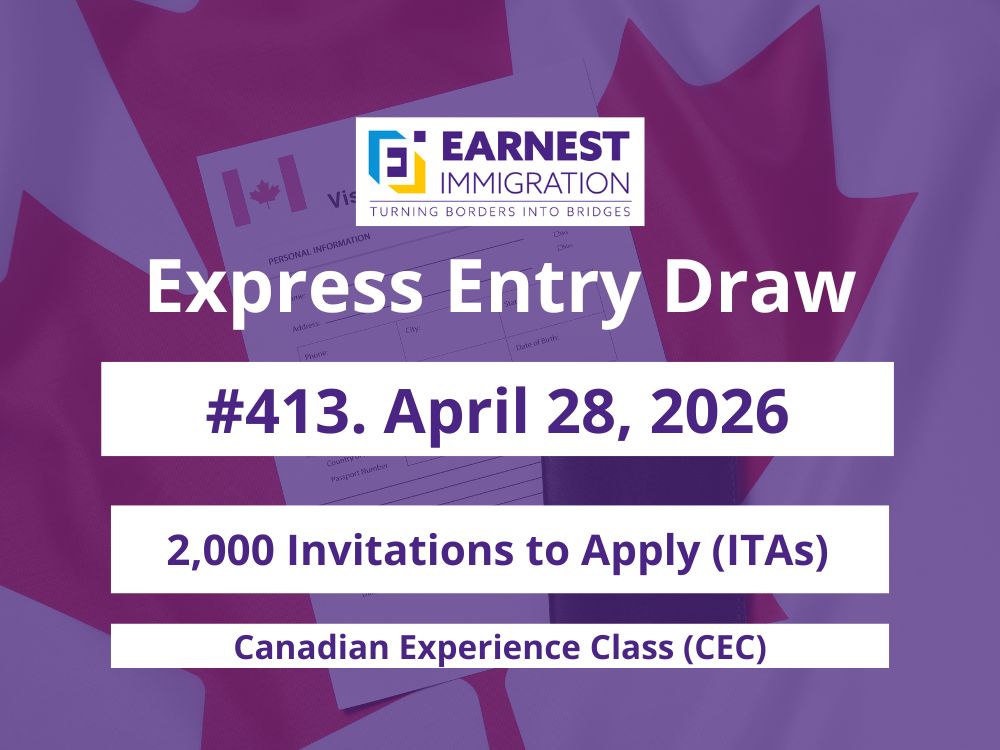
Immigration, Refugees and Citizenship Canada (IRCC) held Express Entry Draw 413 on April 28, 2026, issuing 2,000 Invitations to Apply (ITAs) to candidates under the Canadian Experience Class (CEC). The minimum CRS cut-off was 514 points, with a tie-breaking date of September 24, 2025, at 14:18:43 UTC.
Draw 413 is the eighth CEC draw and the twenty-fifth Express Entry draw of 2026. The headline number is the 1-point CRS reduction from Draw 410 (515) to Draw 413 (514) – the first CEC cut-off decrease since the year’s Q1 draws drove the threshold from 511 down to 507. With the same 2,000 ITA volume held constant across both draws, the 1-point drop reflects a marginal but meaningful shift in pool composition at the 514-515 CRS level: enough newly eligible candidates at 514 entered the pool in the 14-day gap between draws to place the threshold slightly lower.
Draw 413 is the middle draw of the April 27-28-29 three-draw burst (PNP Draw 412, CEC Draw 413, French Draw 414). Together, the three draws issue 6,473 ITAs across 72 hours – virtually matching the April 13-14-15 sequence that issued 6,324 ITAs. This bi-weekly burst pattern has emerged as IRCC’s operational rhythm for Q2 2026, pairing PNP, CEC, and French draws in rapid succession to serve different candidate populations at their respective thresholds.
Table of Contents
ToggleKey Details of Express Entry Draw 413
| Draw Number | 413 |
| Date | April 28, 2026 |
| Program | Canadian Experience Class (CEC) |
| Invitations Issued | 2,000 |
| CRS Cut-off Score | 514 |
| Tie-breaking Rule | September 24, 2025, at 14:18:43 UTC |
The 1-Point CRS Drop: What CRS 514 Means
A 1-point movement in the CRS cut-off – from 515 to 514 – may appear negligible, but it carries meaningful signal for thousands of candidates. At the same draw volume of 2,000 ITAs, the shift from 515 to 514 means that candidates with exactly 514 CRS who were not invited in Draw 410 were potentially invited in Draw 413, subject to the tie-breaking rule. This is one point that separates an ITA from continued waiting.
The 1-point drop is explained by pool dynamics rather than any policy change. In the 14 days between Draw 410 (April 14) and Draw 413 (April 28), the pool at CRS 514-515 shifted slightly: some candidates at exactly 515 from Draw 410 received their ITAs and left the pool, while new profiles at 514 entered. When IRCC issued 2,000 ITAs in Draw 413, the 2,001st candidate sat at 513 rather than 514, producing the 514 cut-off. This is the pool’s natural micro-adjustment mechanism in action – each small draw makes a precise incision into the ranked pool, and the next draw begins from where the previous one left off.
The CEC Pattern Is Locked In: 2,000 ITAs at CRS 513-515
Draw 413 confirms that IRCC has settled into a consistent Q2 CEC draw pattern:
| Draw | Date | ITAs | CRS | Interpretation |
| Draw 390 | Jan 7 | 8,000 | 511 | Largest 2026 CEC draw – lowest CRS of Jan |
| Draw 392 | Jan 21 | 6,000 | 509 | Large draw – lower CRS |
| Draw 396 | Feb 17 | 6,000 | 508 | Large draw – lower CRS |
| Draw 400 | Mar 3 | 4,000 | 508 | Medium – stable |
| Draw 404 | Mar 17 | 4,000 | 507 | Medium – 2026 CEC low |
| Draw 407 | Mar 31 | 2,250 | 509 | Small – CRS rises |
| Draw 410 | Apr 14 | 2,000 | 515 | Smallest to date – CRS peaks at 515 |
| Draw 413 | Apr 28 | 2,000 | 514 | Same size – CRS drops 1 point |
The 2026 CEC draw series shows a clear two-phase pattern. Phase 1 (January-March): large draws of 2,250-8,000 ITAs that drove the CRS down from 511 to a record low of 507. Phase 2 (April onwards): small draws of exactly 2,000 ITAs holding the CRS at 514-515. Draw 413 is the second consecutive 2,000-ITA draw and the second consecutive CRS in the 514-515 range. The consistency is notable: IRCC appears to have calibrated its Q2 CEC draws at precisely this volume to maintain the CRS in the 510-520 range while managing processing capacity.
For candidates at 507-513, this pattern has a direct implication: at 2,000 ITAs per draw, these scores are not being reached. The most recent draws to clear at 507-509 were issuing 2,250-4,000 ITAs – double to quadruple the current volume. For the CEC threshold to drop back to 507-509, IRCC would need to issue a draw of approximately 3,000-4,000+ ITAs. Whether that occurs in Q2 or Q3 depends on IRCC’s processing capacity and annual target management.
The Tie-breaking Date: September 24, 2025 – A 7-Month Backlog
Draw 413’s tie-breaking date of September 24, 2025, at 14:18:43 UTC – approximately seven months before the draw – reveals a significant queue of candidates waiting at CRS 514-515. This is strikingly different from Draw 407 (March 31), which had a tie-breaking date of just 13 days prior, signalling rapid pool turnover at that score level. At 514-515 CRS, the pool has been accumulating profiles since at least September 2025 without being fully cleared.
The practical implication is significant: candidates who entered the pool at CRS 514-515 after September 24, 2025 – and there are likely thousands of them – have not yet received a CEC ITA. They remain in the pool, and each 2,000-ITA draw makes only a small dent in this backlog. At the current pace of 2,000 ITAs per draw at 514-515 CRS, the tie-breaking date advances only slowly, and candidates who entered the pool in October-December 2025 at this score level may still be waiting several more draws.
All 2026 Express Entry Draws to Date
| Draw # | Date | Category | CRS | ITAs |
| 413 | Apr 28 | Canadian Experience Class | 514 | 2,000 |
| 412 | Apr 27 | Provincial Nominee Program | 795 | 473 |
| 411 | Apr 15 | French-Language Proficiency (Version 2) | 419 | 4,000 |
| 410 | Apr 14 | Canadian Experience Class | 515 | 2,000 |
| 409 | Apr 13 | Provincial Nominee Program | 786 | 324 |
| 408 | Apr 2 | Trades Occupations (Version 3) | 477 | 3,000 |
| 407 | Mar 31 | Canadian Experience Class | 509 | 2,250 |
| 406 | Mar 30 | Provincial Nominee Program | 802 | 356 |
| 405 | Mar 18 | French-Language Proficiency (Version 2) | 393 | 4,000 |
| 404 | Mar 17 | Canadian Experience Class | 507 | 4,000 |
| 403 | Mar 16 | Provincial Nominee Program | 742 | 362 |
| 402 | Mar 5 | Senior Managers with Canadian Work Experience | 429 | 250 |
| 401 | Mar 4 | French-Language Proficiency (Version 2) | 397 | 5,500 |
| 400 | Mar 3 | Canadian Experience Class | 508 | 4,000 |
| 399 | Mar 2 | Provincial Nominee Program | 710 | 264 |
| 398 | Feb 20 | Healthcare & Social Services (Version 3) | 467 | 4,000 |
| 397 | Feb 19 | Physicians with Canadian Work Experience | 169 | 391 |
| 396 | Feb 17 | Canadian Experience Class | 508 | 6,000 |
| 395 | Feb 16 | Provincial Nominee Program | 789 | 279 |
| 394 | Feb 6 | French-Language Proficiency (Version 2) | 400 | 8,500 |
| 393 | Feb 3 | Provincial Nominee Program | 749 | 423 |
| 392 | Jan 21 | Canadian Experience Class | 509 | 6,000 |
| 391 | Jan 20 | Provincial Nominee Program | 746 | 681 |
| 390 | Jan 7 | Canadian Experience Class | 511 | 8,000 |
| 389 | Jan 5 | Provincial Nominee Program | 711 | 574 |
Full CEC Draw History for 2026: Tie-breaking Dates Reveal the True Queue
| Draw # | Date | CRS | ITAs | Tie-break Date | Profile Age at Draw |
| 413 | Apr 28 | 514 | 2,000 | Sep 24, 2025 | ~7 months |
| 410 | Apr 14 | 515 | 2,000 | Jun 10, 2025 | ~10 months |
| 407 | Mar 31 | 509 | 2,250 | Mar 18, 2026 | 13 days |
| 404 | Mar 17 | 507 | 4,000 | May 11, 2025 | ~10 months |
| 400 | Mar 3 | 508 | 4,000 | Jun 24, 2025 | ~8 months |
| 396 | Feb 17 | 508 | 6,000 | Mar 16, 2025 | ~11 months |
| 392 | Jan 21 | 509 | 6,000 | Oct 29, 2025 | ~3 months |
| 390 | Jan 7 | 511 | 8,000 | Jun 10, 2025 | ~7 months |
The tie-breaking date pattern across 2026 CEC draws is the most revealing analytical data point. The extraordinary outlier is Draw 407 (March 31) with a 13-day tie-break gap – reflecting a pool at CRS 509 that was being rapidly replenished by new profiles. Every other 2026 CEC draw has a tie-break gap of 3 months or more, indicating substantial backlogs at the respective CRS levels. At CRS 514-515, the September 2025 tie-break dates for Draws 410 and 413 indicate that the queue at this score level extends back more than seven months. For candidates in this range who entered the pool in late 2025, the next few 2,000-ITA draws will progressively advance the tie-breaking date toward their submission time.
2026 Express Entry ITAs by Category (as of April 28, 2026)
| Category | Draws | ITAs | % of Total |
| Canadian Experience Class | 8 | 34,250 | 50.7% |
| French-Language Proficiency | 4 | 22,000 | 32.5% |
| Healthcare and Social Services | 1 | 4,000 | 5.9% |
| Trades Occupations | 1 | 3,000 | 4.4% |
| Provincial Nominee Program | 9 | 3,736 | 5.5% |
| Physicians with Canadian Work Exp. | 1 | 391 | 0.6% |
| Senior Managers with Canadian Work Exp. | 1 | 250 | 0.4% |
| Total | 25 | 67,627 | 100% |
Draw 413 brings CEC’s 2026 total to 34,250 ITAs across eight draws – 50.7% of the year-to-date total of 67,627. This is the first time in 2026 that the CEC share has crossed back above 50% after the French draw’s April surge. French-Language Proficiency (32.5%) remains the second-largest category by volume. Together, CEC and French continue to account for over 83% of all 2026 Express Entry ITAs, confirming their joint dominance of Canada’s Express Entry selection strategy.
Express Entry Pool Composition (April 26, 2026)
| CRS Score Range | Number of Candidates |
| 601-1200 | 472 |
| 501-600 | ~11,600 |
| 451-500 | 73,659 |
| 401-450 | ~64,500 |
| 351-400 | ~52,600 |
| 301-350 | ~19,000 |
| 0-300 | ~8,300 |
| Total | 234,452 |
The pool data as of April 26 (the most recent available before Draw 413) shows 234,452 total candidates. The 501-600 band holding approximately 11,600 candidates is the segment most directly affected by CEC draws at 514-515. With 2,000 ITAs removed in Draw 413, approximately 9,600 candidates remain in the 501-600 band – many at scores below 514 who are waiting for either a larger CEC draw or an improvement in their profile. The 451-500 band at 73,659 candidates remains the largest and most congested tier, continuing to be unreachable by current CEC draw volumes at the 514 threshold.
Key Statistics: 2026 Express Entry (as of April 28, 2026)
- Total ITAs issued in 2026: 67,627 across 25 draws (Draws 389-413)
- Draw 413: 8th CEC draw of 2026; 25th Express Entry draw overall
- CRS 514 – 1-point drop from Draw 410 (515); first CEC CRS decrease of Q2 2026
- Second consecutive 2,000-ITA CEC draw – the small-draw Q2 pattern is confirmed
- Tie-breaking date September 24, 2025 – over 7 months prior, revealing a deep CRS 514-515 backlog
- CEC share of 2026 ITAs: 34,250 of 67,627 (50.7%) – just crossed back above majority
- Draw 413 is the middle of the April 27-28-29 three-draw burst (PNP 473 + CEC 2,000 + French 4,000 = 6,473 ITAs)
- 25th Express Entry draw of 2026 – averaging one draw every 4.6 calendar days since January 5
What Draw 413 Means for CEC Candidates in Q2 2026
The Stabilisation of CEC Draws at 2,000 ITAs: What It Signals
Two consecutive 2,000-ITA CEC draws at CRS 514-515 signal that IRCC has found its Q2 equilibrium for the CEC stream. This equilibrium reflects a deliberate balancing act between several competing priorities:
- Annual target pacing: With 67,627 ITAs already issued by April 28 – well ahead of pace for a 110,000-ITA Express Entry year – IRCC is moderating CEC volumes to avoid concentrating too many invitations in Q1-Q2 while leaving insufficient quota for Q3-Q4
- Processing capacity management: Each ITA generates a permanent residence application. The large Q1 CEC draws (50,000+ applications now in progress) are consuming processing officer capacity. Smaller Q2 draws reduce the incremental application load
- Multi-category balance: IRCC’s category-based strategy means CEC draws compete for “draw slots” with French, Trades, Healthcare, PNP, and other categories. Maintaining CEC at 2,000 ITAs per draw leaves capacity for other categories to run on their own schedules
- Pool composition signalling: The deep September 2025 tie-breaking date indicates that the pool at 514-515 is large and has been accumulating for months. IRCC does not appear to be rushing to clear this backlog – instead, it is managing throughput at a sustainable pace
What Candidates at CRS 507-513 Should Do Right Now
For candidates currently in the pool at CRS 507-513, Draw 413’s threshold of 514 places them just below the current cut-off. In the current 2,000-ITA draw environment, these scores are not being reached. The actionable strategies are:
- Language score improvement: This remains the highest-return action available. Moving from CLB 8 to CLB 9 in a single English ability can add 5-15 CRS points. Moving across multiple abilities or improving French proficiency can add 20-50+ points. A language retest in the next 4-6 weeks could clear the gap to 514+ before the next CEC draw
- French proficiency: If you have any French ability at all, reaching NCLC 7 in all four abilities opens the French draw pathway at CRS 393-419 – over 100 points below the current CEC threshold. The April 29 French draw (Draw 414) cleared at CRS 400, making it accessible to candidates whose base CRS is in the 350-375 range with the bilingualism bonus. Developing French is a months-long investment but transforms the probability calculus dramatically
- Wait and watch for large CEC draws: If IRCC issues a 3,500-4,000 ITA CEC draw, the threshold would likely drop to 507-509. This is possible but not predictable. Monitoring draw sizes alongside CRS is the correct approach – a draw is only relevant at its volume, not just its cut-off score
- Provincial nomination: For candidates with strong ties to a specific province, a nomination adds 600 points and effectively guarantees a PNP ITA regardless of base CRS. Saskatchewan SINP, Ontario OINP, and Alberta AINP remain the most active streams
- Occupation category eligibility: Verify your NOC code against the Trades (CRS 477), Healthcare (CRS 467), and other active category draw eligible lists. If your occupation qualifies, these pathways have cleared at thresholds 37-47 points below the current CEC cut-off
The Proposed Express Entry Reform: Implications for CEC Candidates
Immigration Minister Lena Metlege-Diab’s public consultations on Express Entry reform, launched in late April 2026, include proposals that could significantly affect CEC candidates:
- A single unified pathway replacing the three existing programs (CEC, FSWP, FSTP) would eliminate the need for candidates to qualify under a specific program. This could make many currently ineligible candidates eligible for future draws
- Greater CRS weight on earnings potential and arranged employment could disadvantage younger candidates with high credentials but limited salary history, while potentially benefiting experienced workers in high-wage occupations
- Changes to how occupation-based categories interact with the system could create new draw types targeting specific sectors or skill sets, potentially offering additional pathways for candidates stuck in the 500-513 CRS range
These are proposals, not implemented policy. The current CEC pathway and its eligibility rules remain unchanged. Candidates who are eligible under the current system should enter or maintain the pool now – a profile submission date today is more valuable than a profile submitted after any future reform takes effect, because an earlier submission date improves tie-breaking position under any system.
The April 27-28-29 Three-Draw Burst in Context
Draw 413 is the second draw of a three-day sequence that began April 27 and concludes April 29. The combined impact:
- Draw 412 (April 27, PNP): 473 ITAs at CRS 795 – cleared virtually the entire nominated sub-pool
- Draw 413 (April 28, CEC): 2,000 ITAs at CRS 514 – maintained the Q2 CEC pattern
- Draw 414 (April 29, French): 4,000 ITAs at CRS 400 – served French-proficient candidates 114 points below the CEC threshold
Total: 6,473 ITAs across 72 hours, serving three entirely different candidate populations. This is the most effective illustration of how Canada’s multi-stream Express Entry system works in practice: on the same three days, a nominated candidate with base CRS 195, a CEC worker at 514, and a French speaker at 400 all received ITAs – each through a different draw, at a different threshold, tailored to their specific pathway.
After Receiving a CEC ITA in Draw 413
Candidates who received an ITA in Draw 413 have 60 days from April 28, 2026 (approximately until June 27, 2026) to submit a complete permanent residence application. Key actions:
- Request employer reference letters immediately: On company letterhead, confirming job title, NOC code, duties, hours per week, salary, and employment dates. Allow 2-3 weeks for preparation and HR processing. This is consistently the longest lead-time document in CEC applications
- Verify language test validity: IELTS General Training, CELPIP-General, TEF Canada, or TCF Canada results must remain within their 2-year validity at the time of application submission. If results expire before June 27, arrange an expedited retest
- Initiate police clearance certificates: Canada (RCMP fingerprint-based) and all countries of residence for 6+ months since age 18. International clearances can take 4-12 weeks – request on day one of the 60-day window
- Book medical examination: From an IRCC-designated physician; results valid for 12 months
- Audit your Express Entry profile for accuracy: Every field – NOC code, employment dates, education, language scores – must precisely match your supporting documents. Discrepancies are the leading cause of procedural fairness letters and application delays
- Gather educational credentials: Certificates, transcripts, and ECA (if applicable for FSWP) must be available and consistent with the profile
IRCC targets a six-month processing window for complete CEC applications. The 60-day ITA window is firm – there are no extensions under any circumstances. Candidates who miss the deadline must re-enter the pool and wait for the next ITA. Investing the first two weeks in thorough document preparation is the most effective use of the 60-day period.
Frequently Asked Questions
The CRS dropped 1 point from 515 to 514. Is this a sign the CEC threshold is starting to fall?
A 1-point drop is significant for the individual candidates it reaches (those at exactly 514 who now have ITAs), but it does not constitute a trend reversal. The CRS fell from 515 to 514 because the precise composition of the pool at the 514-515 boundary shifted slightly in the 14 days between draws – a pool micro-adjustment, not a policy change or a structural downward movement. For the CEC threshold to genuinely and sustainably fall back toward 507-509, IRCC would need to issue draws of 3,500-4,000+ ITAs. At 2,000 ITAs per draw, the CRS will likely oscillate in the 512-516 range as the pool at that level gradually turns over. Monitoring draw volumes alongside cut-off scores – not the cut-off in isolation – is the correct framework for forecasting.
My CRS is 514 exactly and my profile was submitted in November 2025. Was I invited in Draw 413?
At CRS 514 with a November 2025 profile submission date: the tie-breaking date for Draw 413 was September 24, 2025. Since November 2025 is after September 24, 2025, you were not selected in Draw 413 even with the right CRS score. You are, however, now very close to the front of the queue at CRS 514. As IRCC holds subsequent 2,000-ITA CEC draws, the tie-breaking date will advance. If the next draw’s tie-breaking date moves to October, November, or December 2025, you may receive an ITA. Maintain your profile in active status without deleting and resubmitting – your November 2025 date is your tie-breaking asset, and resetting it would push you significantly further back in the queue.
IRCC has now held two consecutive 2,000-ITA CEC draws. Will the next CEC draw also be 2,000 ITAs?
There is no guarantee, but the pattern is notable. Two consecutive 2,000-ITA draws at CRS 514-515 suggest IRCC has established this as its Q2 CEC equilibrium. However, IRCC can change draw volume at any time without announcement. Factors that could produce a larger draw include: a significant buildup of processing capacity, a higher-volume quarter planned for Q3, or a ministerial decision to accelerate CEC invitation pace to meet 2026 targets. Factors that could keep volumes small or reduce them further include: processing bottlenecks, a shift toward category-specific draws, or deliberate pacing toward Q3-Q4. The safest planning assumption is that CEC draws will remain in the 1,500-2,500 ITA range for the near term, with the CRS correspondingly in the 512-520 range.
I have CRS 510 and work in healthcare as a registered nurse. Should I be pursuing a Healthcare category draw or a CEC draw?
At CRS 510, both pathways are relevant – but the Healthcare category draw is significantly more accessible right now. The most recent Healthcare draw (Draw 398, February 20, CRS 467) cleared 40+ points below the current CEC threshold of 514. If your NOC code is on the Healthcare and Social Services Occupations eligible list (NOC 31301 for registered nurses is typically included), you are eligible for Healthcare category draws at thresholds around CRS 467-476. At CRS 510, you would be well above the Healthcare draw threshold and would receive an ITA in any future Healthcare draw. The CEC pathway at 510 is not currently being reached by 2,000-ITA draws. You should maintain your profile in the pool (where you are eligible for both CEC and Healthcare draws simultaneously), and advocate for a near-term Healthcare draw by monitoring IRCC announcements. The last Healthcare draw was February 20 – with the category running roughly every 60-90 days in 2025-2026, another draw may be expected in Q2 2026.
My PGWP expires in 6 weeks and my CRS is 514. I missed Draw 413 due to the tie-breaking date. What are my options?
With a PGWP expiring in 6 weeks and CRS 514, your situation is time-sensitive and requires immediate parallel action. First priority: assess whether you can improve your CRS to 514+ with an earlier profile date to improve tie-breaking position – but note that resetting your profile date would hurt, not help. Second: if your profile date predates September 24, 2025, you may receive an ITA in the next CEC draw even at 514. Third: apply for a PGWP extension if eligible, or explore maintained status if not – consult a licensed consultant immediately about your temporary status options, as a gap in work authorization could affect your PR application. Fourth: look at whether a provincial nomination is achievable in your remaining time – Saskatchewan’s SINP has processed nominations in as little as 2-3 weeks. Fifth: if you receive an ITA before your PGWP expires and submit your PR application, you become eligible for a Bridging Open Work Permit (BOWP), which allows you to continue working through PR processing. Do not wait to act on any of these steps – each one requires more lead time than 6 weeks suggests.
The April 29 French draw (Draw 414) cleared at CRS 400 – 114 points below the current CEC threshold. Is learning French really a viable strategy for CEC candidates at 510-514?
Yes, and it is arguably the highest single-action CRS transformation available to candidates in the 510-514 range who cannot quickly close the gap to the CEC threshold. Here is the arithmetic: if your current CRS is 510 and you add NCLC 7 French proficiency plus CLB 5 English (if not already reported), the bilingualism bonus adds 25 points, bringing you to 535 – well above any current CEC threshold. More importantly, NCLC 7 French makes you eligible for French-category draws that cleared at CRS 393-419 in 2026. A candidate at 510 total CRS with French NCLC 7+ would receive a French category ITA long before a CEC draw reaches their score. The realistic timeline for a working professional to reach NCLC 7 French from a lower starting point is 6-18 months depending on prior French exposure. For candidates with any prior French foundation (school, travel, family), the timeline can be considerably shorter. It is a meaningful investment – but for candidates who cannot quickly reach 515+ through other means, it may be the most reliable pathway to a near-term ITA.
The Bottom Line
Express Entry Draw 413 issued 2,000 ITAs to CEC candidates at CRS 514 on April 28, 2026 – a 1-point drop from Draw 410’s 515, confirming that the Q2 CEC draw pattern has stabilised at 2,000 ITAs in the 513-516 CRS range. The tie-breaking date of September 24, 2025 – over 7 months prior – reveals a substantial queue of candidates at this score level who entered the pool in late 2025 and have been waiting through multiple draws for their invitation. At 2,000 ITAs per draw, this backlog clears slowly – providing a predictable but measured throughput for candidates currently at or above 514 CRS.
For the large cohort at 507-513, Draw 413 is a reminder that waiting for a CEC draw to reach these scores under current volumes is a low-certainty strategy. Language score improvement, French proficiency development, occupation category eligibility, and provincial nominations all offer more reliable pathways to a near-term ITA. The system is working exactly as designed – serving multiple candidate populations simultaneously through different draw types at different thresholds – but navigating it effectively requires understanding which of those pathways is most accessible for your specific profile.
At Earnest Immigration, our licensed consultants help CEC candidates calculate their exact CRS and gap to the current threshold, identify the fastest available score improvements, assess eligibility for French draws and occupation category draws, and prepare complete permanent residence applications within the 60-day ITA window. Whether you received an ITA in Draw 413, are at 510-514 and building your Q2 strategy, or are just entering the Express Entry pool for the first time, the Earnest Immigration team is here to guide you. Contact us today for a comprehensive profile assessment.