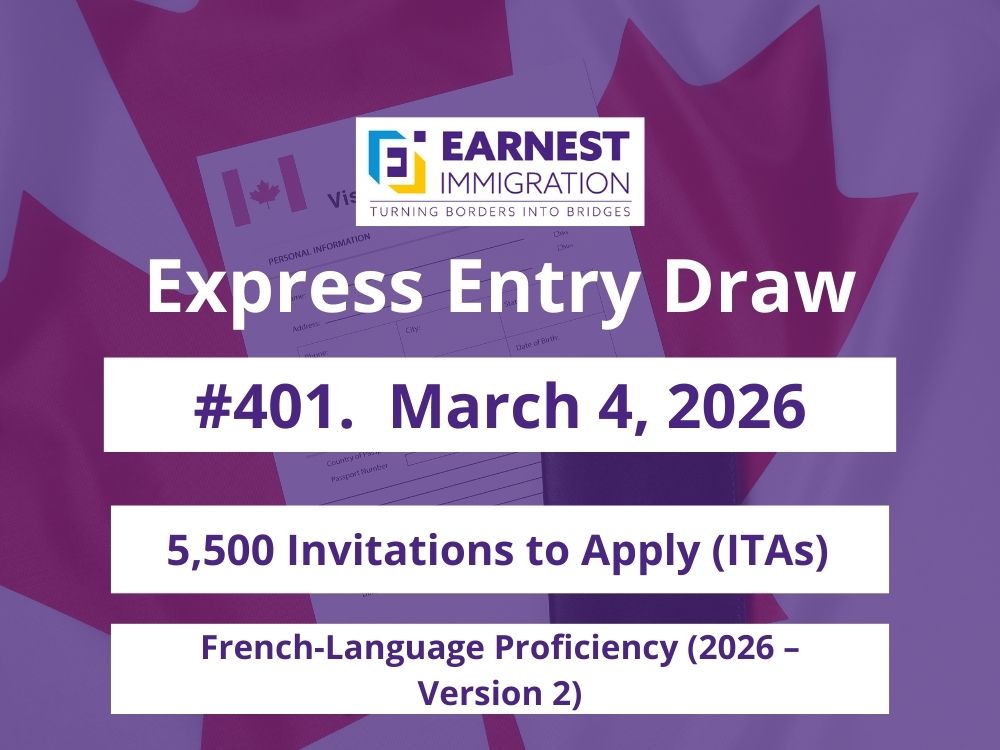
Immigration, Refugees and Citizenship Canada (IRCC) held Express Entry Draw 401 on March 4, 2026, issuing 5,500 Invitations to Apply (ITAs) to candidates under the French-Language Proficiency category (2026 – Version 2). The minimum CRS cut-off was 397, with a tie-breaking date of October 10, 2025.
Draw 401 is the second French-language draw of 2026 and rounds off a remarkable three-draw week: a PNP draw on March 2 (Draw 399), a CEC draw on March 3 (Draw 400), and now this French-language round. Together, these three draws issued 9,764 ITAs across three entirely separate candidate populations in just 72 hours – a demonstration of how effectively IRCC’s category-based system can run multiple simultaneous pipelines.
With a CRS of 397, Draw 401 is the second-lowest French-language cut-off of 2026, narrowly above the record 8,500-ITA draw (Draw 394, February 6) which cleared at exactly 400. For French speakers anywhere in the world who hold an active Express Entry profile, a CRS target in the high 300s is now the established benchmark for this pathway. No other Express Entry category comes close to this level of accessibility at such high invitation volumes.
Table of Contents
ToggleKey Details of Express Entry Draw 401
| Draw Number | 401 |
| Date | March 4, 2026 |
| Category | French-Language Proficiency (2026 – Version 2) |
| Invitations Issued | 5,500 |
| CRS Cut-off Score | 397 |
| Tie-breaking Rule | October 10, 2025, at 18:18:20 UTC |
A Three-Draw Week: March 2–4, 2026
Draws 399, 400, and 401 represent one of the most productive three-day stretches in 2026 Express Entry activity:
- March 2 – Draw 399 (PNP): 264 ITAs at CRS 710
- March 3 – Draw 400 (CEC): 4,000 ITAs at CRS 508
- March 4 – Draw 401 (French-Language Proficiency): 5,500 ITAs at CRS 397
The contrast across these three draws perfectly illustrates how category-based selection creates parallel pathways that serve vastly different candidate profiles. Provincial nominees competed in a narrow pool at effective base scores as low as 110. CEC candidates needed 508 from strong human capital factors alone. French speakers needed just 397 – a score reachable by candidates with moderate skills profiles who have invested in developing strong French proficiency.
Comparison with Draw 394 – The Previous French-Language Draw
Draw 394, held on February 6, 2026, was an extraordinary round: 8,500 ITAs issued – a record for a single French-language draw – at a CRS cut-off of exactly 400. Draw 401, held less than a month later, issued 5,500 ITAs at 397. Key observations:
- Draw 394: 8,500 ITAs | CRS 400 | Tie-breaking: February 3, 2026 at 11:11:44 UTC
- Draw 401: 5,500 ITAs | CRS 397 | Tie-breaking: October 10, 2025 at 18:18:20 UTC
The CRS dropped three points from 400 to 397, while the invitation count fell from 8,500 to 5,500. Despite fewer ITAs, the cut-off decreased – this is explained by the tie-breaking date. Draw 394’s tie-breaking date was February 3, 2026, meaning candidates who created profiles just days before the draw were the marginal cases. Draw 401’s tie-breaking date was October 10, 2025 – nearly five months earlier – indicating that IRCC is working through candidates who entered the pool in mid-2025. These are likely candidates who prepared for this pathway over several months and had profiles ready well before the draws were announced. The advancing tie-breaking date confirms the French-language pool is deep and growing steadily.
Complete Summary of Express Entry Draws in 2026
| Draw # | Date | Category | CRS | ITAs |
| 401 | Mar 4 | French-Language Proficiency (Version 2) | 397 | 5,500 |
| 400 | Mar 3 | Canadian Experience Class | 508 | 4,000 |
| 399 | Mar 2 | Provincial Nominee Program | 710 | 264 |
| 398 | Feb 20 | Healthcare & Social Services (Version 3) | 467 | 4,000 |
| 397 | Feb 19 | Physicians with Canadian Work Experience | 169 | 391 |
| 396 | Feb 17 | Canadian Experience Class | 508 | 6,000 |
| 395 | Feb 16 | Provincial Nominee Program | 789 | 279 |
| 394 | Feb 6 | French-Language Proficiency (Version 2) | 400 | 8,500 |
| 393 | Feb 3 | Provincial Nominee Program | 749 | 423 |
| 392 | Jan 21 | Canadian Experience Class | 509 | 6,000 |
| 391 | Jan 20 | Provincial Nominee Program | 746 | 681 |
| 390 | Jan 7 | Canadian Experience Class | 511 | 8,000 |
| 389 | Jan 5 | Provincial Nominee Program | 711 | 574 |
French-Language Draw History: Trend Analysis
| Draw # | Date | CRS | ITAs | Version | Tie-breaking Date |
| 401 | Mar 4, 2026 | 397 | 5,500 | Version 2 | Oct 10, 2025 |
| 394 | Feb 6, 2026 | 400 | 8,500 | Version 2 | Feb 3, 2026 |
| 388 | Dec 17, 2025 | 399 | 6,000 | Version 1 | Aug 24, 2025 |
| 382 | Nov 28, 2025 | 408 | 6,000 | Version 1 | May 26, 2025 |
| 376 | Oct 29, 2025 | 416 | 6,000 | Version 1 | Sep 8, 2025 |
| 371 | Oct 6, 2025 | 432 | 4,500 | Version 1 | Jun 13, 2025 |
| 365 | Sep 4, 2025 | 446 | 4,500 | Version 1 | Jun 16, 2025 |
| 360 | Aug 8, 2025 | 481 | 2,500 | Version 1 | Jul 18, 2025 |
| 341 | Mar 21, 2025 | 379 | 7,500 | Version 1 | Mar 6, 2025 |
| 339 | Mar 6, 2025 | 410 | 4,500 | Version 1 | Feb 11, 2025 |
| 337 | Feb 19, 2025 | 428 | 6,500 | Version 1 | Feb 10, 2025 |
| 329 | Dec 3, 2024 | 466 | 800 | Version 1 | Nov 26, 2024 |
| 324 | Nov 15, 2024 | 478 | 800 | Version 1 | Nov 7, 2024 |
The French-language draw history reveals a striking pattern. Through most of 2024, draws were small (800-1,000 ITAs) at relatively high CRS cut-offs (444-478). Then, starting with the massive 7,500-ITA draw in March 2025 (Draw 341), IRCC dramatically scaled up French-language draw volumes – and the CRS fell accordingly: from the 420s and 430s in mid-2025 to the high 390s and low 400s by late 2025 and into 2026. Draw 401 at CRS 397 and 5,500 ITAs continues this high-volume, low-threshold pattern. The downward CRS trend from 481 (August 2025) to 397 (March 2026) over just eight months represents one of the most significant accessibility improvements in the history of the French-language category.
Key Statistics: 2026 Express Entry Draws to Date (as of March 4)
• Total ITAs issued in 2026: 48,612 across 15 draws
• CEC ITAs: 24,000 across 4 draws – 49.4% of all 2026 ITAs
• French-Language Proficiency ITAs: 14,000 across 2 draws – 28.8% of all 2026 ITAs
• PNP ITAs: 2,241 across 4 draws
• Healthcare and Social Services ITAs: 4,000 (Draw 398)
• Physicians with Canadian Work Experience ITAs: 391 (Draw 397)
• No general all-program draw held in 2026
• CEC + French together account for over 78% of all 2026 ITAs
Current Express Entry Pool Composition (March 5, 2026)
At CRS 397, Draw 401 invited candidates from the very bottom of the 351-400 band, which contains 53,727 candidates. This is the largest single concentration of candidates below the CEC threshold and represents the group most directly served by French-language and category-based draws:
| CRS Score Range | Number of Candidates |
| 601–1200 | 258 |
| 501–600 | 14,031 |
| 491–500 | 13,321 |
| 481–490 | 12,678 |
| 471–480 | 15,415 |
| 461–470 | 15,099 |
| 451–460 | 15,167 |
| 401–450 | 65,868 |
| 351–400 | 53,727 |
| 301–350 | 18,694 |
| 0–300 | 8,276 |
| Total | 232,534 |
The 351-400 band holds 53,727 candidates – the third-largest band in the pool. Many of these candidates have competitive skills profiles but do not have the language scores, education combinations, or Canadian experience needed to reach the 508 CRS required for CEC draws. French-language proficiency and occupation-based categories are the primary routes available to them. For anyone in the 350-400 range, developing French proficiency to NCLC 7 is the single most transformative action available in the current Express Entry landscape.
Understanding the French-Language Proficiency Category
Why Canada Prioritises French-Speaking Immigration
Canada’s commitment to French-language immigration outside Quebec is rooted in its obligations under the Official Languages Act and a recognition that French-speaking communities outside Quebec have been declining as a proportion of the national population for decades. Without sustained francophone immigration, provinces and territories outside Quebec risk losing the critical mass needed to sustain French-language schools, services, and community institutions.
The 2023-2028 Official Languages Action Plan allocated $137.2 million over five years specifically to promote francophone immigration – supplementing an earlier $84.3 million investment. The practical result of this policy commitment has been the consistent prioritisation of French-language draws in the Express Entry system, with draw volumes and frequencies that have grown substantially over the past two years.
IRCC has established a target of 8% francophone immigration outside Quebec (as a proportion of total economic immigration) and has signalled through its draw activity that it intends to meet or exceed this target through the Express Entry system. The two 2026 French-language draws alone – with 8,500 and 5,500 ITAs – already account for 14,000 invitations, making this category one of the most prolific in the system.
Eligibility Requirements for the French-Language Proficiency Category
To qualify for a French-language proficiency draw, candidates must meet all of the following:
• Hold an active Express Entry profile under at least one of the three eligible programs: Federal Skilled Worker Program (FSWP), Canadian Experience Class (CEC), or Federal Skilled Trades Program (FSTP)
• Achieve a minimum score of NCLC 7 in all four language abilities (reading, writing, speaking, and listening) in French – tested through either TEF Canada or TCF Canada
• No minimum score in English is required to be eligible for this category, though having strong English scores will raise your overall CRS and provide access to other draw types as well
• Meet all other requirements of whichever Express Entry program your profile is filed under (FSWP, CEC, or FSTP)
• Intend to reside outside Quebec – candidates intending to settle in Quebec are managed through the Quebec immigration system and are not eligible for federal Express Entry draws
Accepted French Language Tests
IRCC accepts two tests for French language proficiency in Express Entry: TEF Canada (Test d’évaluation de français) and TCF Canada (Test de connaissance du français). Both are offered by the French Chamber of Commerce and must be taken at an authorized testing centre. The NCLC 7 minimum scores for each are:
| Test | Writing | Speaking | Reading | Listening |
| TEF Canada | Expression Écrite | Expression Orale | Compréhension Écrite | Compréhension Orale |
| NCLC 7 minimum | Approx. 309 / 450 | Approx. 309 / 450 | Approx. 207 / 300 | Approx. 248 / 360 |
| TCF Canada | Expression Écrite | Expression Orale | Compréhension Écrite | Compréhension Orale |
| NCLC 7 minimum | Level 4 (9–12) | Level B2 (10–12) | Score 499–548 | Score 458–502 |
It is important to use the Canada-specific version of these tests (TEF Canada and TCF Canada), not the general TEF or TCF used for study or professional purposes. The general versions are not accepted by IRCC. Results are typically valid for two years from the test date – ensure your results remain valid throughout the application process.
French Language and Your CRS Score
French proficiency impacts your CRS score in two distinct ways:
• Direct language points: Your French scores add points under the First Official Language or Second Official Language factor, depending on how you file your profile
• Bilingualism bonus: If you meet the threshold for both official languages, you receive an additional bonus on top of your language factor scores
The bilingualism bonus, in particular, is one of the most valuable CRS point sources available and is frequently underestimated by candidates:
| Scenario | Additional CRS Points |
| French NCLC 7+ with English CLB 4 or lower | 25 |
| French NCLC 7+ with English CLB 5 or higher | 50 |
| French NCLC 9+ with English CLB 5 or higher | 50 |
A 50-point bilingualism bonus – earned by achieving NCLC 7+ in French and CLB 5+ in English – is equivalent to one or two years of additional Canadian work experience in CRS terms, or to the difference between a two-year and three-year Canadian education credential. For candidates currently sitting at 460-490 in the pool who are targeting the CEC threshold of 508, developing French to NCLC 7 while maintaining English at CLB 5 may be the fastest available route to close that gap.
The Strategic Case for French in 2026 Express Entry
French-language proficiency is arguably the single highest-return investment available to Express Entry candidates in 2026. Here is why:
• Lowest CRS threshold of any category: At 397, French-language draws in 2026 clear at a CRS that is 111 points below the CEC threshold (508) and 70 points below healthcare draws (467). No other pathway offers this degree of accessibility at such high invitation volumes
• Works from anywhere in the world: Unlike CEC (requires Canadian work experience) or most category-based draws (require Canadian work experience or specific occupations), French-language draws are open to candidates whose qualifying experience was gained entirely abroad under the FSWP
• No occupation restriction: Any FSWP, CEC, or FSTP-eligible candidate qualifies regardless of NOC code, as long as French proficiency meets NCLC 7 in all four abilities
• High and growing volumes: The two 2026 French draws together issued 14,000 ITAs. This is not a niche pathway – it is one of the two or three most active draw types in the system
• Bilingualism bonus multiplier: Adding French proficiency to an existing strong English profile produces a 50-point CRS bonus that boosts competitiveness across all draw types simultaneously
• Francophone settlement support: French-speaking immigrants settling outside Quebec have access to dedicated settlement services, language training, employment support, and community resources funded under the Official Languages Action Plan
How to Prepare for a French-Language Draw
For candidates not yet qualifying for the French-language category, the preparation pathway is straightforward:
• Step 1 – Assess your starting point: Many candidates have passive French exposure through education or work but have never formally tested. Take a diagnostic assessment through a French language school or Alliance Française to gauge your approximate NCLC level before investing in intensive preparation
• Step 2 – Enrol in structured French instruction: Online courses through platforms such as TV5MONDE, Français Authentique, or structured Alliance Française programmes are widely used by Express Entry candidates. For faster results, intensive in-person or virtual instruction from a qualified teacher is most effective
• Step 3 – Book TEF Canada or TCF Canada: Register at an authorised testing centre. Both TEF Canada and TCF Canada are offered in-person at accredited centres across Canada and in select international locations. Testing slots can book out weeks in advance – register early
• Step 4 – Update your Express Entry profile: Once you receive qualifying results (NCLC 7+ in all four abilities), update your profile immediately. Your CRS will be recalculated to reflect your French scores and any applicable bilingualism bonus
• Step 5 – Monitor draw activity: French-language draws have been held roughly every four to six weeks in 2025-2026. Ensuring your profile is active and up to date before each anticipated draw maximises your chances of receiving an ITA
What to Do After Receiving a French-Language ITA
Candidates who received an ITA in Draw 401 have 60 days to submit a complete permanent residence application. Required documents depend on which Express Entry program your profile is based under (FSWP or CEC), but will include:
• Valid French language test results (TEF Canada or TCF Canada) showing NCLC 7 or higher in all four abilities, within their two-year validity period
• Valid English language test results if claiming English language points in your CRS (IELTS General Training or CELPIP-General), also within their validity period
• Educational Credential Assessment (ECA) from an IRCC-designated organisation (required for FSWP applicants claiming foreign education points)
• Proof of work experience: employment reference letters on company letterhead confirming title, NOC code, hours, salary, and dates – signed by employer or HR
• Police clearance certificates from Canada and all countries of residence for 6 months or more since age 18
• Medical examination from an IRCC-designated physician
• Valid passport covering the full processing period
• Proof of settlement funds if applying under FSWP and without a valid Canadian job offer – FSWP applicants must demonstrate sufficient funds to support themselves and their dependants upon arrival
IRCC targets a six-month processing timeline for complete Express Entry applications. Candidates applying under FSWP should pay particular attention to proof of funds requirements, as the threshold is adjusted annually and insufficient funds documentation is a common ground for refusal.
Frequently Asked Questions
I have English as my first language. Can I still qualify for a French-language draw?
Yes. The French-language proficiency category has no restriction on your first language or native tongue. Eligibility is based entirely on your NCLC test results – if you score NCLC 7 or higher in all four abilities on TEF Canada or TCF Canada, you are eligible for this category regardless of whether English is your first language. Many successful French-language draw candidates are non-native French speakers who developed proficiency specifically for the Express Entry pathway. Filing French as your first official language if your scores are strongest in French, or claiming the bilingualism bonus if both are strong, can significantly improve your CRS.
What is the difference between Version 1 and Version 2 of the French-language category?
Version 2 of the French-Language Proficiency category was introduced in 2026 as part of IRCC’s broader update to the category-based selection framework announced on February 18, 2026. The core eligibility requirement – NCLC 7 in all four French abilities – remains unchanged. Version 2 reflects updated administrative parameters within the category framework rather than a change to the language threshold. All draws held under Version 2 in 2026 (Draws 394 and 401) use the same minimum language requirement as Version 1 rounds. Candidates with qualifying French scores from existing TEF Canada or TCF Canada results are eligible for Version 2 draws without retesting.
My French score is NCLC 7 in three abilities but NCLC 6 in one. Am I eligible?
No. The eligibility requirement is NCLC 7 or higher in all four language abilities – reading, writing, speaking, and listening. A score of NCLC 6 in any single ability disqualifies you from this category, even if the other three are higher. If you fall short in one ability, the recommended approach is targeted practice on that specific skill and a retest. Many candidates find speaking and writing to be the most challenging components; structured conversation practice with a native speaker and formal writing exercises with feedback from a qualified instructor are the most effective preparation strategies for these components.
I am currently in Canada on a work permit with no intention to stay in a specific province. Can I apply under FSWP through the French-language draw?
Yes. The Federal Skilled Worker Program (FSWP) does not require Canadian work experience – it requires a minimum of one year of continuous full-time (or equivalent part-time) skilled work experience anywhere in the world, meeting minimum FSWP points under the six selection factors (education, language, work experience, age, arranged employment, and adaptability), and a minimum of 67 FSWP points. If you are in Canada on a work permit and meet FSWP requirements, you can file your Express Entry profile under FSWP – and if your French meets NCLC 7, you would be eligible for French-language draws. You may simultaneously be eligible for CEC if you have 12 months of Canadian skilled work experience, which would give you profile access to both CEC and French-language draws.
Does settling outside Quebec as a French speaker provide any additional benefits beyond the ITA?
Yes, in several meaningful ways. French-speaking permanent residents settling outside Quebec have access to dedicated Francophone integration services funded under the Official Languages Action Plan, including French-language employment services, settlement counselling, and community orientation programs. Children have access to French-language schools and Francophone school boards in most provinces. Many Francophone communities outside Quebec – particularly in Ontario, New Brunswick, Manitoba, and Alberta – have strong established networks offering professional and cultural support. New Brunswick is Canada’s only officially bilingual province, making it a particularly appealing destination for Francophone immigrants who want full institutional French-language support across all government services.
How soon after receiving NCLC 7 results can I update my Express Entry profile and become eligible for French draws?
You can update your Express Entry profile as soon as you receive your official TEF Canada or TCF Canada results – there is no waiting period. Once your profile is updated with qualifying French scores, your CRS will be recalculated immediately to reflect your new language points and any applicable bilingualism bonus. Your updated profile becomes active and eligible for French-language draws at the next draw event. This means the timing between receiving your test results, updating your profile, and the next French-language draw is the key variable to manage. French-language draws have been held approximately every four to six weeks in 2025-2026, so updating your profile promptly after receiving results is important.
The Bottom Line
Express Entry Draw 401 issued 5,500 ITAs to French-language proficiency candidates at a CRS cut-off of 397 – one of the lowest thresholds in the history of the Express Entry system for a high-volume draw. Coming as the third draw in a three-day period following the PNP and CEC rounds, it confirms IRCC’s sustained commitment to clearing the French-language pool with large, regular draws at accessible cut-offs.
For candidates currently in the Express Entry pool with CRS scores in the 350-500 range who have not yet developed French proficiency, the case for doing so has never been stronger. A CRS target of 397-400 is reachable by candidates across a wide range of age, education, and work experience profiles who commit to achieving NCLC 7 in all four French abilities. Combined with the 50-point bilingualism bonus that boosts CEC competitiveness simultaneously, French proficiency is the highest-return single investment available in the 2026 Express Entry landscape.
At Earnest Immigration, our licensed consultants help French-language candidates assess their eligibility, optimise their CRS score, select the right Express Entry program, and prepare complete permanent residence applications within the 60-day ITA window. Whether you are currently preparing for TEF Canada or TCF Canada, or have already received qualifying results and want to ensure your application is as strong as possible, the Earnest Immigration team is here to guide you. Contact us today for a comprehensive profile assessment.