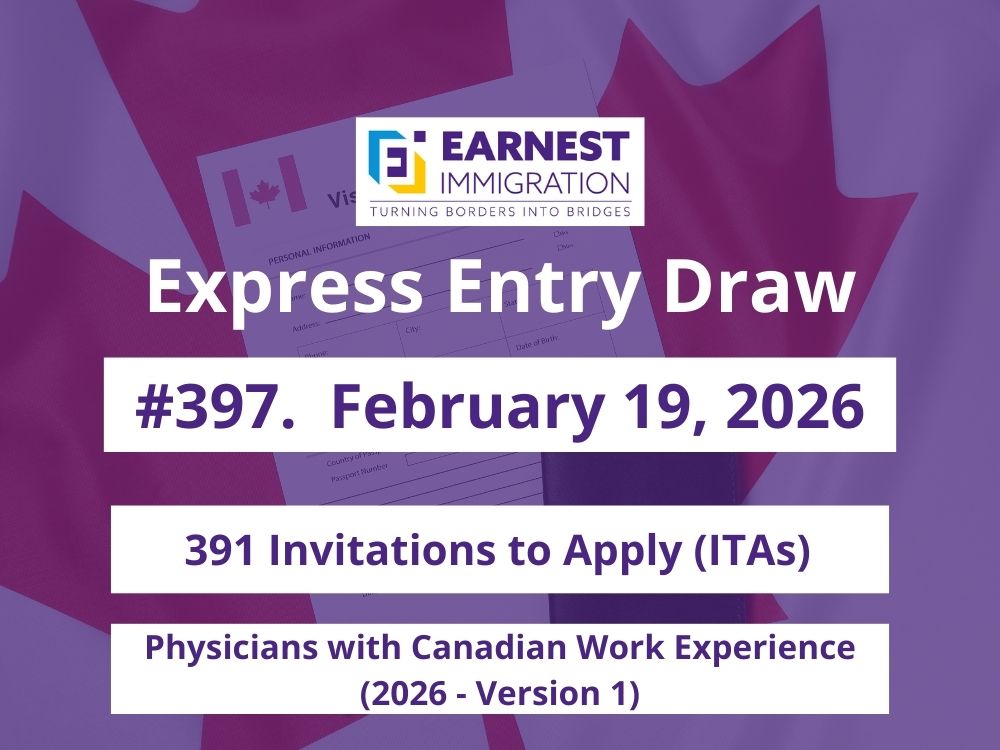
In a landmark moment for Canadian immigration, Immigration, Refugees and Citizenship Canada (IRCC) held Express Entry Draw 397 on February 19, 2026 – the first-ever category-based draw dedicated exclusively to Physicians with Canadian Work Experience. A total of 391 Invitations to Apply (ITAs) were issued, with a minimum CRS cut-off of just 169 points.
This is not a typo. A CRS score of 169 is the second-lowest threshold in the entire history of Express Entry, surpassed only by a 2021 pandemic-era draw that saw a cut-off of 75. For context, regular CEC draws in 2026 have required scores of 508-511. The extraordinary gap between those thresholds is precisely the point: category-based selection allows IRCC to bypass the standard ranking system entirely and invite candidates based on occupational need rather than overall CRS standing.
For physicians working in Canada, Draw 397 is a direct signal from the federal government that your permanent residence pathway is being fast-tracked. For all other Express Entry candidates, it illustrates just how dramatically the 2026 immigration landscape has shifted toward targeted, occupation-driven selection.
Table of Contents
ToggleKey Details of Express Entry Draw 397
| Draw Number | 397 |
| Date | February 19, 2026 |
| Program / Category | Physicians with Canadian Work Experience (2026 – Version 1) |
| Invitations Issued | 391 |
| CRS Cut-off Score | 169 |
| Tie-breaking Rule | January 3, 2026, at 03:25:14 UTC |
Why a CRS of 169 is Historic
To appreciate the significance of Draw 397, some historical context is essential. Since Express Entry launched in 2015, CRS cut-off scores have typically ranged from the high 400s to the mid-500s for most draw types. The all-time low was 75, recorded during the extraordinary circumstances of the 2021 pandemic-era CEC draw. Draw 397 now holds the second-lowest score on record.
This is possible because category-based draws do not select from the full Express Entry pool. They select only from candidates who meet the specific category criteria – in this case, physicians with qualifying Canadian work experience under a defined list of NOC codes. With a smaller, highly specialised eligible pool, the cut-off naturally falls much lower than in broad-based draws. IRCC invited every eligible physician it could identify in the pool, resulting in the 169 threshold.
The Minister has signalled that category-based draws will account for well over half of all ITAs issued in 2026, meaning more historic low-CRS draws are likely to follow across priority sectors.
Eligible NOC Codes for the Physicians Category
Draw 397 was restricted exclusively to candidates whose qualifying Canadian work experience falls under the following three National Occupational Classification (NOC) codes:
| NOC Code | Occupation Title |
| 31100 | Specialists in Clinical and Laboratory Medicine |
| 31101 | Specialists in Surgery |
| 31102 | General Practitioners and Family Physicians |
This means candidates holding NOC codes adjacent to physician roles – such as nurse practitioners, physician assistants, or medical administrators – were not eligible for this draw. The NOC code attached to your Express Entry profile must precisely match one of the three codes above for your profile to have been considered.
Who Qualifies for the Physicians with Canadian Work Experience Category?
To be eligible for this category-based draw, candidates must meet all of the following requirements:
• Hold an active Express Entry profile under the Canadian Experience Class (CEC) or Federal Skilled Worker Program (FSWP)
• Have at least 12 months of full-time (or equivalent part-time) Canadian work experience as a physician in the past three years, under NOC 31100, 31101, or 31102
• Work experience must have been gained while holding valid temporary resident status in Canada
• Hold valid medical licensure in Canada, as required by the relevant provincial or territorial regulatory body
• Meet the minimum language requirements for the underlying Express Entry program (CLB 7 for CEC; CLB 7 for FSWP)
• Plan to reside in a province or territory outside Quebec
It is important to note that holding a medical degree alone is not sufficient. The requirement is for recognised Canadian work experience in a physician role, meaning the candidate must have been practising medicine in Canada under an appropriate licence or registration – not simply completing residency training or observerships.
Complete Summary of Express Entry Draws in 2026
| Draw # | Date | Draw Type | CRS | ITAs |
| 397 | Feb 19 | Physicians (Category-Based) | 169 | 391 |
| 396 | Feb 17 | Canadian Experience Class | 508 | 6,000 |
| 395 | Feb 16 | Provincial Nominee Program | 789 | 279 |
| 394 | Feb 6 | French-Language Proficiency | 400 | 8,500 |
| 393 | Feb 3 | Provincial Nominee Program | 749 | 423 |
| 392 | Jan 21 | Canadian Experience Class | 509 | 6,000 |
| 391 | Jan 20 | Provincial Nominee Program | 746 | 681 |
| 390 | Jan 7 | Canadian Experience Class | 511 | 8,000 |
| 389 | Jan 5 | Provincial Nominee Program | 711 | 574 |
What Draw 397 Means for Healthcare Professionals in Canada
A Dedicated Pathway – Not a One-Off Event
The creation of the Physicians with Canadian Work Experience category represents a structural shift in how IRCC approaches healthcare immigration – not a one-time measure. The category was officially added to IRCC’s category-based selection framework in December 2025 and is expected to produce multiple draws throughout 2026. Physicians who did not receive an ITA in Draw 397 – either because they entered the pool after the tie-breaking date of January 3, 2026 or because their profile was not yet in the system – should submit or update their Express Entry profile immediately to be considered in future rounds.
Canada faces persistent physician shortages across multiple provinces, particularly in family medicine, rural communities, and specialised surgical care. Draw 397 directly addresses this by creating a permanent residence pathway for doctors already embedded in the Canadian healthcare system – professionals who understand local standards, have built patient relationships, and are immediately productive contributors to the workforce.
The Broader Healthcare Category Draw Landscape
Draw 397 is not the only healthcare-focused opportunity in Express Entry. IRCC has maintained a separate Healthcare and Social Service Professionals category that covers a much wider range of occupations beyond physicians. A draw under this broader category was held earlier in 2026, inviting 4,000 candidates at a CRS cut-off significantly lower than CEC draws but higher than the physician-specific round.
Healthcare professionals working in nursing, physiotherapy, pharmacy, medical laboratory technology, and related fields may be eligible for the broader healthcare category draw rather than the physician-specific round. Candidates should confirm which category applies to their NOC code and tailor their Express Entry strategy accordingly.
What the 2026 Category-Based Draw Strategy Means for All Candidates
Category-Based Draws Are Now the Dominant Selection Model
Draw 397 is the clearest illustration yet of a fundamental change to how Express Entry works in 2026. IRCC’s Minister has stated that category-based selection will account for the majority of all ITAs issued this year. This means that for many candidates, the traditional approach of maximising CRS score and waiting for a general draw is no longer the most effective – or even a reliable – strategy.
In 2026, a physician with a CRS of 169 receives an ITA. A French-language speaker with a CRS of 397-400 receives an ITA. A Senior Manager with a CRS of 429 receives an ITA. Meanwhile, a software engineer with a CRS of 505 continues to wait. The determining factor is no longer purely where you rank in the pool – it is whether your occupation, language profile, or other characteristics align with an active IRCC category.
The 10 Active Express Entry Categories in 2026
As of February 18, 2026, IRCC has designated the following active categories for Express Entry selection:
• Canadian Experience Class (CEC) – general skilled workers with Canadian experience
• French-Language Proficiency – candidates demonstrating CLB/NCLC 7+ in French
• Healthcare and Social Service Professionals – broad range of health occupations
• Physicians with Canadian Work Experience – dedicated physician pathway (new in 2025/2026)
• STEM Occupations – science, technology, engineering, mathematics (no draw since April 2024)
• Trades Occupations – electricians, plumbers, carpenters, and other skilled trades
• Transport Occupations – truck drivers, heavy equipment operators, and related roles
• Education Occupations – teachers and educational support professionals
• Senior Managers – executives in NOC 00012-00015 (new February 2026)
• Researchers – academic and applied researchers (new February 2026)
Note: The Agriculture and Agri-food category was retired for 2026. Candidates in this sector should explore Provincial Nominee Program streams as an alternative route.
Strategic Options for Candidates Who Are Not CEC-Competitive
For candidates sitting below the 508 CRS threshold for standard CEC draws, 2026 offers more pathways than any previous year – but only for those who actively identify and pursue the right lane:
• French-language proficiency: Investing in French language training to achieve CLB/NCLC 7 opens access to draws with cut-offs as low as 397-400, which is accessible to a much wider range of candidates
• Occupation-specific categories: Confirm whether your NOC code falls within any of the 10 active 2026 categories. Healthcare, transport, trades, education, and senior management candidates may qualify for draws well below 500 CRS
• Provincial Nominee Programs: A provincial nomination adds 600 CRS points, guaranteeing competitiveness in any future PNP-specific draw. Smaller provinces such as Manitoba, Saskatchewan, and Atlantic Canada often have more accessible employer-driven streams
• CRS score engineering: Strategic actions such as retaking language tests, completing a Canadian credential, or timing profile submission accurately can meaningfully improve scores for candidates approaching key thresholds
The Tie-breaking Rule: Why Profile Timing Matters
In Draw 397, the tie-breaking timestamp was set at January 3, 2026, at 03:25:14 UTC. This means that among all eligible physicians with exactly 169 CRS points, only those who submitted their Express Entry profiles before this date received an invitation.
For physicians not yet in the pool, the practical implication is straightforward: submit your Express Entry profile as soon as you confirm eligibility. As future draws for this category are held, earlier submission dates will be favoured in tie-breaking scenarios. Waiting to enter the pool is a direct competitive disadvantage.
Frequently Asked Questions
Is a CRS score of 169 really all that was needed for Draw 397?
Yes – but only for candidates who met the strict eligibility criteria for the Physicians with Canadian Work Experience category. This score does not apply to any other Express Entry draw type. Candidates in other occupations cannot use this draw as a benchmark for their own eligibility. The 169 cut-off reflects the limited size of the eligible physician pool in the Express Entry system, not a general reduction in CRS requirements.
I am a physician currently working in Canada. Am I automatically eligible?
Not automatically. You must have an active Express Entry profile, at least 12 months of qualifying Canadian work experience under NOC 31100, 31101, or 31102 within the past three years, valid provincial medical licensure, and meet the language and other minimum requirements for the CEC or FSWP. If your profile is not in the Express Entry pool or your NOC code does not match these three codes precisely, you would not have been eligible for Draw 397. Submitting or correcting your profile now positions you for future draws in this category.
Will there be more physician-specific draws in 2026?
Based on the structure of the Physicians with Canadian Work Experience category and IRCC’s stated direction for 2026, further draws under this category are expected throughout the year. The February 19 draw was labelled Version 1, which strongly implies future versions are planned. Physicians should treat Draw 397 as the first of multiple opportunities rather than a one-time event.
What if my medical specialty is not covered by the three eligible NOC codes?
If your Canadian work experience falls outside NOC 31100, 31101, and 31102, you were not eligible for Draw 397. However, depending on your occupation, you may qualify for the broader Healthcare and Social Service Professionals category, which covers a wider range of health sector roles and has historically featured CRS cut-offs lower than standard CEC draws. Confirming your precise NOC code with a regulated immigration consultant is an important first step.
Does this draw affect non-physician candidates?
Not directly. Draw 397 only issued ITAs to physician-category candidates and had no effect on the CRS pool composition for CEC, PNP, or other draw types. However, it signals the trajectory of Canada’s 2026 immigration strategy: continued expansion of category-based selection, more draws targeting priority occupations, and a growing divergence between category-based cut-offs and standard CEC thresholds. Candidates in any occupation should assess their category eligibility rather than relying solely on CRS ranking.
The Bottom Line
Express Entry Draw 397 is a milestone in Canadian immigration history. The first-ever physician-specific draw – with a CRS cut-off of just 169 – demonstrates how fundamentally category-based selection has changed the mechanics of Express Entry in 2026. For eligible physicians, it is one of the clearest and most direct pathways to permanent residence ever created. For all other candidates, it is a reminder that occupation alignment, not just CRS score, is now the defining factor in Express Entry success.
At Earnest Immigration, our licensed consultants help candidates at every stage – from confirming NOC code eligibility and building a category-aligned Express Entry strategy to preparing complete, accurate applications within the 60-day ITA window. Whether you are a physician seeking to confirm your eligibility for future draws, or a skilled worker exploring which 2026 category best fits your profile, we are here to guide you.
Contact the Earnest Immigration team today for a comprehensive profile assessment and a personalised immigration strategy built for the 2026 landscape.